
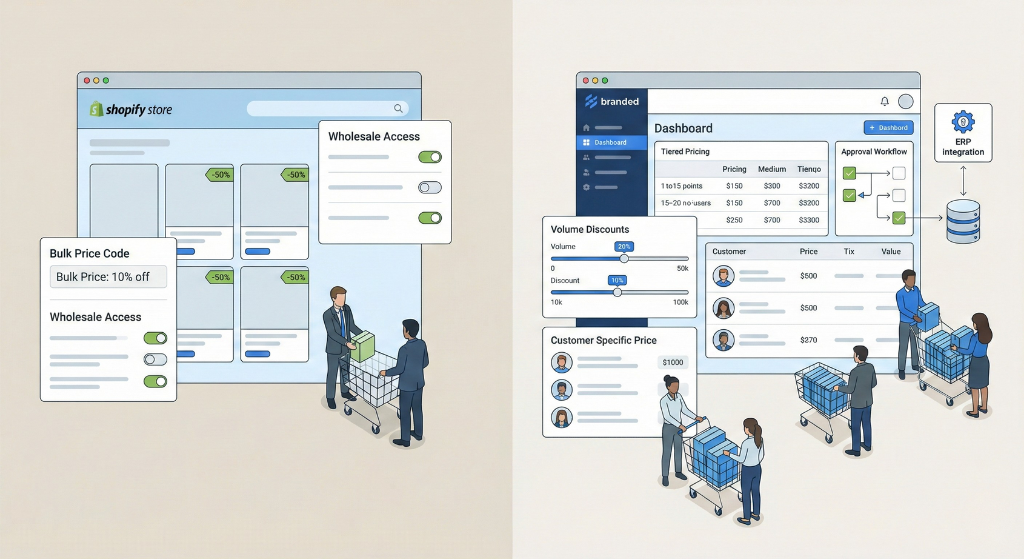
Your wholesale channel is growing. Orders are increasing, more retailers want to stock your products, and manual processes are becoming unsustainable. You need technology to manage this growth effectively.
Two paths emerge: install a wholesale app from the Shopify App Store or invest in a custom wholesale portal built specifically for your business. Both solve the same fundamental problem but differ dramatically in cost, flexibility, and long-term fit.
This guide compares wholesale apps and custom portals across every factor that matters. By the end, you will know which approach makes sense for your business today and how your needs might evolve over time.
What Are Shopify Wholesale Apps?
Wholesale apps are pre-built solutions available in the Shopify App Store. They add B2B functionality to your existing store without custom development.
How They Work
Apps install directly into your Shopify admin. After configuration, they modify how your store behaves for tagged wholesale customers. When a wholesale buyer logs in, they see different pricing, access restricted products, or encounter different checkout rules.
Most apps work by layering functionality on top of standard Shopify. Your theme, products, and checkout remain largely unchanged. The app intercepts specific interactions and applies wholesale logic.
Popular Options
Several well-established wholesale apps serve Shopify merchants:
Wholesale Club provides customer-specific pricing, tiered discounts, minimum order quantities, and net payment terms. It works across all Shopify plans and integrates with existing themes.
B2B Wholesale Solution offers wholesale pricing, quick order forms, customer approval workflows, and quantity breaks. It includes features specifically designed for B2B ordering patterns.
Wholesale Gorilla combines pricing management with wholesale-specific features like order minimums, custom registration forms, and volume discounts.
Bold Custom Pricing focuses on flexible pricing rules including customer group pricing, quantity tiers, and promotional pricing.
Typical Features
Most wholesale apps include:
Customer tagging to identify wholesale accounts. Percentage or fixed discounts off retail prices. Minimum order values or quantities. Basic quantity break pricing. Wholesale registration forms. Password-protected access to wholesale pricing. Simple net payment term options.
App pricing typically ranges from $20 to $150 per month depending on features and transaction volume.
What Is a Custom Wholesale Portal?
A custom wholesale portal is a purpose-built solution developed specifically for your business requirements. Instead of adapting to an app’s limitations, the portal adapts to your processes.
How It Works
Custom portals can take several forms. Some are built as custom Shopify themes with wholesale-specific functionality coded directly into the storefront. Others use Shopify’s headless commerce capabilities, connecting a custom front-end to Shopify’s backend systems.
For Shopify Plus merchants, custom development can leverage native B2B features while extending them with unique functionality. The portal might include custom interfaces, specialized workflows, or integrations that no app provides.
What Customization Enables
Custom portals can include virtually any functionality your wholesale operation requires:
Unique ordering interfaces designed around how your buyers actually purchase. Complex pricing logic that accounts for customer tiers, product categories, regional variations, and negotiated terms simultaneously. Deep integration with ERP systems, inventory management, or fulfillment platforms. Custom approval workflows matching your credit and account management processes. Branded experiences that reinforce your wholesale identity rather than looking like a modified consumer store. Specialized features for your industry: size matrices for apparel, case pack configurations for food service, or specification sheets for industrial products.
Our Shopify app development team builds custom solutions when standard apps cannot meet business requirements.
Detailed Comparison
Understanding the tradeoffs helps you make an informed decision.
Setup Time and Cost
Wholesale apps install in minutes and configure in hours or days. Most merchants can launch basic wholesale functionality within a week. Monthly costs range from $20 to $150, making the barrier to entry very low.
Custom portals require weeks or months of development. Simple custom implementations might cost $15,000 to $30,000. Complex portals with extensive integrations and unique functionality can exceed $50,000 to $100,000.
The cost difference is substantial. Apps cost hundreds annually. Custom portals cost tens of thousands upfront plus ongoing maintenance.
Functionality and Flexibility
Apps provide predefined functionality. You configure options within the app’s framework but cannot fundamentally change how it works. If the app does not support a feature you need, workarounds may be impossible or awkward.
Custom portals do exactly what you specify. Every feature, workflow, and interface element can match your requirements precisely. The only limitations are development budget and technical feasibility.
For businesses with standard wholesale needs, app functionality is usually sufficient. For businesses with unique processes, complex pricing, or specialized requirements, apps often fall short.
Our guide on 10 awesome things about Shopify B2B explores native Shopify Plus capabilities that reduce the gap between apps and custom solutions.
Scalability
Apps scale reasonably well for growing order volumes. However, they may struggle with very large catalogs, thousands of wholesale accounts, or extremely complex pricing structures. Some apps charge more at higher volumes, increasing costs as you grow.
Custom portals scale according to how they are built. Well-architected solutions handle growth smoothly. Poorly built ones create problems. The key is building with scalability in mind from the start.
For most SMBs, app scalability is adequate. Businesses planning aggressive B2B growth should consider whether app limitations will eventually force migration to custom solutions.
Maintenance and Updates
App vendors handle maintenance and updates. When Shopify releases platform changes, app developers update their products accordingly. You benefit from ongoing improvements without additional investment.
The downside is dependency. If an app vendor discontinues their product, raises prices dramatically, or fails to keep pace with Shopify changes, you face difficult transitions.
Custom portals require ongoing maintenance investment. When Shopify updates, your custom code may need adjustments. Budget for continuous maintenance, typically 15% to 20% of initial development cost annually.
Our Shopify store maintenance support services help merchants manage both app-based and custom wholesale implementations.
User Experience
Apps modify your existing store experience. The result can feel inconsistent: consumer design elements mixed with wholesale functionality that was not originally designed for that context.
Better apps integrate smoothly. Others create jarring experiences where wholesale features obviously do not belong. Theme compatibility varies, and visual polish may suffer.
Custom portals deliver cohesive experiences designed specifically for wholesale buyers. Every element serves B2B purposes. Navigation, product presentation, and checkout flow all optimize for how wholesale customers actually shop.
For brands where B2B represents a significant revenue channel, customer experience matters. Professional wholesale buyers compare your ordering experience against competitors. A polished custom portal creates competitive advantage.
Our Shopify custom theme development services include wholesale-optimized interfaces for merchants prioritizing B2B experience.
Comparison Table
Factor | Wholesale Apps | Custom Portal |
Setup Time | Days to weeks | Weeks to months |
Upfront Cost | $0 to $500 | $15,000 to $100,000+ |
Monthly Cost | $20 to $150 | Maintenance only |
Flexibility | Limited to app features | Unlimited |
Customization | Configuration only | Full control |
Scalability | Good for most SMBs | Depends on architecture |
Maintenance | Vendor handled | Your responsibility |
User Experience | Variable | Purpose-built |
Integration Depth | API limitations apply | Full integration possible |
Risk | Vendor dependency | Development quality |
When to Choose a Wholesale App
Apps make sense in several common scenarios.
You are testing wholesale viability. Before investing heavily, validate that B2B represents a real opportunity. Apps let you launch quickly and learn what wholesale customers actually need with minimal financial risk.
Your wholesale needs are straightforward. Standard pricing discounts, basic quantity breaks, and simple customer management work well through apps. If your requirements match common wholesale patterns, apps deliver adequate functionality.
Budget constraints are significant. Custom development requires substantial investment. If your wholesale revenue does not justify that expense, apps provide functional solutions at accessible price points.
You need speed to market. Launching wholesale in weeks rather than months captures opportunities faster. Apps enable rapid deployment when timing matters.
Your team lacks technical resources. Managing custom development requires technical oversight. If you lack internal expertise or agency relationships, apps provide turnkey solutions your team can manage directly.
Our Shopify app installation configuration and customization support services help merchants get maximum value from wholesale apps.
When to Invest in a Custom Portal
Custom development makes sense when apps genuinely cannot meet your needs.
Complex pricing requirements. If your pricing involves multiple simultaneous factors like customer tier, product category, order volume, region, and contract terms, apps struggle to handle the complexity. Custom logic addresses sophisticated pricing accurately.
Deep system integration. Connecting wholesale operations to ERP systems, warehouse management, or custom CRM platforms often requires integration depth that apps cannot provide. Custom portals connect systems seamlessly.
Unique ordering workflows. Industries have specific ordering patterns. Apparel buyers need size and color matrices. Food service buyers order by case configuration. Industrial buyers reference specification sheets. Custom portals accommodate these specialized workflows.
Brand experience priorities. If your wholesale channel represents significant revenue and competitive differentiation matters, custom portals deliver experiences that generic apps cannot match.
Outgrowing app limitations. Sometimes businesses start with apps and hit ceilings. Catalog size, account volume, or feature requirements exceed what apps support. Migration to custom solutions becomes necessary.
Shopify Plus investment. If you already use Shopify Plus, you have access to native B2B features. Custom development extends these capabilities further, leveraging platform investment for maximum wholesale functionality.
Our Shopify website development team builds custom wholesale solutions for merchants who have outgrown app-based approaches.
Hybrid Approach: Starting with Apps, Scaling to Custom
Many successful wholesale operations follow a phased approach.
Phase One: Validate with Apps
Launch wholesale using an app. Keep investment minimal while learning what your B2B customers need. Pay attention to friction points, feature requests, and limitations you encounter.
This phase typically lasts 6 to 18 months depending on growth rate.
Phase Two: Evaluate and Plan
Once wholesale revenue is established, evaluate whether apps continue meeting needs. Document gaps between current functionality and requirements. Estimate the business impact of addressing those gaps.
If apps remain adequate, continue using them. If limitations constrain growth or create competitive disadvantage, plan custom development.
Phase Three: Custom Development
Build custom solutions informed by real operational experience. You know exactly what features matter because you have run wholesale operations. Development focuses on proven needs rather than speculative requirements.
This phased approach minimizes risk. You invest heavily in custom development only after validating wholesale opportunity and understanding requirements clearly.
Conclusion
Wholesale apps and custom portals serve different situations. Apps provide fast, affordable entry into B2B with adequate functionality for straightforward wholesale operations. Custom portals deliver unlimited flexibility and polished experiences for businesses with complex requirements or strategic B2B priorities.
Neither option is universally better. The right choice depends on your current wholesale revenue, operational complexity, budget constraints, and growth ambitions.
For most SMBs starting wholesale, apps provide the sensible starting point. Launch quickly, learn what matters, and validate the opportunity. As wholesale grows and requirements become clearer, evaluate whether custom development would unlock additional value.
For businesses already running substantial wholesale operations hitting app limitations, custom portals remove ceilings and create competitive advantage. The investment is significant but justified when B2B represents a core revenue channel.
Need help deciding between wholesale apps and custom development? CGColors has been building Shopify stores since 2014, implementing both app-based and custom wholesale solutions for growing SMBs. We assess your specific requirements and recommend the approach that fits your business today while supporting future growth. Contact us today for a free consultation.


