
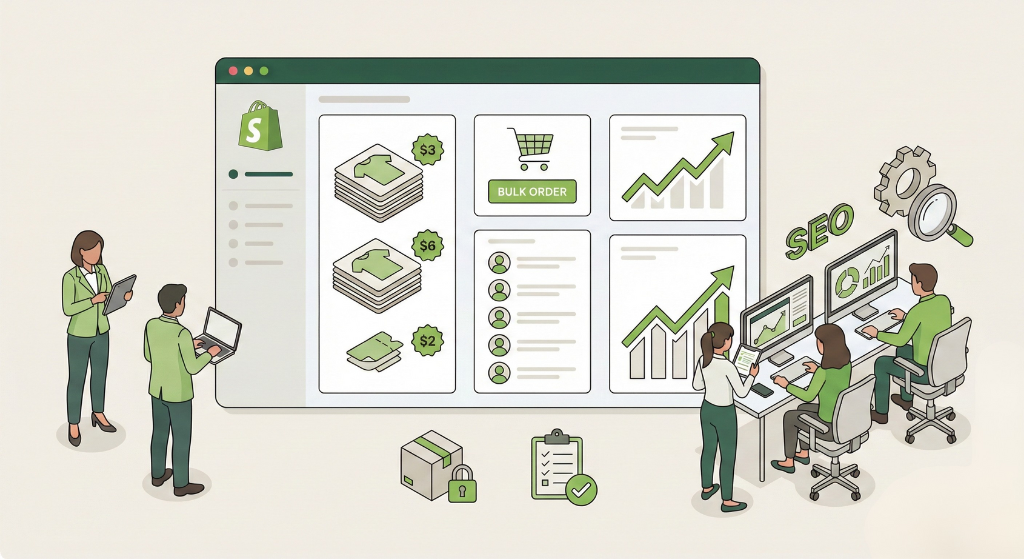
Selling wholesale opens a powerful growth channel for your business. Instead of acquiring customers one at a time, you land accounts that order repeatedly in larger quantities. One wholesale relationship can equal dozens or hundreds of individual sales.
Many SMBs hesitate to pursue B2B because it seems complicated. Different pricing, payment terms, order minimums, and customer approval processes feel like enterprise-level challenges. But Shopify has made wholesale increasingly accessible, even for smaller merchants.
This guide walks you through everything needed to create a B2B or wholesale store on Shopify. Whether you choose native Shopify B2B features, third-party apps, or a dedicated wholesale storefront, you will understand your options and how to implement them.
B2B Options on Shopify
Shopify offers multiple paths to wholesale selling. The right choice depends on your current plan, budget, and operational complexity.
Shopify Plus Native B2B
Shopify Plus includes built-in B2B functionality that lets you serve wholesale customers directly from your existing store. No separate installation or third-party apps required for core features.
With native B2B, you create company profiles for wholesale accounts. Each company can have unique price lists, payment terms, and catalog access. Customers log in and see their personalized wholesale experience while regular consumers see standard pricing.
Key capabilities include custom pricing per company, quantity rules and minimums, net payment terms, company-specific catalogs, and dedicated B2B checkout experiences.
The limitation is that native B2B requires Shopify Plus, which starts at $2,300 per month. For businesses with established wholesale operations, this investment often makes sense. For those just testing B2B, it may be premature.
Our article on 10 awesome things about Shopify B2B explores these native capabilities in more detail.
Wholesale Apps for Standard Shopify
Merchants on standard Shopify plans can add B2B functionality through apps. Several well-regarded options exist in the Shopify App Store.
Popular wholesale apps include Wholesale Club, B2B Wholesale Solution, and Bold Custom Pricing. These apps typically offer customer tagging for wholesale access, tiered pricing based on customer groups, minimum order quantities, and password-protected wholesale sections.
App pricing ranges from $20 to $100+ per month depending on features and order volume. This makes B2B accessible to merchants not ready for Plus investment.
The tradeoff is that apps add complexity. You manage another subscription, rely on third-party support, and work within each app’s limitations. Deep customization may require multiple apps working together or custom development.
Separate Wholesale Store
Some businesses create an entirely separate Shopify store dedicated to wholesale customers. Your consumer store operates independently while wholesale buyers access a different URL with its own theme, pricing, and checkout.
This approach provides complete separation between B2B and B2C operations. You can design entirely different experiences without worrying about consumer customers accidentally seeing wholesale pricing.
Drawbacks include managing two stores, maintaining separate inventory sync, and paying for two Shopify subscriptions. For businesses with significantly different B2B and B2C needs, the separation may be worth it. For most SMBs, a unified approach is more efficient.
Our Shopify website development team helps merchants evaluate these options and implement the right solution for their situation.
Setting Up Wholesale Pricing
Wholesale pricing is the foundation of your B2B operation. You need flexibility to offer competitive rates while protecting margins.
Percentage Discounts
The simplest approach applies a flat percentage discount off retail prices. Wholesale customers might receive 30%, 40%, or 50% off depending on your margin structure and industry norms.
This method is easy to manage. When retail prices change, wholesale prices adjust automatically. However, it lacks flexibility for products with different margin profiles.
Tiered Pricing
Tiered pricing rewards larger orders with better rates. A customer ordering 10 units pays one price. Ordering 50 units unlocks a better price. Ordering 100 units gets the best rate.
Tiered structures encourage larger orders and reward your best customers. They also create negotiation flexibility since you can offer tier upgrades as incentives.
Some wholesale relationships require unique pricing. A large retailer might negotiate rates different from a small boutique. Customer-specific price lists accommodate these variations.
Shopify Plus native B2B handles customer-specific pricing elegantly. On standard Shopify, apps like Wholesale Club support this functionality with customer tags.
Volume-Based Pricing
Volume pricing adjusts based on cart total rather than individual product quantities. Customers spending over certain thresholds unlock better rates across their entire order.
This approach simplifies pricing management while still rewarding larger purchases.
Customer Management and Approval Workflows
Unlike consumer stores where anyone can purchase, wholesale typically requires customer vetting. You need systems to manage applications, approvals, and ongoing account relationships.
Application Process
Create a wholesale application form collecting business information: company name, tax ID, business type, estimated order volume, and how they discovered your brand.
This information helps you evaluate fit and prevent unauthorized access. Requiring legitimate business credentials keeps your wholesale pricing protected.
Approval Workflows
After receiving applications, review and approve qualified businesses. Manual review ensures quality control but creates administrative burden. As volume grows, consider criteria-based auto-approval for applications meeting specific requirements.
Once approved, customers receive login credentials or account activation. Shopify Plus B2B handles this through company profiles. Apps typically use customer tags that unlock wholesale access.
Customer Segmentation
Not all wholesale customers deserve the same treatment. Segment accounts based on order volume, payment history, or strategic importance.
Your best accounts might receive exclusive pricing, early access to new products, or dedicated support. Standard accounts get baseline wholesale terms. New accounts might start with limited access until they establish purchasing history.
Order Minimums and Quantity Rules
Wholesale orders need to make economic sense for your business. Order minimums and quantity rules ensure profitability.
Minimum Order Value
Set a minimum cart total for wholesale orders. This threshold ensures each order covers fulfillment costs and generates meaningful revenue.
Common minimums range from $100 to $500 for smaller wholesalers, with larger operations requiring $1,000 or more. Base your minimum on operational costs and typical order profiles.
Minimum Quantities Per Product
Some products require case pack ordering. Instead of allowing single-unit purchases, require customers to order in multiples of 6, 12, or whatever makes sense for your packaging.
Quantity minimums simplify fulfillment and prevent wholesale customers from cherry-picking single units at discounted prices.
Quantity Increments
Beyond minimums, you might require ordering in specific increments. If your minimum is 12 units, customers order 12, 24, 36, and so on. They cannot order 15 units.
Shopify Plus B2B supports quantity rules natively. On standard Shopify, apps provide this functionality.
Payment Terms for Wholesale Buyers
Consumer transactions require immediate payment. Wholesale often operates differently, with established customers expecting invoicing and payment terms.
Net Payment Terms
Net 15, Net 30, or Net 60 terms give customers time to pay after receiving goods. This standard B2B practice improves relationships with established buyers.
Shopify Plus includes native support for net payment terms. Orders complete without immediate payment, and invoices are sent for later collection.
On standard Shopify, managing payment terms requires workarounds: manual invoicing outside Shopify, apps that enable draft orders and invoicing, or external accounting system integration.
Deposit Requirements
New wholesale accounts often pay deposits or full payment upfront until they establish credit history. After several successful orders, they graduate to net terms.
This approach protects your business while building toward standard wholesale relationships.
Payment Methods
Wholesale buyers may prefer payment methods uncommon in consumer transactions: wire transfers, ACH payments, or company checks. Ensure your setup accommodates preferred B2B payment types.
For checkout optimization strategies that apply to both B2C and B2B, our guide on eCommerce checkout optimization covers relevant principles.
Catalog and Product Visibility Control
Wholesale catalogs often differ from consumer offerings. You need control over what wholesale customers see.
Exclusive Wholesale Products
Some products exist only for wholesale: bulk packs, unbranded items for white-labeling, or exclusive SKUs. These should appear only for logged-in wholesale customers.
Hidden Consumer Products
Conversely, some consumer products might not be available wholesale. Limited editions, personalized items, or low-margin products may be excluded from wholesale catalogs.
Company-Specific Catalogs
Different wholesale customers might access different products. A retailer in one region sees products available for their market. A specialty boutique sees only product categories relevant to their niche.
Shopify Plus B2B allows company-specific catalog assignment. Apps on standard Shopify achieve similar results through customer tagging and conditional visibility.
Choosing the Right Approach for Your Business
Your ideal B2B setup depends on several factors.
Choose Shopify Plus native B2B if:
You already use Shopify Plus or plan to upgrade. Your wholesale volume justifies the platform cost. You need sophisticated features like net payment terms and company-specific catalogs. You want a unified solution without third-party app dependencies.
Choose wholesale apps if:
You use standard Shopify and are not ready for Plus investment. Your B2B needs are relatively straightforward. You want to test wholesale before committing to larger infrastructure.
Choose a separate store if:
Your B2B and B2C operations are fundamentally different. You need complete separation between customer experiences. Managing two stores fits your operational model.
For most SMBs starting with wholesale, apps on standard Shopify provide the best entry point. As B2B revenue grows and needs become more complex, upgrading to Shopify Plus makes increasing sense.
Our Shopify custom theme development services include B2B-specific design work for merchants needing specialized wholesale experiences.
Common B2B Setup Mistakes to Avoid
Learn from mistakes other merchants have made.
Exposing wholesale prices to consumers. Configuration errors can reveal discounted pricing to regular shoppers. Test thoroughly from logged-out and logged-in states to verify pricing displays correctly.
Overcomplicating initial setup. Start simple. Basic wholesale pricing and manual customer approval work fine initially. Add complexity as you learn what your wholesale customers actually need.
Ignoring mobile experience. Wholesale buyers increasingly place orders from phones and tablets. Ensure your B2B experience works well on mobile devices.
Neglecting customer communication. Wholesale relationships require more communication than consumer sales. Set up email flows for order confirmations, shipping updates, payment reminders, and reorder suggestions.
Setting unsustainable terms. Generous payment terms and deep discounts attract customers but hurt profitability. Model your economics before committing to terms you cannot sustain.
Forgetting about ongoing management. B2B stores require maintenance: updating price lists, managing customer accounts, adjusting terms, and handling support requests. Budget time and resources for ongoing operations.
Our Shopify store maintenance support services help merchants manage both B2C and B2B operations efficiently.
If your B2B requirements need custom functionality beyond standard options, our Shopify app development team builds tailored solutions.
Conclusion
Creating a B2B or wholesale store on Shopify is achievable for SMBs at every stage. Shopify Plus merchants access powerful native B2B features that handle complex wholesale operations elegantly. Standard Shopify merchants can start with apps that add essential wholesale functionality at modest cost.
Success requires thoughtful planning: pricing structures that protect margins while remaining competitive, customer management workflows that scale with growth, order rules that ensure profitability, and payment terms that balance customer needs with cash flow.
Start with your most important wholesale requirements. Implement the simplest solution that meets those needs. Add sophistication as you learn what your wholesale customers value and what your operations can support.
The B2B opportunity is too significant to ignore. Even if wholesale represents a small percentage of revenue initially, those relationships often grow into your most valuable accounts.
Ready to launch your wholesale channel? CGColors has been building Shopify stores since 2014, including B2B implementations for growing SMBs. We help you choose the right approach, implement it correctly, and scale as your wholesale business grows. Contact us today for a free consultation.