
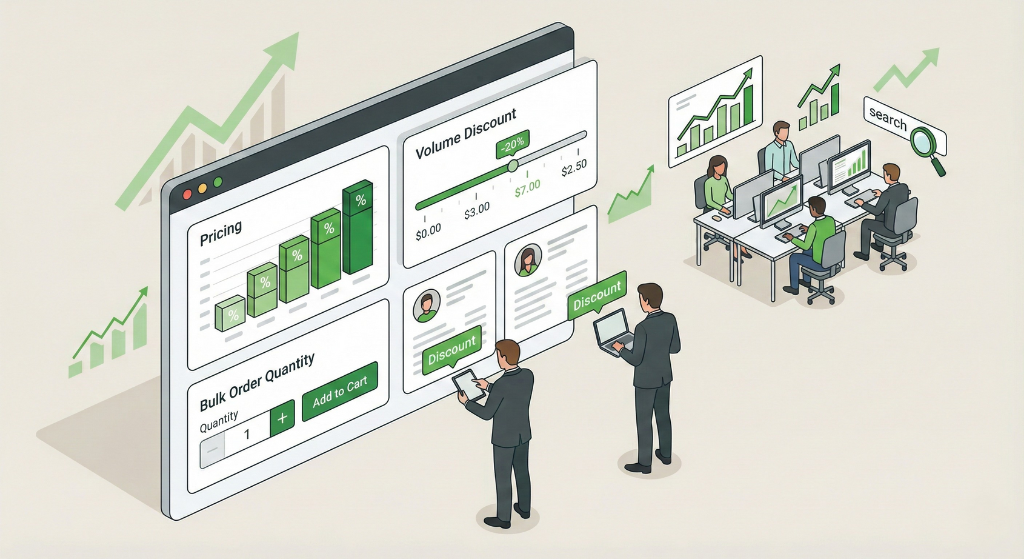
Pricing is the most powerful lever in your wholesale business. The right pricing strategy attracts quality buyers, encourages larger orders, and protects your margins. The wrong approach leaves money on the table or drives away potential accounts.
Many Shopify merchants default to simple flat discounts for wholesale customers. While easy to implement, this one-size-fits-all approach ignores opportunities to incentivize behavior, reward loyalty, and maximize order value.
This guide explores custom pricing, tiered discounts, and volume pricing strategies available on Shopify. You will learn which models work best for different situations and how to implement them effectively.
Understanding Pricing Models for Wholesale
Before diving into implementation, understand the pricing models available and when each makes sense.
Flat Percentage Discounts
The simplest wholesale pricing applies a fixed percentage off retail prices. All wholesale customers receive the same discount, typically 30% to 50% depending on your margins and industry.
This model works when your product margins are consistent across your catalog, you want simple administration with minimal ongoing management, and your wholesale customers have similar purchasing patterns and volumes.
The limitation is inflexibility. A small boutique ordering $500 gets the same rate as a major retailer ordering $50,000. You cannot reward growth or incentivize larger purchases.
Tiered Pricing
Tiered pricing offers better rates as order quantities increase. A customer buying 10 units pays one price per unit. Buying 50 units unlocks a better price. Buying 100 units gets the best rate.
This model encourages larger orders by making the economics more attractive at higher quantities. Customers see clear incentive to reach the next tier, often adding items to qualify for better pricing.
Tiered pricing works well when you want to encourage bulk purchasing, when fulfillment costs per unit decrease with larger orders, and when you have capacity to handle bigger shipments.
Volume-Based Pricing
Volume pricing adjusts based on total cart value rather than individual product quantities. When a customer’s order exceeds certain thresholds, better pricing applies across their entire purchase.
For example, orders under $500 receive standard wholesale pricing. Orders from $500 to $2,000 get an additional 5% off. Orders over $2,000 receive 10% off.
This approach simplifies pricing when you have diverse catalogs where per-product tiers would be unmanageable. It rewards overall spending without requiring customers to buy large quantities of single items.
Customer-Specific Pricing
Some wholesale relationships require unique pricing arrangements. A major account negotiates rates different from standard terms. A strategic partner receives exclusive pricing to support a joint initiative.
Customer-specific pricing accommodates these situations. Each account or customer group can have tailored price lists reflecting their negotiated terms.
This model is essential for businesses with diverse wholesale channels: distributors, retailers, institutions, and direct accounts may all require different pricing structures.
Our article on awesome features about Shopify B2B covers how these pricing models integrate with broader wholesale functionality.
How to Set Up Custom Pricing on Shopify
Implementation options depend on your Shopify plan and complexity requirements.
Shopify Plus Native Options
Shopify Plus includes built-in B2B features that handle sophisticated pricing natively.
Price lists let you create multiple pricing structures and assign them to specific companies. Each wholesale account sees their designated prices when logged in. You can create unlimited price lists for different customer segments, regions, or negotiated arrangements.
Percentage adjustments apply blanket discounts to entire catalogs without manually repricing each product. Set a price list at 40% off retail, and all products reflect that discount automatically.
Fixed pricing overrides let you set specific prices for individual products within a price list. If most products follow percentage discounting but certain items need exact pricing, you can configure both within the same structure.
Quantity price breaks enable tiered pricing directly in Shopify Plus. Define price points at different quantity thresholds, and customers see pricing adjust as they increase quantities.
For comprehensive exploration of Shopify Plus B2B capabilities, see our guide on 10 awesome things about Shopify B2B.
Apps for Standard Shopify
Merchants on standard Shopify plans access custom pricing through apps. Several options provide robust functionality.
Wholesale Club offers customer tagging, percentage discounts, volume discounts, and quantity breaks. It integrates with existing themes and works across standard Shopify plans.
Bold Custom Pricing provides tiered pricing, customer group pricing, and quantity-based discounts. It handles complex scenarios like buy-one-get-one and bundled pricing.
B2B Wholesale Solution combines pricing features with broader wholesale functionality including minimum orders, quick order forms, and customer approval workflows.
App pricing typically ranges from $20 to $100 monthly depending on features and order volume. Evaluate options based on your specific pricing requirements rather than choosing the cheapest solution.
Our Shopify website development team helps merchants select and configure the right pricing tools for their wholesale operations.
Tiered Discount Strategies That Work
Effective tiered pricing requires thoughtful structure. Poorly designed tiers confuse customers or fail to influence behavior.
Set Meaningful Thresholds
Tier thresholds should align with natural ordering patterns. If most customers order 20 to 30 units, setting your first tier break at 100 units will not influence many purchases.
Analyze your order history. Identify common order sizes and set tier breaks slightly above those levels. Customers ordering 25 units see incentive to reach 30 for better pricing.
Create Attractive Gaps
The price difference between tiers needs to be meaningful. A 2% improvement for doubling quantity will not change behavior. A 10% improvement makes customers think seriously about ordering more.
Balance attractiveness with margin protection. Each tier should remain profitable even as discounts deepen.
Limit Tier Complexity
Three to four tiers typically work better than six or eight. Too many tiers confuse customers and complicate administration. Simple structures are easier to communicate and remember.
Example structure:
- 1 to 24 units: Standard wholesale price
- 25 to 99 units: 10% additional discount
- 100+ units: 20% additional discount
Communicate Clearly
Customers cannot respond to incentives they do not understand. Display tiered pricing clearly on product pages. Show what they currently pay and what they would pay at higher quantities.
Consider visual elements: progress bars showing how close they are to the next tier, savings calculators, or prominent callouts when adding items would unlock better pricing.
Volume Pricing Implementation
Volume pricing based on cart totals requires different implementation than per-product tiers.
Define Logical Thresholds
Set volume thresholds based on your typical order values and desired outcomes. If your average wholesale order is $800, a threshold at $1,000 encourages customers to add a bit more.
Common threshold structures:
- Under $500: Base wholesale pricing
- $500 to $1,499: 5% additional discount
- $1,500 to $4,999: 10% additional discount
- $5,000+: 15% additional discount
Automate Application
Volume discounts should apply automatically at checkout. Requiring customers to enter codes or request discounts creates friction and inconsistent experience.
Shopify Plus handles this through Shopify Functions. On standard Shopify, apps like Automatic Discounts or Volume and Tiered Discounts can trigger cart-level discounts based on thresholds.
Show Real-Time Feedback
Display cart total and current discount level prominently. When customers are close to a threshold, show how much more they need to spend to unlock better pricing.
Messages like “Add $47 more to save an extra 5% on your entire order” drive incremental purchases effectively.
For checkout strategies that complement volume pricing, our guide on eCommerce checkout optimization covers relevant tactics.
Combining Pricing Strategies for Maximum Impact
The most effective wholesale pricing often combines multiple strategies.
Base Pricing Plus Volume Incentives
Start with customer-specific or segment-based pricing as your foundation. Layer volume incentives on top that reward larger orders regardless of base pricing tier.
A standard wholesale account receives 35% off retail. Orders over $2,000 earn an additional 5% off. A premium account starts at 45% off with the same volume incentive structure.
Product-Specific Tiers Plus Cart-Wide Volume
Apply tiered pricing to your best-selling products where quantity flexibility exists. Add cart-wide volume pricing to encourage overall spending.
Customers ordering popular items in bulk get per-product tier pricing. Reaching cart thresholds unlocks additional savings across everything including items without quantity tiers.
New Customer Versus Established Account Pricing
Differentiate pricing based on relationship stage. New wholesale accounts receive standard terms. After demonstrating consistent ordering, accounts graduate to preferred pricing.
This approach protects margins with unproven accounts while rewarding loyalty over time.
Our Shopify custom theme development services include building interfaces that communicate complex pricing clearly to wholesale customers.
Pricing Mistakes That Hurt Wholesale Margins
Avoid common errors that erode profitability.
Discounting Too Deeply Too Soon
Eager to land wholesale accounts, some merchants offer unsustainable discounts. Once established, those terms become expected. Raising prices damages relationships.
Start conservative. You can always offer better terms to reward growing accounts. Pulling back discounts is much harder.
Ignoring Product-Level Margins
Flat percentage discounts ignore margin variation. A 40% discount works fine on a 70% margin product. Applied to a 50% margin product, profitability disappears.
Analyze margins by product or category. Adjust pricing strategies to protect lower-margin items from excessive discounting.
Setting Unreachable Tiers
Tier thresholds far beyond typical order sizes provide no real incentive. If nobody reaches your top tier, it exists only on paper.
Design tiers that customers can realistically achieve with modest behavior change. The goal is influencing purchases, not creating aspirational pricing nobody uses.
Failing to Update Pricing
Costs change. Competitors adjust pricing. Market conditions shift. Wholesale pricing set years ago may no longer make sense.
Review pricing quarterly. Ensure rates remain competitive while protecting margins against cost increases.
Overcomplicating Structures
Complex pricing confuses customers and burdens your team. If explaining your pricing requires a spreadsheet and 30-minute conversation, simplification is needed.
Aim for structures customers can understand quickly and your team can administer efficiently.
Testing and Optimizing Your Pricing
Pricing is not set-and-forget. Ongoing optimization improves results.
Monitor Key Metrics
Track average order value, orders per account, and margin per order. Watch how these metrics respond to pricing changes.
Also monitor customer feedback. Complaints about pricing complexity or competitiveness signal issues needing attention.
Test Threshold Adjustments
Experiment with tier thresholds. Lowering a threshold slightly might significantly increase customers reaching that level. The additional volume could outweigh margin reduction.
Compare Segment Performance
Analyze whether different customer segments respond differently to pricing incentives. Retailers might respond to volume pricing while distributors prefer per-product tiers.
Tailor strategies to segment preferences when practical.
If your pricing strategy needs custom functionality beyond standard tools, our Shopify app development team builds tailored solutions.
Conclusion
Effective wholesale pricing goes far beyond simple percentage discounts. Tiered pricing encourages larger orders. Volume pricing rewards overall spending. Customer-specific rates accommodate negotiated relationships. Combined strategically, these approaches maximize order value while protecting margins.
Shopify Plus merchants access sophisticated native pricing tools. Standard Shopify merchants can achieve similar results through well-chosen apps. Regardless of platform, success requires thoughtful strategy: thresholds that influence behavior, discounts that remain profitable, and structures customers can easily understand.
Start with clear objectives. Do you want larger orders, more frequent purchases, or better margins on specific products? Design pricing that incentivizes those outcomes. Test, measure, and refine as you learn what moves your wholesale customers.
Ready to optimize your wholesale pricing strategy? CGColors has been building Shopify stores since 2014, including B2B implementations with sophisticated pricing structures. We help you design and implement pricing that grows revenue while protecting profitability. Contact us today for a free consultation.


