
Launching an online store is one of the most important decisions you’ll make for your business. With e-commerce sales continuing to grow year after year, choosing the right platform can mean the difference between a thriving online presence and a frustrating experience for both you and your customers.
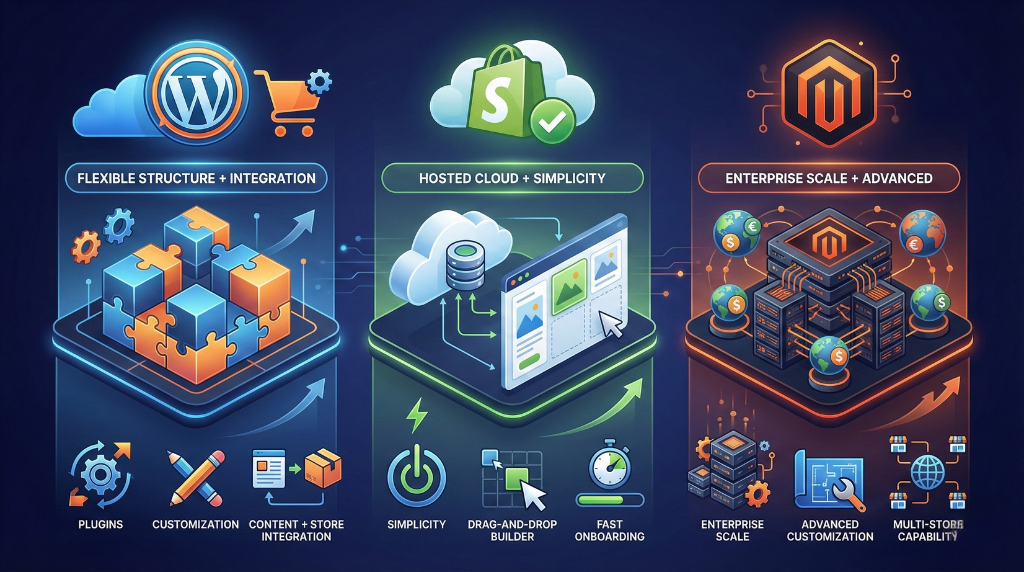
The three platforms that consistently rise to the top of most business owners’ consideration lists are WordPress (with WooCommerce), Shopify, and Magento. Each has carved out its own space in the e-commerce world, and each serves different types of businesses remarkably well. But which one is right for your specific needs?
After helping over 200 clients launch and grow their online stores over the past 11 years, we’ve seen firsthand how the right platform choice can accelerate growth, while the wrong one can create unnecessary headaches. This guide will walk you through everything you need to know to make an informed decision.
Understanding Your Three Main Options
Before diving into comparisons, let’s establish what each platform actually is and what it was designed to do.
WordPress with WooCommerce is technically two separate tools working together. WordPress started as a blogging platform in 2003 and has evolved into the world’s most popular content management system, powering over 40% of all websites. WooCommerce is a plugin that transforms WordPress into a fully functional e-commerce platform. Together, they create a flexible, content-rich online store.
Shopify launched in 2006 as a dedicated e-commerce platform. It’s a hosted solution, meaning Shopify handles all the technical infrastructure while you focus on running your business. Everything you need to sell online comes built into one package, from hosting to payment processing to inventory management.
Magento (now Adobe Commerce) began in 2008 and positioned itself as the enterprise-level e-commerce solution. It’s the most powerful and complex of the three options, designed for businesses that need extensive customization and have the technical resources to manage it. Magento comes in two versions: an open-source edition and a paid Commerce edition for larger enterprises.
Cost Comparison: Initial Investment and Long-Term Expenses
One of the first questions most business owners ask is: “How much is this going to cost?” The answer isn’t straightforward because each platform has a different pricing model.
WordPress with WooCommerce is free to download and install, but you’ll need to pay for web hosting, a domain name, an SSL certificate for security, and potentially a premium theme.
Your initial costs typically range from $100 to $500 to get started, depending on your hosting choice and whether you purchase a premium theme. Monthly hosting costs can run anywhere from $10 to $100 or more as your store grows.
When you need professional WordPress development services to customize your store, those are separate investments, but you have complete control over when and how you spend.
Shopify operates on a subscription model with clear monthly fees. Plans start at $39 per month for basic features and scale up to $399 per month for advanced functionality.
While this seems straightforward, you’ll also pay transaction fees (unless you use Shopify Payments), and many stores need to purchase apps from the Shopify App Store to add functionality, which can add $50 to $500 per month depending on your needs.
The advantage is predictable costs, but those costs continue whether you’re making sales or not. Our team offers comprehensive Shopify development services for businesses that want to maximize their investment in the platform.
Magento’s open-source version is free to download, but that’s misleading. The platform requires significant development expertise to set up and maintain. You’ll need robust hosting (often running $500+ per month), and you’ll almost certainly need developer support.
Many businesses invest $20,000 to $50,000 or more just to launch a Magento store. The Commerce (paid) version starts around $22,000 annually and goes up from there. Magento makes sense for businesses doing millions in annual revenue, but it’s overkill for most small to medium-sized operations.
The real cost consideration isn’t just the initial investment but the total cost of ownership over time. A WordPress store might cost less upfront but require more ongoing maintenance. Shopify costs more monthly but includes that maintenance. Magento costs the most but provides enterprise-level capabilities that might actually reduce costs for very large operations.
Ease of Use: How Quickly Can You Get Started?
Your technical skill level and available time should heavily influence your platform choice.
Shopify wins the ease-of-use category hands down. The platform was designed for people who want to sell products, not become web developers. The dashboard is intuitive, adding products is straightforward, and you can have a basic store running in an afternoon.
The drag-and-drop store builder makes customization accessible to non-technical users. If you want to change your store’s appearance, you can purchase a theme from Shopify’s theme store and install it with a few clicks.
For businesses that want custom Shopify theme development to stand out from competitors, the platform makes it easy for developers to implement those customizations without disrupting your store’s operation.
WordPress with WooCommerce requires a bit more technical understanding, but it’s not overwhelming for most users. You’ll need to understand concepts like plugins, themes, and basic website management.
The learning curve is steeper than Shopify, but countless tutorials and documentation are available. Once you understand how WordPress works, you have tremendous flexibility. The platform’s popularity means finding help is relatively easy, and the community support is exceptional.
Many businesses work with a WordPress development partner for the initial setup and customization, then manage day-to-day operations themselves.
Magento is not user-friendly for non-technical people. The admin panel is complex, customization requires coding knowledge, and even routine tasks often require developer assistance.
This platform is designed with the assumption that you have a technical team managing it. If you don’t have in-house developers, you’ll need to maintain an ongoing relationship with a development agency, which adds to your operational complexity and costs.
Flexibility and Customization: Adapting to Your Unique Needs
Every business is different, and your online store should reflect your unique brand, processes, and customer experience goals.
WordPress with WooCommerce offers the most flexibility of the three platforms. Because it’s open-source software, there are virtually no limitations on what you can customize.
Need a unique checkout process? Custom product options? Integration with a specialized inventory system? A developer can make it happen. The WordPress ecosystem includes over 50,000 plugins, providing pre-built solutions for most common needs.
You can combine content marketing, blogs, portfolios, and e-commerce all in one cohesive website. This integration is particularly valuable if content marketing is part of your strategy. Our WordPress theme customization services help businesses create truly unique online experiences that match their exact specifications.
Shopify provides substantial customization within its ecosystem, but you’re working within boundaries. The Liquid templating language allows developers to customize themes extensively, and the Shopify API enables powerful integrations. However, you can’t modify the core platform itself.
For most businesses, Shopify’s capabilities are more than sufficient, but if your business has highly specialized requirements, you might bump up against limitations. The Shopify App Store offers over 8,000 apps to extend functionality, though each app adds to your monthly costs and potential complexity.
Magento offers enterprise-level flexibility rivaling WordPress. Everything is customizable, and the platform is built to handle complex product catalogs, multiple stores, and sophisticated business rules.
If you need to sell in multiple countries with different currencies, tax rules, and languages, Magento handles this natively. However, this flexibility comes with complexity. Simple changes often require developer involvement, making even small updates time-consuming and expensive.
Scalability: Growing Your Business Without Changing Platforms
Your business won’t stay the same size forever, and switching e-commerce platforms down the road is painful and expensive.
Shopify excels at scalability from a technical standpoint. The platform is hosted in the cloud and automatically handles traffic spikes, whether you’re getting 100 visitors or 100,000.
Shopify processes billions in transactions annually and has proven it can handle businesses of almost any size. As you grow, you can upgrade to higher-tier plans that offer more features and lower transaction fees.
Shopify Plus, their enterprise solution, powers major brands and can handle sophisticated requirements. The limitation isn’t technical capacity but potentially feature constraints as your business becomes more complex.
WordPress with WooCommerce can scale effectively, but it requires more hands-on management. As your traffic and product catalog grow, you’ll need to upgrade your hosting, optimize your database, and potentially implement caching solutions.
This isn’t automatic like Shopify, but it gives you control over your infrastructure and costs. A small store might run perfectly well on $15/month hosting, while a large operation might need managed WordPress hosting costing several hundred dollars monthly.
The advantage is you scale your costs with your actual needs, not on a predetermined pricing tier. Working with experienced WordPress developers ensures your store remains fast and reliable as you grow.
Magento was built for scale. Major retailers with millions of products and complex operations use Magento successfully. The platform handles multi-store setups, complex inventory management, and high transaction volumes.
However, it requires significant infrastructure and expertise from the start. You can’t really “start small” with Magento and scale up gradually. It’s more of an all-in commitment suitable for businesses already operating at significant scale or certain they’ll get there quickly.
SEO Capabilities: Getting Found by Customers
An online store is only valuable if customers can find it, and search engine optimization plays a crucial role in driving traffic.
WordPress with WooCommerce has a significant advantage here because WordPress itself is built with SEO in mind. You have complete control over your site structure, URLs, meta descriptions, and all the technical elements that search engines care about.
Plugins like Yoast SEO and Rank Math provide guidance and tools to optimize every page and product. Because WordPress also excels at content creation, you can easily maintain a blog, create buying guides, and develop content that attracts organic traffic.
This content marketing capability is harder to implement on pure e-commerce platforms. Our SEO services leverage WordPress’s natural strengths to help businesses rank higher in search results.
Shopify has improved its SEO capabilities significantly over the years and now offers solid fundamental SEO features. You can edit title tags, meta descriptions, and URLs.
The platform automatically generates sitemaps and handles many technical SEO requirements. However, Shopify does have some limitations. The platform adds “/products/” and “/collections/” to URLs, which you can’t remove.
Blog functionality exists but isn’t as robust as WordPress. For stores where products are the primary draw and you’re not heavily invested in content marketing, Shopify’s SEO capabilities are generally sufficient. Shopify SEO services can help optimize within the platform’s constraints.
Magento provides comprehensive SEO features at an enterprise level. You have complete control over URLs, meta data, canonical tags, and all technical elements. The platform can handle complex site structures and multiple stores while maintaining strong SEO.
Like WordPress, Magento requires you to actively manage and optimize SEO rather than relying on automated solutions, but it gives you the tools to do so effectively.
Payment Processing and Transaction Fees
How you accept payments and what it costs you directly impacts your profitability.
Shopify has its own payment processing solution called Shopify Payments, which is actually powered by Stripe on the backend. If you use Shopify Payments, you pay only credit card processing fees (around 2.4% to 2.9% plus 30 cents per transaction, depending on your plan) with no additional transaction fees.
However, if you use a third-party payment processor like PayPal or Stripe directly, Shopify charges an additional transaction fee of 0.5% to 2% on top of the payment processor’s fees.
This encourages using Shopify Payments but limits flexibility if you have existing relationships or prefer different processors.
WordPress with WooCommerce doesn’t process payments itself. Instead, you choose from dozens of payment gateway options including Stripe, PayPal, Square, Authorize.Net, and many others.
You pay only the payment processor’s fees with no additional platform fees. This flexibility lets you shop for the best rates and terms for your specific business. Many payment processors offer better rates for established businesses with good processing history, and with WooCommerce, you can take advantage of those relationships.
Magento similarly doesn’t impose its own transaction fees. You integrate whatever payment gateway works best for your business and negotiate rates directly with payment processors.
Enterprise-level businesses often have the volume to negotiate significantly better processing rates than the standard fees smaller businesses pay.
The transaction fee difference might seem small, but on a store doing $100,000 in monthly sales, an extra 1% fee costs you $1,000 per month or $12,000 annually. Over time, these costs add up significantly.
Security and Compliance: Protecting Your Business and Customers
Security isn’t optional in e-commerce. A data breach can destroy customer trust and create legal liability.
Shopify handles security for you as part of their hosted service. The platform is PCI DSS compliant out of the box, meaning it meets the security standards required for processing credit cards.
Shopify automatically updates their systems, monitors for threats, and maintains SSL certificates for secure connections. This is one of the major advantages of a hosted platform security is someone else’s responsibility, and they have full-time teams dedicated to it.
WordPress with WooCommerce puts security responsibility on you, though it’s more manageable than you might think. You need to maintain your own SSL certificate (which most hosting providers now include free), keep WordPress, WooCommerce, and all plugins updated, and follow basic security best practices.
Quality hosting providers offer security features like firewalls and malware scanning. Many businesses use security plugins to add additional protection layers.
As long as you stay on top of updates and work with a reputable hosting provider, WordPress stores can be very secure. However, the responsibility is yours, not automatic. WordPress maintenance services can handle updates and security monitoring for businesses that prefer hands-off management.
Magento is secure when properly configured and maintained, but like WordPress, the responsibility falls on you. Given Magento’s complexity, security configuration requires expertise.
Many Magento breaches happen not because the platform is insecure but because it wasn’t properly configured or maintained. For businesses with the resources to manage it properly, Magento can be extremely secure.
Support and Community: Getting Help When You Need It
Problems will arise, and having access to quality support makes the difference between a minor hiccup and a business crisis.
Shopify provides direct support through chat, email, and phone 24/7. As a paying customer, you have access to their support team for technical issues, questions, and guidance.
The quality of support is generally good, though complex customization questions might require hiring a Shopify Expert from their partner network. Shopify also maintains extensive documentation and an active community forum where you can find answers to common questions.
WordPress with WooCommerce doesn’t have a central support system because it’s open-source software. However, the WordPress community is massive, and you can find answers to almost any question through forums, tutorials, and documentation.
WooCommerce itself offers support if you purchase extensions directly from them. Many businesses work with WordPress development agencies for ongoing support, ensuring they have expert help when needed. The advantage is you’re not locked into one company’s support structure you can choose from thousands of WordPress developers and agencies worldwide.
Magento’s open-source version has community support through forums and documentation, but no direct support from Adobe. Magento Commerce (the paid version) includes support, though it’s generally assumed you have technical expertise. Most Magento businesses maintain relationships with specialized Magento agencies for ongoing support and development.
Integration Capabilities: Connecting to Other Business Tools
Your online store doesn’t exist in isolation. It needs to work with your accounting software, CRM, email marketing platform, shipping carriers, and other business tools.
All three platforms offer integrations, but the depth and breadth differ significantly.
Shopify has a robust app ecosystem with over 8,000 apps covering nearly every integration you might need. Common integrations like QuickBooks, Xero, Mailchimp, Klaviyo, ShipStation, and major shipping carriers are straightforward.
Most integrations involve installing an app from the Shopify App Store, often with monthly subscription fees. The Shopify API is well-documented, making custom integrations relatively straightforward for developers. Shopify app development services can create custom integrations when off-the-shelf solutions don’t meet your needs.
WordPress with WooCommerce has an even larger ecosystem of plugins and integrations. The WordPress plugin directory contains over 50,000 free plugins, and many premium plugins offer advanced functionality.
Because WordPress is so popular, most major business software offers WordPress integration options. Custom integrations are highly feasible with the right development expertise. WordPress plugin development can create exactly the connections your business needs.
Magento’s enterprise focus means it’s built with integration in mind. The platform offers robust APIs and can connect to complex enterprise systems like SAP, Oracle, and sophisticated ERP systems.
Most integrations require developer work rather than simple plugin installation, but Magento’s architecture makes enterprise-level integrations feasible.
Mobile Experience: Shopping on Smartphones and Tablets
Over 70% of e-commerce traffic now comes from mobile devices, making mobile optimization critical.
All three platforms can create mobile-responsive stores, but the implementation differs.
Shopify themes are mobile-responsive by default. The platform automatically adjusts your store’s layout for different screen sizes, and the checkout process is optimized for mobile users.
Shopify’s mobile app lets you manage your store from your phone, processing orders and updating inventory on the go. The platform also makes it relatively easy to sell through mobile channels like Instagram and Facebook.
WordPress with WooCommerce stores are mobile-responsive if you choose a quality theme. Most modern WordPress themes are built with mobile-first design principles.
However, mobile optimization is something you need to actively consider and test rather than assuming it works perfectly out of the box. The flexibility of WordPress means you can create sophisticated mobile experiences, but you need to ensure your developer prioritizes mobile optimization. WordPress development services should always include mobile optimization as a core component.
Magento handles mobile responsiveness well at the theme level, and progressive web app (PWA) capabilities are becoming increasingly common for Magento stores. PWAs offer app-like experiences through web browsers, providing fast, engaging mobile experiences without requiring users to download native apps.
Making Your Decision: Which Platform Is Right for You?
After exploring all these factors, let’s look at which businesses are best suited to each platform.
Choose Shopify if:
- You want to get online quickly with minimal technical complexity
- You prefer predictable monthly costs over variable maintenance expenses
- You’re primarily focused on selling products rather than content marketing
- You don’t have specialized requirements that demand extensive customization
- You value having 24/7 support from the platform provider
- Your business model fits within Shopify’s structured approach
- You plan to sell across multiple channels (social media, marketplaces, etc.)
Shopify is ideal for product-focused businesses, fashion retailers, consumer goods, subscription box services, and businesses that want e-commerce to be straightforward and managed.
Choose WordPress with WooCommerce if:
- Content marketing is central to your strategy and you want blog and e-commerce seamlessly integrated
- You need extensive customization or have unique business requirements
- You want complete control over your platform and costs
- You have or can hire WordPress development expertise
- You’re building more than just an online store (membership sites, educational content, etc.)
- You want to own your platform without ongoing platform fees
- Your budget is limited initially but you can invest in customization over time
WordPress excels for content-driven brands, businesses selling complex or configurable products, membership sites with e-commerce components, and businesses that want maximum flexibility.
Choose Magento if:
- Your business does several million dollars in annual revenue
- You have complex requirements like multi-store setups, B2B and B2C on one platform, or sophisticated pricing rules
- You have in-house technical resources or a dedicated development agency
- You need enterprise-level features and can justify the investment
- Your product catalog is extremely large and complex
- You’re operating internationally with different requirements by region
Magento is designed for established businesses with complex needs and the resources to manage an enterprise platform.
The Hybrid Approach: Starting Small and Migrating Later
One question we often hear is: “Can I start on one platform and move to another later if my business grows?” The answer is yes, but it’s neither easy nor cheap.
Platform migrations involve rebuilding your store, transferring all your product data, moving customer information (where possible), updating payment processing, reconfiguring integrations, and redirecting URLs to maintain SEO value. This typically costs thousands to tens of thousands of dollars and risks disrupting your business during the transition.
That said, many successful businesses have migrated between platforms as their needs evolved. We’ve helped numerous clients move from Shopify to WordPress when they needed more flexibility, or from WordPress to Shopify when they wanted to reduce technical management. If you do anticipate migrating, choosing a platform with good data export capabilities makes future transitions easier.
The better approach is to think carefully about your three-year business plan. Where do you see your business going? What features will you need as you grow? It’s better to choose the platform that fits your growth trajectory even if it requires a bit more investment upfront.
Getting Started: Next Steps for Your Online Store
Choosing your e-commerce platform is just the first step. Successful online stores require careful planning around your products, pricing, shipping, marketing strategy, and customer experience.
If you’re still uncertain which platform best fits your needs, talking with experienced developers who work across all three platforms can provide valuable perspective.
At CGColors, we’ve built over 350 online stores over the past 11 years using WordPress, Shopify, and Magento. We’ve seen which platform choices lead to success for different types of businesses, and we’ve learned from the ones that didn’t work as well.
We don’t push any particular platform because we work with all of them. Our goal is helping you make the right choice for your specific situation, then building a store that drives results.
Whether you need WordPress development, Shopify expertise, or guidance on e-commerce strategy, we’re here to help.
The most important thing is taking action. An imperfect online store that’s live and generating sales is better than the perfect store that never launches because you’re paralyzed by decisions.
Choose the platform that makes the most sense for your current situation, plan for growth, and focus on creating a great experience for your customers.
Your online store has the potential to transform your business. With the right platform foundation and thoughtful execution, you can build an e-commerce presence that serves your customers well and supports your business goals for years to come.
Ready to launch your online store? Contact our team to discuss which platform makes the most sense for your business and how we can help bring your vision to life.