
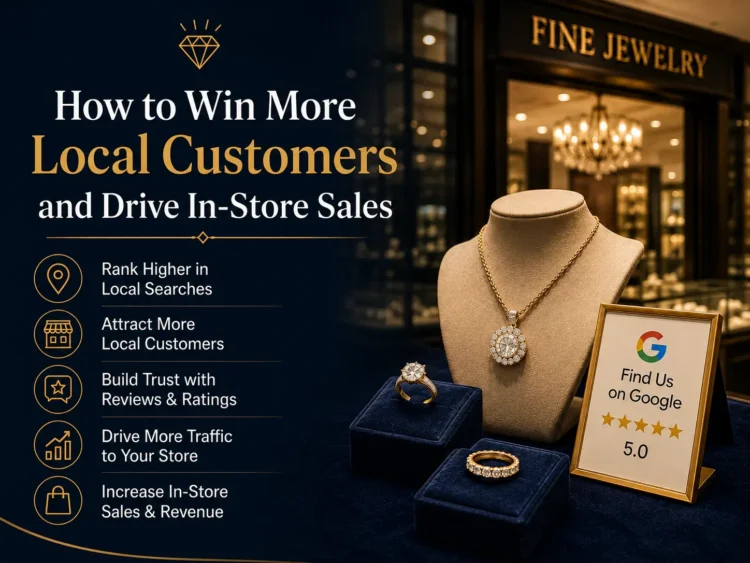
In today’s digital retail landscape, a jewellery store must excel in local SEO to attract nearby customers ready to buy. Key tactics include optimizing the Google Business Profile (GBP), targeting geo-specific keywords, and building trust through reviews and local content. Community experts stress that GBP and reviews often “do the heavy lifting” for immediate leads. This blog post shares actionable steps (with examples and mini case studies) on keyword strategy, on-site and GBP optimisation, content and link-building, and tech improvements, all illustrated by real-world anecdotes from Reddit and LinkedIn. We also include a KPI tracking table, an implementation timeline, and a legal compliance checklist for retailers.
Understand Local Intent and Keywords
Local shoppers for jewellery often search with immediate intent (e.g. “diamond engagement rings near me”, “jewellery repair [city]”). As one Redditor notes, queries like “I need this service right now” drive the map-pack (GBP) results, while broader content on your site helps with voice/AI searches. To capture this demand:
- Find geo-specific terms: Include city/neighborhood names and “near me” in keyword lists (e.g. “best gold jewellery [Town]”).
- Cover category and product searches: Optimize for items people actively seek (rings, necklaces, repairs). One SEO case study emphasized targeting a high-potential category – engagement rings – which yielded ~18,000 visits in 8 months.
- Balance intent: Mix transactional (“buy diamond ring”) with informative queries (“how to clean silver jewellery”).
Google Business Profile (GBP) Optimisation
Your GBP listing often appears before any website result. Follow these key steps (every recommendation below is affirmed by community experts):
- Claim and Verify: Immediately set up/verify your GBP. Choose precise categories (e.g. “Jewellery Store” or “Jewellery Wholesaler”). One Reddit answer advises: “set up and verify your Google Business Profile, choose the right categories (like ‘Jewelry Store’ or ‘Fashion Accessories’)…”.
- Complete All Fields: Add your full NAP (Name, Address, Phone) consistently everywhere (the same format on your site, socials, and citations).
- Add Photos: Upload high-quality images of your store interior, products, and team regularly. Visuals make your GBP more compelling.
- Write a Strong Description: Summarize your unique offerings (designer brands, custom work, etc.). Include local keywords naturally.
- Enable Features: Add available attributes (e.g. wheelchair access, appointment links), list services or products, and set correct business hours.
- Regular Posts: Publish Google Posts for promotions or events. (While some Redditors say GBP posts are lower priority than core GBP optimization, promotions can boost engagement.)
- Questions & Answers: Populate FAQs on your GBP. Encourage customers to ask about hours, services, hallmarking etc., then answer in detail.
- Review Management: Respond promptly to all reviews. Industry data shows “review velocity” is a top ranking factor.
Anecdote: A local SEO consultant on Reddit reported that after adding a QR code campaign to ask customers for reviews, his business saw significant traffic growth. He said, “in my case we increased traffic after incentivizing Google reviews… Verdict is clear”.
On-Page SEO and Technical Health
Your website must support the local intent signaled by GBP. Community experts highlight basics plus jewellery-specific optimisations:
- Title Tags & Meta Descriptions: Include local keywords and product types. For example: “Luxury Diamond Engagement Rings – [City] Jewellers”. Ensure each page has a unique, descriptive title and meta.
- URL and Heading Structure: Use clear, keyword-rich URLs (e.g.
/engagement-rings-london/). Every main page needs an H1 tag. One real-life audit found missing H1s and little content on a jeweller’s site, which was immediately fixed. - Schema Markup: Implement LocalBusiness schema on each store page (include address, phone, opening hours). Use Product schema on jewellery items (to show price, stock in search). If possible, add Review schema for customer testimonials. A community SEO expert warns that AI and voice assistants rely on structured data, so “embedded structured data [is needed to] rank in AI results”.
- Images: Optimize filenames and alt-text with keywords (e.g.
emerald-anniversary-ring.jpg). Compress images for fast loading. One poster in a case study emphasized site speed and image SEO as huge for jewelry (see UX section). - Mobile-Friendly and Speed: Ensure fast load times (especially on mobile). Tools like Google PageSpeed Insights should show good Core Web Vitals. Another LinkedIn consultant notes modern search (voice, AI) heavily values mobile performance, so “invest in a website designed to be interpreted by AI, and speed”.
- Content Depth: Add helpful copy on service pages (product details, unique value). A local SEO observed that businesses with good structured content can outrank others even without a GBP.
- Internal Links: Link related pages (e.g. a blog about engagement tips linking to the “Engagement Rings” page) to keep visitors browsing.
Step-by-Step: Conduct a technical audit (via Google Search Console or tools like SEMrush) and fix any issues (missing tags, duplicate content, broken links, etc.). Update the site gradually by category or page, tracking improvements.
Local Content and Community Engagement
Build trust and relevance with content targeted to local customers:
- Local Landing Pages: If you serve multiple areas, create pages like “Jewellery in [City]” that highlight local offerings or events. Include testimonials or case examples involving local customers.
- Blog & News: Write blog posts on topics like “How to Choose an Engagement Ring”, “Wedding Jewellery Trends in [City]”, or local events (wedding fairs, festivals). Community member SophieAvocado even used a local giveaway to drive review collection, a good reminder to leverage fun content for engagement.
- Visual Content: Share images/videos of custom designs or in-store events. A LinkedIn SEO case noted Pinterest optimization doubling referrals for a jeweller.
- Social Media & PR: Use Instagram/Facebook to highlight local events, and seek features in local news or fashion blogs. For example, sponsoring a city art fair or being featured in a local bridal magazine often results in press coverage and backlinks.
- Community Involvement: Partner with wedding planners, local charities or clubs – these partnerships can lead to press mentions and links.
Anecdote: One jeweller posted on LinkedIn that timely seasonal content made a big difference. A case study from an SEO agency reported a jeweller achieving a 60% uplift in holiday-season traffic by focusing on Mother’s Day and Christmas campaigns.
Citation and NAP Consistency
Accurate citations (online mentions of your business) are the foundation of local SEO:
- Consistency: Ensure your business name, address, and phone are identical in every listing (website, GBP, social profiles, directories). As one SEO analyst put it, “consistent Name, Address, and Phone = Map Pack success” (see Table).
- Key Listings: List on Google, Bing, Apple, Yelp, Yellow Pages, local directories, Jewelers.org, industry sites, and relevant local chambers.
- Cleanup: Remove duplicates or outdated listings. Tools like Moz Local or Yext can help audit NAP.
- Structured Citations: Submit to authoritative directories (that include schema). This strengthens credibility.
- Monitor Changes: Regularly check your GBP and third-party listings after any address change or rebranding.
One DIY tip from a Reddit discussion: treat citations as foundational “links” – start by building them before paid link-building.
Review Acquisition and Reputation
Online reviews are critical for jewellery buyers. Steps:
- Ask for Reviews: Train staff to request Google reviews (and on other platforms) after every sale or service. Even incentivize them (as one retailer did via a QR code, boosting traffic).
- Follow-up: Use email/SMS automations to solicit reviews post-purchase. Reddit users stress review velocity and recency as key ranking factors.
- Respond Promptly: Thank reviewers and address concerns. Show empathy and offer solutions for negative feedback to signal trustworthiness.
- Highlight Positives: Share top reviews on your site (with schema markup). They build confidence for new visitors.
- Manage Issues: If a competitor posts fake reviews, use Google’s reporting or consult forums (several Reddit threads address review attacks).
Quote: As one local SEO consultant summarized, “For local SEO, GBP optimization + review velocity are the #1 and #2 ranking factors.” He advises: first fully optimize your GBP (with images and detail), then ensure you have tech in place to regularly request reviews.
Local Link-Building and PR
Earn links and mentions from local sources:
- Local Partnerships: Sponsor local events (sports teams, charity runs, cultural festivals). Such sponsorships often include links on the event’s site. One SEO advised using Google: search
"city name" inurl:sponsorsto find such opportunities. - Business Partnerships: Collaborate with complementary businesses (bridal shops, florists, wedding planners). Exchange website shout-outs or guest posts. Reddit SEO experts recommend partnering with adjacent non-competing businesses to expand networks.
- Local Directories & Associations: Get listed on local business directories, the local chamber of commerce, and jewellery industry associations.
- Content Outreach: Publish locally-relevant blog posts and pitch them to regional bloggers or publications. (E.g., an article on “Top 5 Engagement Ring Trends in [Your City]” could attract links from wedding blogs.)
- HARO and Press: Use Help A Reporter Out (HARO) to provide expert quotes about jewelry trends for local media, earning backlinks.
- Niche Guest Posts: Write for fashion or lifestyle blogs, focusing on unique angles (e.g. gemstone education). Community SEO advice suggests focusing on relevance: “Our general roadmap is to start with foundational listings and grow into strategic partnerships and engaging content, which earns local endorsements”.
Case Study: On Reddit, one agency’s stepwise link strategy for small businesses started with “consistent citations on reputable directories” then moved to local sponsorships and partnerships. This approach reflects our step-by-step plan below.
Technical SEO and Performance
Ensure your site is technically healthy and fast:
- Mobile-Friendly Design: Use responsive design. On mobiles, show your phone number and “click-to-call” prominently.
- Page Speed: Compress images, enable caching, use a Content Delivery Network (CDN). Faster sites convert better.
- SSL: Use HTTPS (required for Google ranking and user trust).
- Structured Data: (Repeated) Implement schema (LocalBusiness, Product, Review, etc.) so search engines can parse your offerings. Without schema, you miss out on AI/voice results.
- Core Web Vitals: Optimize for low Cumulative Layout Shift (CLS) and fast Largest Contentful Paint (LCP). Use Google’s tools to identify issues.
- Site Architecture: Keep navigation simple. Every important page should be reachable in few clicks from the homepage.
- Fix Crawl Issues: Regularly check Google Search Console for errors, broken links, or indexing problems.
Tip: Use Search Console to monitor how Google sees your site. Also, implement hreflang if you target multiple languages (some SEOs suggest it for jewellery stores in bilingual regions).
UX and Conversion Optimisation
A local shopper should find what they need quickly:
- Clear CTAs: Include prominent calls-to-action: “Book an Appointment,” “Call Now,” “Get Directions.”
- Contact Info Everywhere: Put your address and phone in the header or footer on every page.
- Store Locator: If multiple locations, add a store locator with map.
- Trust Badges: Display hallmark logos, payment security icons (SSL, PCI), association memberships or guarantees. For instance, showing a UK Assay Office logo or Hallmark on product images can reassure customers.
- High-Quality Images: Jewelry needs detail. Use professional photos (consider lightboxes or reflected light techniques as Reddit users suggest) so customers feel confident in online quality.
- Easy Booking: If possible, integrate online appointment scheduling or chat.
- Mobile UI: Optimize for thumbs – large buttons, easy forms.
- Fast Checkout: Minimise steps; show secure payment and clear returns info. (Don’t surprise customers at the end.)
One LinkedIn expert reminds retailers: “Fast-loading pages that keep users engaged… product pages that speak value, not confusion… checkout flow that’s smooth, secure, and persuasive”. This is especially true for the high-value purchases typical of jewellery.
Advertising and Social Integration
While our focus is organic, coordinated ads can boost local awareness:
- Local Search Ads: Use Google Local Services Ads or Performance Max campaigns with location targets. These increase visibility in the map pack and Google Maps.
- Social Geo-Targeting: Run Facebook/Instagram ads targeting customers in your city (e.g., promote engagement ring collection to engaged users in a radius).
- Remarketing: Target visitors who browsed your site but didn’t convert, with special offers.
- Event Promotion: Create Facebook events for in-store happenings (new collection launch, trunk show, etc.).
- Content Promotion: Use a small budget to boost top local content (guides or events) on social.
- Integration: Ensure your social profiles link back to GBP and the website. Post shop updates and use local hashtags.
Measurement: KPIs and Tools
Track success with concrete metrics. Key KPIs include:
| KPI | What to Measure | Tools |
|---|---|---|
| Google Business Profile | Profile views, searches, clicks (calls, website, directions) | Google Business Profile (Insights), BrightLocal, Yext |
| Local Search Rankings | Positions for target local keywords, Local Pack visibility | BrightLocal, Whitespark, Moz Local |
| Website Traffic & Engagement | Local organic sessions, bounce rate, time on site | Google Analytics 4, Google Search Console |
| Reviews & Reputation | Number of reviews, average rating, review response rate | Google Business, Trustpilot, ReviewTrackers |
| Conversions | Calls, contact form submissions, appointment bookings | Google Analytics (Goals/GA4 events), GMB Insights, call-tracking tools |
| Citations & Backlinks | Number of local citations/listings, quality of backlinks | Moz Local, WhiteSpark, Ahrefs/SEMrush |
By regularly monitoring these, you can see which tactics are working. For example, a rise in GBP profile views or directions after a photo update indicates success, whereas stagnant traffic may signal the need for fresh content or link efforts.
Implementation Timeline
timeline
    title Local SEO Implementation Timeline
    2026-06 : Claim GBP and verify NAP across directories
    2026-07 : Audit & fix on-page SEO (titles, schema, mobile)
    2026-08 : Publish localised pages and content (service pages, blog)
    2026-09 : Build citations and local links (chamber, sponsorships)
    2026-10 : Launch review acquisition campaign (email/SMS reminders)
    2026-11 : Roll out seasonal promotions (holiday gift campaigns)
    2026-12 : Analyze KPIs and refine strategy for next year
This timeline gives a 6-month rollout with overlapping tasks. In practice, many tasks are ongoing: e.g. monitor reviews & analytics weekly, post on GBP monthly, and adjust based on data.
Mini Case Studies
- Engagement Rings Focus (E-commerce Jeweller): A family-owned store expanded online by optimising specifically for engagement rings. They fixed technical issues (missing H1s) and built content for that category. Over 8 months they achieved ~18,000 website visits (1.5M impressions) without paid ads.
- Google Maps Boost (Miami Store): A LinkedIn case study of “Stellar SEO” reports a Miami jewellery store doubled foot traffic by ranking in the Google “Map Pack” for local ring searches. This shows that local map visibility can convert directly to store visits.
- Multilingual Targeting (Denver Market): Another LinkedIn example describes “Stigan Media” helping a Denver jeweller by adding Spanish-language SEO. The result was a 120% jump in organic traffic. For stores in diverse cities, speaking customers’ languages can open big opportunities.
These stories underline that tailored local SEO tactics (even small or unique optimisations) can have large impacts on real sales and visits.
Step-by-Step Recommendations
- Claim & verify all local listings: Set up Google Business Profile (and Apple, Bing, Yelp) immediately. Ensure your business name is consistent everywhere.
- Populate and optimise GBP: Add photos, products/services, business hours and attributes. Write a concise, keyword-rich description.
- Build reviews: Use follow-up messages or staff requests to collect new Google reviews daily. Aim for at least one review per month to maintain “velocity.”
- Improve on-page SEO: Fix title tags, meta descriptions, headings, and add LocalBusiness schema. Ensure the site loads fast on mobile.
- Create local content: Add or refresh pages focusing on specific products or services, including city names. Write blog posts addressing customer questions and local events.
- Expand citations and links: List your store on industry and local sites. Network with local businesses and sponsor community groups to earn relevant backlinks.
- Promote offers: Post special promotions on GBP and social media, especially for holidays. For example, create a Google Post about a Valentine’s sale.
- Measure and tweak: Weekly, check GBP insights and Google Analytics. Monthly, review keyword rankings. Adjust strategy based on what’s working.
By following these steps iteratively, a jewellery retailer can steadily climb local rankings and footfall.
Legal & Compliance Checklist for Jewellery Retailers
- Hallmarking & Purity: In the UK, all precious-metal jewellery (gold, silver, platinum, palladium) above certain weights must carry a legally recognised hallmark to certify purity. Ensure all items meet hallmarking regulations (Hallmarking Act 1973).
- Return Policy (UK): Provide the mandatory 14-day “cooling-off” period for online purchases. Note that bespoke or engraved jewellery is generally exempt from returns (though faulty items are still covered). Clearly state these terms on your site.
- Consumer Rights: Comply with the Consumer Rights Act 2015: goods must be as described and of satisfactory quality. Offer repairs, replacements or refunds as required if items are defective.
- Pricing & Advertising: Follow trading standards – do not mislabel weights or gemstones. For UK jewellery, ensure any discount claims (e.g. “50% off”) meet legal definitions.
- Privacy & Data: Follow GDPR by securing customer data and having a clear privacy policy.
- Secure Payments: Use PCI-compliant payment processors. Display security badges (e.g. SSL padlock icon).
- Trust Signals: Highlight professional accreditations (gemmologist certifications, trade association memberships) and contact details (company registration, VAT number, etc.) to build trust.


