
New York City represents one of the most competitive business environments in the world. Whether you’re operating in Manhattan, Brooklyn, Queens, the Bronx, or Staten Island, thousands of businesses compete for customer attention in your category. Standing out in this crowded marketplace requires strategic thinking, and increasingly, that strategy must include local search engine optimization.
When someone in New York searches for “destists near me,” “emergency clinics near me,” or “web design company NYC,” search engines determine which businesses to show based on complex algorithms evaluating relevance, distance, and prominence. Local SEO is the practice of optimizing your business to appear prominently in these local searches.
The stakes are substantial. Studies consistently show that 76% of people who search for something nearby visit a business within 24 hours, and 28% of those searches result in purchases. For New York businesses, where foot traffic and local clientele often drive revenue, appearing in local search results directly impacts your bottom line.
Over the past decade working with New York-based businesses across industries, we’ve developed comprehensive understanding of what works in this unique market. The strategies that succeed in less competitive markets often fall short in New York’s intense environment. This guide provides actionable insights specifically designed for businesses competing in the New York metropolitan area.
Understanding Local SEO Fundamentals
Local SEO differs fundamentally from traditional SEO. While traditional SEO focuses on ranking for searches regardless of searcher location, local SEO targets searches with local intent and optimizes for geographic relevance.
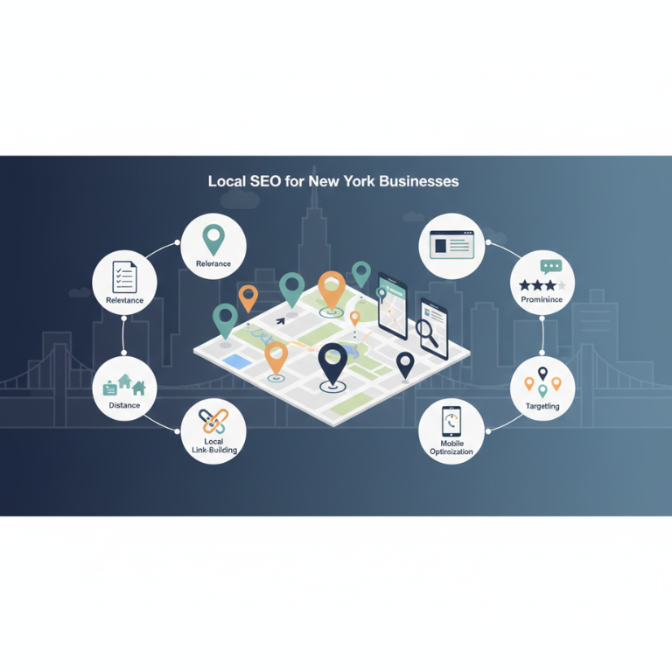
Search engines determine local search rankings through three primary factors that Google explicitly acknowledges: relevance, distance, and prominence.
Relevance measures how well your business matches what someone is searching for. If someone searches for “Italian restaurant,” search engines evaluate whether your business serves Italian food, what information your website provides, and how clearly you communicate what you offer.
Distance considers how far your business is from the searcher or the location mentioned in their search. Someone searching “pizza near me” from Midtown Manhattan will see different results than someone searching the same thing from Williamsburg, Brooklyn. You can’t change your physical location, but you can optimize to ensure search engines accurately understand where you’re located.
Prominence reflects how well-known and authoritative your business is. Search engines evaluate prominence through factors including online reviews, citations on other websites, links pointing to your site, and general web presence. In competitive markets like New York, prominence often determines which businesses appear above competitors offering similar services in similar locations.
Understanding these three factors helps explain why some local SEO tactics matter and others don’t. Every optimization effort should connect to improving relevance, leveraging proximity, or building prominence.
Local search results appear in several formats. The “Local Pack” or “Map Pack” shows three businesses with map locations directly in search results. These coveted positions drive enormous traffic. Below the Map Pack, organic search results appear, which can also include local businesses. Additionally, Google Maps results serve users specifically searching for businesses on maps rather than through web search.
Your local SEO strategy must address all these result types to maximize visibility across the various ways potential customers search for businesses like yours.
Google Business Profile: Your Local SEO Foundation
Google Business Profile (formerly Google My Business) represents the single most important element of local SEO. Your profile directly controls whether you appear in the Map Pack, what information displays about your business, and how you show up in Google Maps.
Creating or claiming your Google Business Profile is the essential first step. Search for your business name on Google. If a profile exists but you don’t control it, claim it. If no profile exists, create one. This process requires verification, typically through a postcard mailed to your business address with a verification code.
Complete every section of your profile thoroughly. Incomplete profiles perform poorly compared to comprehensive ones. Include your exact business name, accurate address, phone number, website URL, business category, hours of operation, and detailed business description.
Business categories deserve careful consideration. Your primary category should precisely match your core business. If you’re a web design company, select “Website Designer” rather than something generic like “Marketing Agency.” You can add secondary categories reflecting additional services, but your primary category should be specific and accurate.
Business description allows 750 characters to explain what you do, what makes you unique, and why customers should choose you. Write naturally for humans, not keyword-stuffed text for search engines. Include your location, services, and value proposition clearly.
Business hours must be accurate and updated for holidays. Nothing frustrates potential customers more than arriving at a closed business that claimed to be open online. Special hours for holidays like Thanksgiving, Christmas, and New Year’s should be set in advance.
Photos significantly impact engagement and conversions. Businesses with photos receive 42% more requests for directions and 35% more clicks to their websites than businesses without photos. Upload high-quality images of your storefront, interior, products, team, and work examples. Add new photos regularly recent images signal an active, current business.
For service-area businesses without physical locations customers visit, properly configure your service areas. Web design companies, contractors, and similar businesses should list areas served rather than attempting to show a location customers can visit.
Posts feature lets you share updates, promotions, events, and news directly on your Google Business Profile. Posts appear in your profile and can influence engagement. Regular posting signals an active business to both potential customers and Google’s algorithms.
Q&A section lets anyone ask questions about your business. Monitor this section and answer questions promptly and helpfully. Proactively add common questions and answers to provide helpful information and control messaging.
Messaging enables customers to contact you directly through your Google Business Profile. If you enable this feature, respond quickly. Slow responses or ignored messages create poor impressions and may signal to Google that you’re not actively managing your business.
The work of optimizing your Google Business Profile is never truly done. Regular updates, new photos, posts, and active management signal to Google that your business is active and engaged, potentially boosting your local rankings.
NAP Consistency: The Foundation of Local Citations
NAP stands for Name, Address, and Phone number the basic information that identifies your business location. Consistency in how this information appears across the web fundamentally affects your local search performance.
Search engines aggregate data about businesses from hundreds of sources: online directories, social media profiles, review sites, business associations, local websites, and more. When they find consistent information across sources, confidence increases that the information is accurate. Inconsistent information creates confusion and reduces trust in the data.
Even small inconsistencies matter. “CG Colors Inc.” versus “CGColors, INC.” versus “CG Colors” might seem trivial, but search engines treat these as potentially different businesses. Similarly, “335 Central Ave” versus “335 Central Avenue” or phone numbers formatted differently all create citation inconsistencies.
Establish your canonical NAP format and use it consistently everywhere. Decide exactly how you’ll format your business name, address, and phone number, then use that exact format across all platforms. Document this format and share it with anyone managing your online presence.
For New York addresses, be particularly careful with suite numbers, floor numbers, and building designations that are common in NYC. Include these consistently if they’re part of your official address.
Audit existing citations to identify inconsistencies. Tools like Moz Local, BrightLocal, or Whitespark help discover where your business is listed and how information appears. Manual searching for your business name plus city also reveals citations.
Correct inconsistencies systematically. Update your information on major platforms first: Google Business Profile, Bing Places, Apple Maps, Yelp, Facebook, and industry-specific directories relevant to your business. Then work through secondary directories and citation sources.
Major directories for New York businesses include general platforms like Yelp, Foursquare, and YellowPages, plus New York-specific directories and local business associations. Industry-specific directories matter for certain businesses web design companies might list in design directories while restaurants focus on food and dining platforms.
Build new citations on authoritative directories where you’re not currently listed. Focus on quality over quantity. A citation on a respected, relevant directory matters more than dozens on low-quality sites.
Unstructured citations mentions of your business without formal directory listings also contribute to local SEO. Local news coverage, blog posts, local business roundups, and community website mentions all provide citation value when they include your NAP information.
For businesses serving specific New York neighborhoods, neighborhood-specific citations can be particularly valuable. Brooklyn businesses might get listed in Brooklyn-focused directories, Williamsburg neighborhood guides, or local business associations. This geographic specificity reinforces your local relevance.
On-Page SEO for Local Search
Your website’s on-page optimization signals to search engines what you do and where you operate. Local on-page SEO ensures search engines understand your geographic relevance.
Title tags and meta descriptions for key pages should include location terms naturally. Your homepage title might be “Web Design & Development Company in New York | CGColors” rather than just “CGColors – Web Design Company.” Service pages can be even more specific: “WordPress Development Services in NYC” or “Shopify Design for New York Retailers.”
Header tags throughout your content should incorporate location terms where relevant and natural. Don’t force location into every header, but use it where it makes sense: “Serving New York Businesses Since 2014” or “Why NYC Companies Choose Our Development Services.”
Content should naturally reference your New York location and service areas. Mention neighborhoods you serve, projects you’ve completed in specific areas, and your connection to the New York business community. This geographic content reinforces relevance for location-based searches.
Location pages work well if you serve multiple distinct areas. A web development company might create dedicated pages for Manhattan, Brooklyn, and Long Island services, each with unique content addressing those specific markets.
Schema markup structured data that helps search engines understand page content should include LocalBusiness schema on your homepage and location pages. This markup explicitly tells search engines your business name, address, phone, hours, and other details. Our web development services always include proper schema implementation for local businesses.
Embed your Google Map on your contact page and location pages. The map embed reinforces your location and provides easy directions for visitors.
Footer consistency matters for NAP information. Your business name, address, and phone should appear in your website footer using the exact same format as your citations and Google Business Profile.
Avoid over-optimization. Writing “New York” into every sentence or creating awkward, keyword-stuffed content hurts more than helps. Content should read naturally while strategically incorporating location relevance where it makes sense.
Content Strategy for Local SEO
Content marketing amplifies local SEO efforts by creating opportunities to target local search terms, demonstrate expertise, and attract links from local sources.
Local landing pages targeting specific services in specific locations capture long-tail local searches. A page targeting “WordPress development in Manhattan” can rank for that specific search while providing relevant information to users searching for exactly that service.
Create these pages only if you can write unique, valuable content for each. Duplicate or thin content hurts more than helps. If you can’t write genuinely different content for Manhattan versus Brooklyn services, a single page covering all of New York makes more sense.
Blog content addressing local topics attracts local audiences and creates opportunities for local links. A New York web design company might publish “Website Requirements for New York Restaurants” or “How NYC Healthcare Practices Can Improve Online Presence.” This content targets local businesses searching for industry-specific guidance while reinforcing your local expertise.
Case studies and success stories featuring New York clients serve multiple purposes. They provide social proof, demonstrate expertise, and naturally incorporate location relevance. Describing projects completed for Brooklyn restaurants or Manhattan professional services firms reinforces your connection to the New York market.
Event coverage and community involvement content shows your engagement with the local community. Participating in New York tech meetups, business events, or community activities creates content opportunities and potential link sources when organizations link to participants.
Neighborhood guides and local resources position you as a community authority. A guide to “The Best Co-Working Spaces in Brooklyn” or “NYC Business Resources Every Startup Should Know” provides genuine value while building local relevance and attracting links from other local sites.
Content should always prioritize reader value over search engines. Useful, engaging content naturally attracts traffic, links, and shares. Thin content created purely for SEO rarely performs well in competitive markets like New York.
Reviews and Reputation Management
Online reviews significantly impact local search rankings, click-through rates, and conversion rates. Review quantity, quality, diversity, and recency all factor into local SEO performance.
Google reviews matter most because they appear directly in your Google Business Profile and Local Pack results. Actively encourage satisfied customers to leave Google reviews. Don’t buy reviews or use services that provide fake reviews Google detects this and may penalize your profile severely.
The most effective review generation strategies integrate requests into normal business processes. Email follow-ups after project completion, thank you messages including review requests, or in-person asks all work when done genuinely and not aggressively.
Respond to every review positive and negative. Thoughtful responses to positive reviews show appreciation and engage your audience. Professional responses to negative reviews demonstrate that you care about customer satisfaction and will work to resolve issues. Potential customers read both reviews and responses when evaluating businesses.
For negative reviews, respond promptly, professionally, and constructively. Acknowledge concerns, apologize if appropriate, and offer to resolve issues offline. Never argue publicly or become defensive. Many potential customers give businesses with well-handled negative reviews more credit than businesses with only positive reviews and no negative feedback.
Review diversity across multiple platforms strengthens your overall reputation. While Google reviews matter most for local SEO, reviews on Yelp, Facebook, industry-specific platforms, and other sites contribute to overall online reputation. New York businesses should particularly focus on Yelp given its strong presence in NYC.
Monitor review platforms regularly. Set up alerts so you’re notified immediately when new reviews appear. Quick responses show attentiveness and prevent negative reviews from sitting unaddressed for days or weeks.
Encourage detailed reviews that mention specific services, team members, or positive experiences. Reviews mentioning “WordPress development” or “website redesign” or specific aspects of your service provide more value than generic “great service” comments.
Never incentivize reviews with discounts or payments, even for honest reviews. This violates platform policies and can result in penalties. The only acceptable incentive is providing excellent service that naturally motivates satisfied customers to share their experiences.
Building Local Links and Citations
Links from other websites signal authority and trust to search engines. Local links from New York-based organizations, businesses, and publications provide both SEO value and direct referral traffic.
Local partnerships and relationships often create natural linking opportunities. Web development companies might partner with marketing agencies, refer clients to complementary services, or collaborate on projects. These relationships often lead to links from partner websites.
Local business associations and chambers of commerce provide citation and link opportunities. New York has numerous business organizations at city, borough, and neighborhood levels. Membership often includes directory listings with links to your website.
Local media and publications offer valuable links when they cover your business, quote you as an expert, or feature your work. Building relationships with local business journalists, contributing expert commentary, or sharing newsworthy stories about your business can generate coverage.
Sponsorships and community involvement create linking opportunities. Sponsoring local events, nonprofit organizations, or community initiatives often results in links from event pages, sponsor listings, or organizational websites.
Guest posting on local business blogs or contributing to local publications provides links while demonstrating expertise. A byline on a respected New York business blog carries more weight than links from random, unrelated sites.
Industry-specific directories and resources relevant to your business provide valuable links. Web design companies might get listed in design galleries, agency directories, or technology resource lists. These niche, relevant links often provide more SEO value than general directories.
Focus on link quality over quantity. A link from the New York Times, Crain’s New York Business, or a respected local blog matters far more than dozens of links from irrelevant, low-quality sites. In competitive markets like New York, authoritative links make real differences in rankings.
Never buy links or participate in link schemes. Search engines detect these tactics and impose penalties that devastate rankings. Building links through genuine relationships, quality content, and real value takes longer but produces sustainable results.
Mobile Optimization for Local Search
Over 60% of local searches happen on mobile devices, and this percentage continues increasing. Mobile optimization isn’t optional for businesses targeting local customers it’s essential.
Responsive design ensures your website works excellently on all device sizes. Your site should automatically adapt to phones, tablets, and desktops, providing optimal experience on each. Testing on actual devices reveals issues that desktop testing misses.
Page speed matters even more on mobile. Mobile users often search on slower connections than home broadband. If your site takes more than three seconds to load, over half of mobile users will abandon it. Optimize images, minimize code, and leverage caching to achieve fast mobile loading.
Click-to-call functionality makes it easy for mobile users to contact you immediately. Phone numbers should be tappable links that open the device’s phone dialer with one touch. In local search results, many users want to call businesses immediately rather than visit websites.
Directions integration lets mobile users get directions to your location with one tap. Embed Google Maps on your contact page and ensure your address is formatted consistently across your site.
Form optimization for mobile submission prevents frustration. Forms should be simple, use appropriate input types (numeric keyboards for phone numbers, email keyboards for email fields), and minimize required fields. Completing forms on mobile devices is harder than on desktops make it as easy as possible.
Local content accessible to mobile users provides immediate value. Service area information, hours, parking information, and other practical details that mobile searchers need should be prominent and easy to find.
Mobile user intent often differs from desktop. Mobile searchers are frequently closer to making immediate decisions calling a business, visiting a location, or taking action. Your mobile experience should accommodate this high-intent behavior with clear calls-to-action and easy conversion paths.
Tracking and Measuring Local SEO Results
You can’t improve what you don’t measure. Tracking local SEO performance helps you understand what’s working, identify problems, and make data-driven optimization decisions.
Google Business Profile Insights provide data about how customers find and interact with your profile. Track how many people view your profile, what searches trigger it, how many people request directions or visit your website, and phone calls generated through your profile. These metrics directly indicate profile performance.
Google Analytics reveals geographic data about website visitors. Filter for New York traffic specifically to understand how local visitors behave differently from overall traffic. Set up goals tracking local-specific conversions like contact form submissions or calls.
Rank tracking for local search terms shows where you appear in search results for important queries. Track rankings for terms like “web design company New York,” “NYC Shopify development,” and other local variations of your target keywords. Local rank tracking tools show results from specific geographic locations, important because search results vary by where the searcher is located.
Citation tracking ensures your NAP information remains consistent across directories. Regular audits catch changes or errors that might hurt local rankings.
Review monitoring tracks new reviews across platforms, average ratings, review velocity, and sentiment. Understanding review trends helps you improve customer experience and identify reputation issues early.
Website traffic from local sources includes visitors from Google Maps, local directories, and location-specific referrals. This traffic often converts at higher rates than general traffic because it’s more targeted.
Set benchmarks and track progress over time. Local SEO improvements typically show results over months, not days. Consistent measurement helps you understand whether your efforts are moving metrics in the right direction.
Compare your performance against competitors. Track where they rank, how many reviews they have, and how their profiles appear compared to yours. This competitive intelligence identifies gaps and opportunities in your local SEO strategy.
New York-Specific Considerations
New York’s unique characteristics create specific challenges and opportunities for local SEO.
Extreme competition means you’re competing against numerous businesses in every category. Standing out requires excellence, not just adequacy. The tactics that work in less competitive markets might not move the needle in New York.
Neighborhood targeting often matters more than city-level optimization. New York’s neighborhoods function almost like separate cities. Someone in Williamsburg searching for services usually wants options in Williamsburg or nearby Brooklyn neighborhoods, not Manhattan results requiring substantial travel.
Consider creating neighborhood-specific content, optimizing for neighborhood names, and participating in neighborhood business communities. These granular geographic targets can be less competitive than citywide terms while attracting highly qualified local traffic.
Subway accessibility matters to New York customers in ways unique to the city. Mentioning nearby subway stops in your location content can influence customer decisions and attract location-specific searches.
Industry density in certain sectors creates fierce local competition. Tech companies in Manhattan, restaurants throughout the city, and professional services in financial districts all face intense local competition requiring sophisticated strategies.
Multi-borough presence considerations arise for businesses with locations in multiple boroughs or serving all of New York. Each location should have its own Google Business Profile, and content should address each service area specifically without creating thin duplicate content.
Language diversity creates opportunities for businesses serving non-English speaking communities. New York’s incredible linguistic diversity means local SEO in Spanish, Chinese, Russian, or other languages can capture underserved markets.
Common Local SEO Mistakes to Avoid
Understanding mistakes helps you avoid wasting time and effort on tactics that don’t work or actively hurt your local rankings.
Inconsistent NAP information across platforms confuses search engines and reduces trust in your data. Even small inconsistencies matter and should be corrected systematically.
Neglecting Google Business Profile after initial setup means missing opportunities to improve rankings through regular updates, posts, photos, and active management.
Buying or faking reviews seems tempting but risks severe penalties including complete removal from Google Business Profile. The risk far outweighs any temporary benefit.
Keyword stuffing location terms into content creates poor user experience and signals manipulation to search engines. Write naturally for humans, incorporating location strategically but not excessively.
Ignoring mobile optimization effectively excludes you from the majority of local searchers who use smartphones to find businesses.
Using a PO Box instead of a physical address in Google Business Profile violates guidelines for most business types and can result in profile suspension.
Creating multiple profiles for one location to rank more prominently violates Google’s guidelines and results in suspension of all profiles when detected.
Neglecting review management means negative reviews sit unaddressed, creating poor impressions for potential customers, and missing opportunities to engage satisfied customers.
Inconsistent business hours frustrate customers who arrive when you’re actually closed and damage trust in your business information.
Avoiding these mistakes is often as important as implementing positive tactics. Local SEO requires consistent attention and adherence to platform guidelines, particularly in competitive markets like New York.
Moving Forward with Local SEO
Local SEO represents ongoing work, not a one-time project. Search engines continuously update algorithms, competitors improve their optimization, and your business evolves. Sustained success requires consistent effort and attention.
Start with foundational elements: claim and optimize your Google Business Profile, ensure NAP consistency, build initial citations, and optimize your website for local search. These fundamentals establish your baseline presence.
Build momentum through consistent execution: regularly publish content, actively manage reviews, pursue quality local links, and maintain citation accuracy. Monthly or quarterly review of local SEO metrics helps track progress and identify issues.
Stay informed about local SEO changes. Google updates local search algorithms regularly, sometimes with significant impacts on rankings. Following reputable SEO news sources and working with professional SEO services keeps your strategy current with best practices.
For New York businesses, local SEO isn’t optional it’s essential for competing effectively in one of the world’s most competitive markets. Customers searching for services you provide are making decisions right now about which businesses to contact. Without strong local SEO, you’re simply not in the conversation.
The businesses that succeed with local SEO in New York share common traits: comprehensive optimization, consistent execution, authentic engagement with customers, and patience to let strategies work over time. Quick tricks and shortcuts don’t work in competitive markets sustainable approaches built on solid foundations do.
Whether you’re just beginning local SEO efforts or looking to improve existing performance, the strategies outlined in this guide provide a framework for success. Implementation requires dedication and consistency, but the results increased visibility, more customers, and competitive advantage justify the investment.
Need help optimizing your New York business for local search? Our team understands the unique challenges of New York’s competitive market and can help you develop and execute a local SEO strategy that drives real results. Contact us to discuss your local search opportunities.


