
When planning a new website or considering a redesign, one of the most fundamental decisions you’ll face is whether to build on WordPress or develop a custom solution using PHP. Both approaches have powered millions of successful websites, yet they represent fundamentally different philosophies about web development.
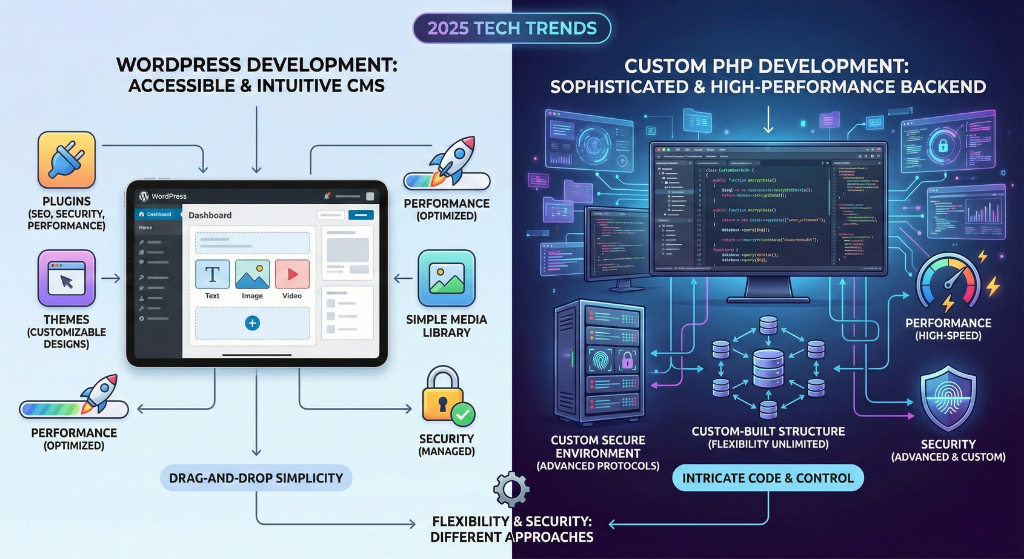
WordPress offers a proven content management system with extensive ecosystem, plugins for nearly any functionality, and the ability to launch professional websites quickly. Custom PHP development provides unlimited flexibility, complete control over every aspect of your site, and the ability to build exactly what you envision without platform constraints.
The choice between WordPress and custom PHP isn’t about which is objectively better it’s about which better aligns with your specific business needs, budget, technical resources, and long-term goals. Making the wrong choice can cost you time, money, and opportunities, while the right choice provides a solid foundation for growth.
After building hundreds of websites using both WordPress and custom PHP over the past decade, we’ve developed clear understanding of when each approach makes sense, what trade-offs each involves, and how to make informed decisions that serve business objectives rather than following technology trends or personal preferences.
Understanding WordPress: Strengths and Philosophy
WordPress began as blogging software in 2003 and has evolved into the world’s most popular content management system, powering over 40% of all websites. This dominance reflects genuine strengths that serve many business needs excellently.
Content management is WordPress’s core competency. The platform makes creating, editing, organizing, and publishing content straightforward for non-technical users. Blog posts, pages, images, and media all manage easily through intuitive interfaces. For businesses where content is central blogs, news sites, corporate websites, portfolios WordPress excels.
Ecosystem and plugins extend WordPress functionality dramatically. The WordPress plugin repository contains over 60,000 free plugins covering everything from SEO optimization to e-commerce to contact forms to security. Premium plugins from commercial developers add even more specialized functionality.
This ecosystem means you rarely need custom development for common features. Need contact forms? Install Contact Form 7 or Gravity Forms. Want e-commerce? Add WooCommerce. Email marketing integration? Dozens of plugins connect to every major email service. This availability accelerates development and reduces costs for standard functionality.
Themes provide professional designs without custom design work. Thousands of free and premium themes offer pre-designed layouts for various industries and purposes. Quality themes like Astra, GeneratePress, or Divi provide extensive customization options while maintaining code quality and performance.
Community and resources surrounding WordPress are enormous. Millions of developers work with WordPress, creating massive knowledge bases, tutorials, forums, and support resources. Finding help, hiring developers, or learning WordPress yourself is accessible because of this vast community.
Regular updates improve security, fix bugs, and add features. WordPress core updates several times annually, and quality plugins and themes update regularly. This ongoing development maintains WordPress’s relevance and security in evolving web environments.
Lower initial costs compared to custom development make WordPress accessible for businesses with limited budgets. Basic WordPress sites can launch for thousands of dollars, while comparable custom development might cost tens of thousands.
These strengths explain WordPress’s dominance and make it the right choice for many business websites. However, understanding where WordPress struggles helps identify when alternatives make more sense.
WordPress Limitations and Challenges
Despite its popularity, WordPress has real limitations that affect certain types of projects negatively.
Performance overhead exists because WordPress loads numerous files, executes extensive code, and queries databases for every page view. Well-optimized WordPress sites perform adequately, but they’ll never match the raw speed of properly optimized custom code doing exactly what’s needed and nothing more.
For most business websites, WordPress performance is acceptable or even excellent with proper optimization. However, extremely high-traffic sites or applications requiring maximum performance might benefit from custom solutions optimized specifically for their needs.
Security concerns arise partly from WordPress’s popularity. Because it powers 40% of websites, it’s a frequent target for automated attacks. While WordPress core is secure when updated, vulnerable plugins and themes create security issues. The ecosystem’s openness means quality varies poorly coded plugins introduce vulnerabilities that attackers exploit.
Maintaining WordPress security requires vigilance: regular updates, security plugins, strong passwords, and quality hosting. Many businesses successfully maintain secure WordPress sites, but security requires ongoing attention rather than being set-and-forget.
Plugin conflicts and compatibility issues frustrate WordPress users. Plugins from different developers sometimes conflict, breaking functionality or causing errors. Major WordPress updates occasionally break plugins that developers haven’t updated for compatibility. Managing these issues requires testing updates before applying them to live sites and occasionally finding alternative plugins when developers abandon projects.
Flexibility limitations constrain what’s possible within WordPress’s architecture. While you can accomplish extensive customization, fundamentally changing how WordPress works requires fighting against the platform rather than working with it. If your needs differ substantially from WordPress’s content management focus, custom development might provide better solutions.
Code bloat accumulates as plugins and themes add CSS, JavaScript, and PHP that might not be necessary for your specific needs. A plugin providing twenty features when you only need three still loads all twenty features’ code. This bloat affects performance and increases maintenance complexity.
Learning curve for advanced customization surprises many businesses. Basic WordPress use is straightforward, but customizing themes, developing plugins, or troubleshooting complex issues requires technical knowledge. The ease of basic use sometimes creates false impressions that everything about WordPress is equally accessible.
Ongoing maintenance requirements include updating WordPress core, themes, and plugins; monitoring security; optimizing databases; and managing backups. While WordPress maintenance services can handle these tasks professionally, maintenance represents ongoing costs and attention that custom solutions sometimes require less frequently.
Understanding these limitations doesn’t mean WordPress is wrong for your project it means recognizing where WordPress’s strengths align with your needs and where limitations might cause problems.
Custom PHP Development: Power and Control
Custom PHP development means building websites from scratch using PHP programming language without relying on content management systems. This approach provides maximum flexibility and control at the cost of longer development timelines and higher initial investment.
Unlimited flexibility defines custom development. Everything is possible because you’re not constrained by platform architecture. Unique business logic, specialized workflows, custom data structures, or innovative features all fall within custom development’s scope. If you can imagine it and explain it clearly, developers can build it.
This flexibility particularly benefits businesses with unique processes or competitive advantages dependent on capabilities that don’t exist in standard platforms. Custom development lets you build exactly what serves your business rather than adapting business processes to fit platform constraints.
Optimized performance results from writing only necessary code. Custom solutions don’t load plugin frameworks, theme systems, or generalized code designed to handle every possible use case. They execute exactly what’s needed for your specific functionality, resulting in lean, fast code.
For applications where performance is critical high-traffic sites, real-time applications, or complex interactive experiences custom development can deliver performance that WordPress struggles to match.
Complete security control means implementing exactly the security measures your application needs without relying on third-party plugins or platform updates. You control authentication systems, data encryption, access controls, and every security aspect.
However, this control also means security is entirely your responsibility. Unlike WordPress where security experts work on core platform security, custom applications require your team or development partners to implement and maintain security properly.
No plugin dependencies eliminate concerns about plugin conflicts, abandoned plugins, or security vulnerabilities in third-party code. Everything is under your control and integrated specifically for your needs.
Scalability options are more flexible with custom development. You can architect systems specifically for expected growth, optimize databases for your data patterns, and scale infrastructure precisely for your traffic characteristics.
Unique competitive advantages through technology become possible with custom development. If your business model depends on capabilities that don’t exist in standard platforms, custom development creates those advantages. Proprietary systems, specialized algorithms, or innovative user experiences all differentiate your business through technology.
Long-term cost efficiency sometimes favors custom development despite higher initial costs. If your needs require extensive WordPress customization through custom plugins and theme development, you might spend comparable amounts with ongoing plugin licensing costs. Custom solutions, once built, don’t have subscription fees for platforms or plugin licenses.
These advantages make custom PHP development compelling for specific use cases where control, performance, and unique functionality justify the investment required.
Custom Development Limitations
Custom PHP development isn’t universally superior despite its flexibility. Real limitations make it inappropriate for many projects.
Higher initial costs represent the most obvious limitation. Custom development requires building everything from scratch rather than leveraging existing systems. Development timelines of months rather than weeks translate to costs typically 2-5 times higher than comparable WordPress sites.
A business website that might cost $5,000-15,000 on WordPress could cost $25,000-75,000 as custom development. This investment makes sense for some businesses but is prohibitive for others.
Longer development timelines delay launches. WordPress sites often launch in 4-8 weeks. Custom development typically requires 3-6 months or longer depending on complexity. Time-to-market matters in competitive markets where delays cost opportunities.
Ongoing development dependencies mean you need developers for updates, features, or changes. With WordPress, non-technical teams handle much content management and basic updates independently. Custom systems typically require developer involvement for more changes, creating dependencies and costs.
Limited third-party integrations mean building or custom-integrating everything. WordPress’s popularity means most services offer WordPress plugins. Custom systems require custom integration development for email marketing, payment processing, analytics, and other services.
Recruitment challenges for specialized talent increase costs and complexity. Finding developers who understand your custom codebase is harder than finding WordPress developers. If key developers leave, replacing them and bringing new developers up to speed takes time.
No community resources specific to your custom system mean debugging relies entirely on your development team. With WordPress, thousands of tutorials, forum discussions, and documented solutions exist for common problems. Custom systems lack these resources.
Feature development costs for functionality that exists as free WordPress plugins become custom development projects. Adding capabilities that would take hours with plugins might take weeks in custom development.
Maintenance complexity increases with custom systems. Every security patch, performance optimization, and bug fix is your responsibility. WordPress benefits from millions of websites testing code and thousands of developers improving the platform custom systems don’t have this advantage.
These limitations don’t mean custom development is wrong they mean understanding when custom development’s benefits justify its costs and when WordPress’s efficiency better serves business needs.
Cost Comparison: True Total Investment
Understanding real costs requires looking beyond initial development to total cost of ownership over several years.
WordPress initial development for business websites typically ranges from $3,000-25,000 depending on customization, design complexity, and functionality. Simple business sites with quality themes and basic customization might cost $3,000-8,000. More sophisticated sites with custom designs, specialized functionality, and extensive content might reach $15,000-25,000.
E-commerce sites on WordPress with WooCommerce typically cost $8,000-30,000 depending on product complexity, payment integrations, and custom features.
Custom PHP initial development for comparable sites typically costs $15,000-100,000 or more. Simple business sites might cost $15,000-40,000. Complex business sites with specialized functionality easily reach $40,000-100,000. Custom e-commerce development often exceeds $50,000-150,000 depending on requirements.
WordPress ongoing costs include hosting ($10-200+ monthly depending on traffic and hosting quality), premium plugins ($100-500+ annually for typical business sites), security and maintenance (DIY or $50-300+ monthly for professional services), and occasional development for customizations or troubleshooting ($500-3,000 annually typically).
Over three years, WordPress sites might cost $7,000-40,000 total including initial development and ongoing costs, depending on complexity and whether professional maintenance is used.
Custom PHP ongoing costs include hosting ($50-500+ monthly for quality infrastructure supporting custom applications), developer time for updates and maintenance ($200-1,000+ monthly depending on complexity and whether in-house or contracted), security updates and monitoring ($100-500+ monthly), and feature development as needs evolve ($3,000-20,000+ annually).
Over three years, custom development might cost $30,000-200,000+ total including initial development and ongoing maintenance.
Break-even analysis shows WordPress typically costs less over any reasonable timeframe for standard business websites. Custom development might become cost-competitive only for very specific scenarios where WordPress customization would be extensive and ongoing, or where custom development enables revenue opportunities that WordPress can’t support.
When WordPress Makes Sense
Certain project types and business situations clearly favor WordPress as the optimal choice.
Content-focused websites where publishing, organizing, and managing content is the primary purpose benefit enormously from WordPress’s content management strengths. Blogs, news sites, corporate websites, portfolios, and informational sites all align perfectly with WordPress’s core competency.
Standard business websites presenting company information, services, team, and contact information rarely need custom development. WordPress with quality themes delivers professional results at reasonable costs.
Budget-conscious projects where minimizing initial investment is critical favor WordPress’s lower costs. Startups, small businesses, or established businesses launching secondary websites often prioritize cost-effectiveness that WordPress provides.
Fast time-to-market needs where launching quickly provides competitive advantage suit WordPress’s rapid development. Testing market concepts, responding to opportunities, or replacing outdated sites quickly all benefit from WordPress’s speed.
E-commerce for small to medium businesses works excellently on WordPress with WooCommerce. Unless you have highly specialized e-commerce requirements, WooCommerce development provides robust e-commerce capabilities at reasonable costs.
Marketing websites requiring frequent content updates, blog publishing, or dynamic content benefit from WordPress’s ease of content management. Marketing teams can manage content independently without developer dependencies.
Sites requiring common integrations with email marketing, CRMs, payment processors, or other services leverage WordPress’s extensive plugin ecosystem. These integrations are straightforward with WordPress but require custom development work for custom systems.
Projects with limited technical resources benefit from WordPress’s accessibility and available support. Small businesses or organizations without in-house developers can manage WordPress sites with basic training and occasional developer support.
Multi-site networks managing multiple related websites use WordPress Multisite functionality, letting you run multiple sites from one WordPress installation with shared resources and centralized management.
When Custom PHP Makes Sense
Specific scenarios justify custom development’s higher costs and complexity through benefits WordPress can’t provide.
Unique business logic that doesn’t fit content management systems needs custom development. If your website is fundamentally an application rather than content presentation complex workflows, specialized calculations, proprietary systems custom development accommodates these needs naturally.
Competitive differentiation through technology justifies custom development when your business model depends on capabilities competitors don’t have. If technology is your competitive advantage rather than just supporting operations, custom development provides the flexibility to build unique capabilities.
Extreme performance requirements for high-traffic sites or real-time applications might exceed what WordPress efficiently handles. Custom development optimized specifically for your needs delivers performance that generalized platforms struggle to match.
Complex integrations with proprietary systems, specialized industry software, or multiple enterprise systems might work better through custom development than forcing integrations through WordPress’s architecture.
Data-heavy applications with complex data relationships, specialized queries, or massive databases sometimes work better in custom systems designed specifically for your data architecture.
Specialized security requirements beyond standard website security such as healthcare applications requiring HIPAA compliance, financial applications with strict security needs, or government sites with specific security mandates might benefit from custom development where every security aspect is controlled precisely.
Long-term scalability plans for applications expected to grow substantially might justify custom development’s upfront investment for better long-term architecture. This particularly applies when you know current needs are simple but future needs will be complex.
Established businesses with technical resources already employing development teams might find custom development more cost-effective than repeatedly contracting WordPress development. If you have in-house PHP expertise, custom development leverages existing resources.
SaaS applications or web-based software products rarely work well in WordPress. These applications need custom development designed specifically for software-as-a-service architectures, user management, subscription billing, and application-specific features.
Hybrid Approaches: Best of Both Worlds
The WordPress versus custom PHP decision isn’t always binary. Hybrid approaches combine advantages of both.
WordPress with custom plugins uses WordPress as the content management foundation while adding custom functionality through purpose-built plugins. This approach leverages WordPress’s content management while extending it with capabilities that don’t exist in existing plugins.
Custom plugin development for WordPress typically costs less than full custom development while providing flexibility beyond off-the-shelf plugins. This middle ground serves many businesses well.
Headless WordPress uses WordPress as a content management backend while serving content through custom front-end applications built with modern JavaScript frameworks. This architecture provides WordPress’s content management advantages with completely custom user experiences.
Custom admin with WordPress frontend sometimes makes sense for applications needing specialized admin interfaces but standard content presentation. Custom admin systems handle complex data management while WordPress serves public-facing content.
WordPress for marketing site, custom for application separates public marketing websites running WordPress from customer-facing applications running custom code. This approach optimizes each system for its purpose without forcing one platform to handle everything.
Hybrid approaches require careful planning and expert implementation but can provide excellent solutions for businesses whose needs span both content management and custom functionality. Our WordPress development services include custom plugin development and hybrid approaches when they best serve client needs.
Making Your Decision: Framework for Evaluation
Systematic evaluation helps determine which approach serves your specific situation best.
Define your requirements clearly before evaluating platforms. Document exactly what your website must do, what features are essential versus nice-to-have, and what problems you’re solving. Clear requirements drive platform decisions rather than assumptions or preferences.
Evaluate technical complexity of your needs. If requirements fit standard website patterns content presentation, e-commerce, forms, integrations with common services WordPress likely suffices. If requirements involve specialized logic, unique workflows, or capabilities that don’t exist in standard platforms, custom development might be necessary.
Consider your timeline and how urgently you need to launch. Tight timelines favor WordPress’s faster development. Flexible timelines accommodate custom development’s longer processes.
Assess your budget realistically including both initial development and ongoing maintenance. Be honest about what you can invest initially and sustain long-term. Underfunding either approach creates problems.
Evaluate your team’s capabilities and resources. Do you have technical expertise in-house, or will you depend entirely on external developers? Can your team manage WordPress independently, or will even basic updates require developer help?
Consider long-term evolution and how you expect your website to grow. Sites with predictable evolution within standard patterns work well on WordPress. Sites with uncertain future needs requiring substantial flexibility might benefit from custom foundations.
Analyze competitive landscape and whether technology provides competitive advantage. If competitors successfully use WordPress, it probably works for your industry. If your business model requires capabilities competitors don’t have, custom development might be strategic.
Calculate total cost of ownership over 3-5 years, not just initial development. WordPress often wins on initial costs, but compare realistic ongoing costs for both approaches to understand true total investment.
Prototype or MVP strategy sometimes means starting with WordPress to validate concepts quickly and cheaply, then rebuilding custom if validation succeeds. This approach minimizes risk while maintaining flexibility.
Real-World Examples and Use Cases
Concrete examples illustrate how businesses successfully use both approaches.
Professional services firms law firms, consultancies, agencies typically thrive on WordPress. Their needs center on content: service descriptions, case studies, blog posts, team bios. WordPress handles these needs excellently at reasonable costs with easy content management.
E-commerce retailers for most small to medium businesses succeed on WordPress with WooCommerce. Standard product catalogs, shopping carts, payment processing, and order management all work well. Only businesses with highly specialized e-commerce requirements need custom solutions.
Media and publishing sites universally choose WordPress or similar content management systems. When your entire business is content creation and publication, WordPress’s strengths align perfectly.
SaaS companies building web-based software almost always choose custom development. Subscription management, user dashboards, complex application logic, and integration with multiple services all work better in custom systems designed specifically for SaaS architectures.
Healthcare providers with HIPAA compliance requirements might choose custom development for patient portals and secure data handling while using WordPress for public marketing websites. This separation optimizes each system for its security and functionality needs.
Educational institutions often successfully use WordPress for public websites while running custom student information systems and learning management platforms. Again, separating public content from complex applications plays to each platform’s strengths.
Marketplaces connecting buyers and sellers typically require custom development. Two-sided marketplaces with complex matching, transaction management, and user interactions rarely work well on content management systems.
These examples show how business needs and website purposes guide platform decisions more than industry or size alone.
Migration Considerations: Switching Platforms
Sometimes businesses outgrow initial platform choices and consider migrations.
Migrating from WordPress to custom happens when businesses discover WordPress limitations or when success justifies investing in custom solutions. These migrations are expensive and time-consuming but sometimes necessary for growth.
Plan migrations carefully. Document exactly what’s not working with WordPress and what custom development will solve. Ensure custom development actually addresses problems rather than just being different technology. Many businesses regret expensive migrations that didn’t solve underlying issues.
Migrating from custom to WordPress occasionally makes sense when custom systems become maintenance burdens and business needs have simplified to standard patterns WordPress handles well. This migration can reduce ongoing costs substantially.
Avoiding premature migration saves money and disruption. Don’t migrate because technology is old or different from current trends. Migrate when platforms genuinely constrain growth or create problems justifying migration costs.
Phased migration reduces risk by moving functionality incrementally rather than complete rebuilds. Migrating in phases maintains business continuity while progressively moving to new platforms.
Migration costs often exceed initial development costs because they involve understanding existing systems, extracting data, rebuilding functionality, testing comprehensively, and managing transitions without business disruption.
Moving Forward with Confidence
Choosing between WordPress and custom PHP development requires honest assessment of needs, constraints, and priorities rather than following technology trends or developer preferences.
For most business websites content marketing, corporate presence, standard e-commerce, professional services WordPress provides excellent solutions at reasonable costs with manageable ongoing maintenance. The platform’s maturity, ecosystem, and continuous development serve typical business website needs very well.
For applications with unique requirements, specialized functionality, or where technology provides competitive advantage, custom PHP development’s flexibility and control justify higher investment. These projects benefit from exactly-fit solutions rather than adapting business needs to platform constraints.
Neither approach is universally better. The right choice aligns with your specific situation: budget, timeline, technical resources, business model, and long-term vision.
Whether you choose WordPress development for its efficiency and ecosystem or custom PHP for unlimited flexibility, the most important factor is working with experienced developers who understand both technology and business to implement solutions that serve your objectives effectively.