
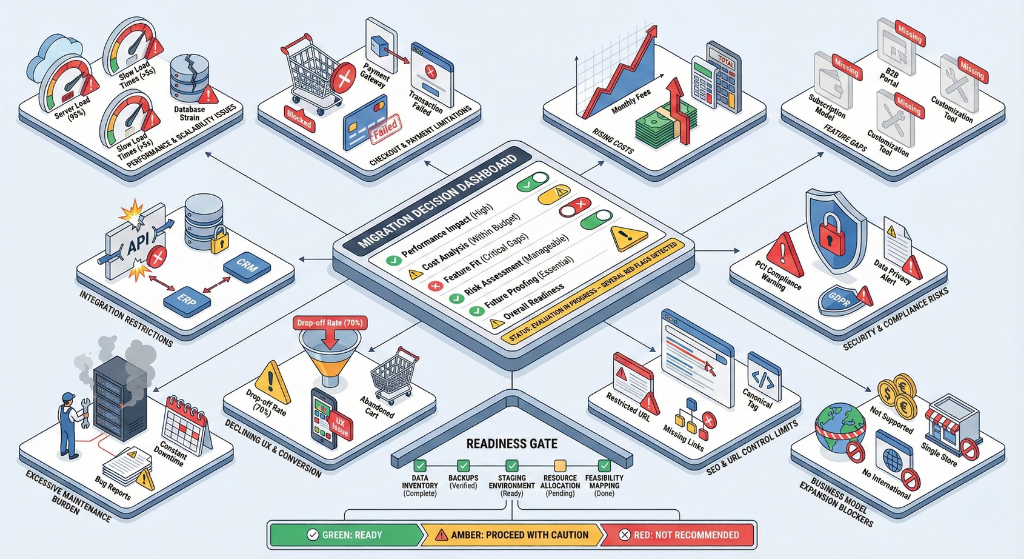
A practical, decision-focused guide for merchants with operational checks you can run immediately.
Migrating an e-commerce platform is expensive and risky. Use the items below as binary decision signals (Yes/No) plus concrete checks. If you hit 3+ “Yes” items and the impact is material to revenue or growth, start formal migration planning.
Sign 1 Repeated Performance & Scalability Failures
Why it matters: Slow pages, timeouts, or instability cost conversions and limit growth.
Operational checks
- Do Core Web Vitals fail for product and category pages under typical load?
- Are peak-traffic events causing timeouts, cart failures, or server errors?
- Is your current host unable/unwilling to scale (no vertical/horizontal options)?
- Is the platform slowing when catalog size, SKUs, or variant counts increase?
Decision trigger: Persistent speed/availability problems that your engineering/host cannot fix within budget.
Sign 2 Checkout, Payments or Tax/Shipping Logic You Cannot Implement
Why it matters: Checkout is revenue-critical; missing logic breaks revenue and UX.
Operational checks
- Can you implement required payment gateways, split payments, or local payment methods?
- Can you reproduce current shipping tiers, table-rates, rules, and marketplace flows?
- Are tax, VAT, or cross-border rules cumbersome or impossible on the current platform?
- Have attempted workarounds compromised reliability or auditability?
Decision trigger: Essential checkout/payment/shipping rules cannot be implemented natively or via robust integrations.
Sign 3 Total Cost of Ownership (TCO) Is Increasing Unacceptably
Why it matters: Rising platform fees, transaction costs, or required apps can make the current stack uneconomic.
Operational checks
- Are subscription + transaction + app fees growing faster than incremental revenue?
- Do you pay for multiple third-party apps because the platform lacks core features?
- Would migrating lower fixed and variable costs materially improve profit margins?
Decision trigger: Migration ROI breakeven within a reasonable period (12–24 months) after TCO modeling.
Sign 4 Feature Gaps That Block Business Strategy
Why it matters: If the platform prevents product offers, subscription models, personalization, or omnichannel needs, growth stalls.
Operational checks
- Can you support subscriptions, bundles, dynamic pricing, or B2B features required by sales?
- Does the platform limit headless, API access, or custom composable architecture needed for roadmap items?
- Are product data modeling needs (complex variants, custom attributes, digital goods) unsupported?
Decision trigger: Platform prevents essential product/commerce features and no acceptable plugin exists.
Sign 5 Integrations & Data Access Are Restricted
Why it matters: Poor integrations break analytics, automation, fulfillment, and CRM flows.
Operational checks
- Do APIs restrict read/write access to orders, customers, inventory, or webhooks?
- Do critical integrations (ERP, PIM, OMS, CRM, analytics) require fragile workarounds?
- Are you unable to centralize data for marketing, reporting, or personalization?
Decision trigger: Integration limitations cause manual processes, data gaps, or reconciliation errors that materially increase ops cost.
Sign 6 Security, Compliance, or PCI Limitations
Why it matters: Compliance failures risk fines and loss of customer trust.
Operational checks
- Does the platform restrict TLS/PCI patches or force reliance on third-party checkout because of compliance gaps?
- Can you implement required data residency, logging, or audit controls?
- Have security incidents been platform-related with no vendor fix available?
Decision trigger: Platform cannot meet legal/regulatory/compliance needs for target markets.
Sign 7 Maintenance Burden & Technical Debt Is Excessive
Why it matters: High engineering effort on patches, workarounds, and plugin compatibility is a recurring hidden cost.
Operational checks
- Do releases require frequent hotfixes for theme/app incompatibilities?
- Are upgrades frequently breaking custom integrations?
- Does your operations team spend more time maintaining platform quirks than building features?
Decision trigger: >X% of engineering time (set a threshold) spent on maintenance rather than feature work.
Sign 8 Conversion or UX Decline You Can’t Fix In-Platform
Why it matters: If conversion optimization is constrained by platform templating or checkout control, revenue suffers.
Operational checks
- Can you A/B test checkout flows, layout variations, or server-side experiments?
- Are personalization, fast search, faceted navigation, or product merchandising limited?
- Is mobile UX failing and not fixable because of platform theme limitations?
Decision trigger: Proven UX or conversion improvements cannot be implemented without migration.
Sign 9 SEO & URL Control Is Restricted (Traffic Risk)
Why it matters: Platform-generated URL structures, limited canonical control, or poor redirect options can destroy organic traffic during changes.
Operational checks
- Can you create and preserve SEO-friendly URLs, custom canonical tags, and full 301 redirect control?
- Is there constrained control over robots, sitemap generation, or server responses?
- Have you encountered indexing or crawlability issues caused by platform behavior?
Decision trigger: SEO control gaps risk organic traffic; migration required to secure traffic baseline.
Sign 10 Business Model Evolution (Internationalization / Multi-Store / B2B / Marketplaces)
Why it matters: As business models diversify, a platform must support multi-currency, multi-warehouse, multi-storefront or B2B features without hacks.
Operational checks
- Do you need localized storefronts, multi-currency pricing, or separate domain structures?
- Does the platform prevent merchant expansion to marketplaces, POS, or wholesale channels effectively?
- Can the platform scale operations (multiple warehouses, tax jurisdictions) without bolt-ons?
Decision trigger: Strategic expansion is blocked or requires brittle workarounds.
Pre-Migration Readiness: Key Questions to Answer Before You Commit
Use this as a minimal gating checklist stop and remediate if any are missing.
- Have you exported a complete inventory (products + variants + SKUs + images + metadata + redirects + blog URLs + media)?
- Do you have a full backup (database + files + media) of the live store?
- Is a staging environment prepared for a full test migration?
- Have you created a project plan with milestones, owners, rollback plan, and budget?
- Do you have the technical resources (devs, QA, SEO, integrations) allocated?
- Have you assessed hosting and infrastructure needs for the target platform?
- Have you run a migration feasibility map identifying feature parity and gaps?
Minimum Migration Data & QA Checklist (post-migration tests you must pass)
- Data integrity: all products, SKUs, variants, prices, stock levels, images, and metadata verified.
- Customers & orders: customer accounts and order history migrated or archived; login flows validated (password reset plan if needed).
- Checkout & payments: end-to-end checkout, tax, shipping, and payment gateway tests pass in staging.
- Redirects & SEO: URL mapping completed; 100% of authority pages have 301s; sitemap submitted; 404s monitored.
- Performance: Core Web Vitals, mobile load times, and site stability meet or exceed previous baseline.
- Integrations: CRM, ERP, analytics, email, PIM, and fulfillment integrations tested and reconciled.
- Security & compliance: SSL, PCI, logging, and necessary compliance features validated.
- Monitoring: analytics, Search Console, error alerts, and business KPIs monitoring in place for 30–90 days.
Risk Awareness & Tradeoffs (what you must accept up front)
- Migrations often cause temporary ranking/traffic drops; plan for 30–90 days of active monitoring and remediation.
- Some platform features may have no exact equivalent expect development or process changes.
- Migration requires ongoing operational discipline: backups, patching, monitoring, and longer maintenance cycles on self-hosted setups.
- Resource requirement: migrations typically take more time and budget than naive estimates; plan contingency.
Quick Decision Framework (practical)
- Green: 0–2 signs → do not migrate now; fixable by host, plugins, or optimizations.
- Amber: 3–4 signs → commission a feasibility study & ROI model; prepare a staged migration plan.
- Red: 5+ signs OR single catastrophic sign (e.g., compliance failure) → schedule migration with priority, secure fallback plan.