
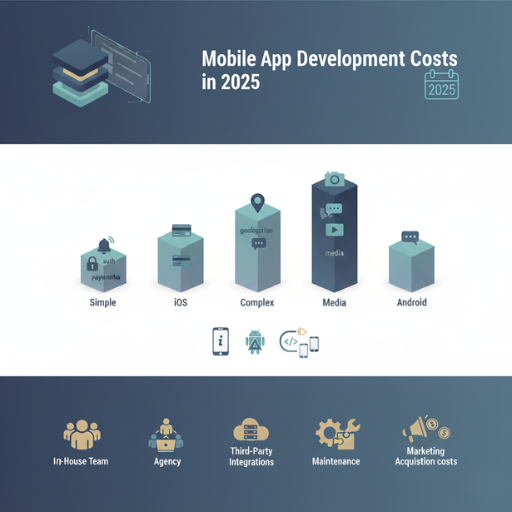
Few questions in digital business provoke more anxiety than “How much will my mobile app cost?” The answers you’ll find online range from $10,000 to over $500,000, which isn’t particularly helpful when you’re trying to budget for your project. This massive variation isn’t due to agencies being deliberately vague it reflects the genuine complexity and range of possibilities in mobile app development.
Think of asking “How much does a mobile app cost?” like asking “How much does a house cost?” The answer depends on size, location, materials, features, and dozens of other factors. A studio apartment in a small town costs vastly different from a four-bedroom house in a major city, yet both serve the fundamental purpose of shelter. Similarly, a simple utility app costs dramatically less than a sophisticated platform with complex features, yet both are mobile applications.
After developing mobile applications for over a decade and working with businesses across industries from startups to established enterprises, we’ve developed a clear framework for understanding app development costs. This guide breaks down exactly what influences mobile app pricing, what you should expect to invest at different complexity levels, and how to make informed decisions that balance budget constraints with business objectives.
Understanding the Cost Factors: What Makes Apps Expensive
Before looking at specific price ranges, it’s essential to understand what drives mobile app development costs. Unlike purchasing a physical product where materials and manufacturing largely determine price, app development costs primarily reflect the time and expertise required to build your vision.
Design complexity significantly impacts cost. A simple, utilitarian interface using standard components costs far less than a custom-designed experience with unique animations, transitions, and visual elements. Every pixel that deviates from platform standards requires additional design time, review cycles, and implementation effort. Apps competing on user experience rather than functionality alone require substantial design investment.
Feature complexity represents perhaps the largest cost variable. A basic app displaying information or performing simple calculations requires relatively straightforward development. Adding user accounts, social features, real-time notifications, payment processing, or integration with other services exponentially increases complexity. Each feature requires not just implementation but also testing, error handling, and maintenance considerations.
Platform choice affects both initial and ongoing costs. Building for iOS only, Android only, or both platforms simultaneously requires different approaches and investments. We’ll explore platform decisions in detail later, but understanding that each platform represents a separate development effort helps explain why cross-platform apps cost more initially.
Backend infrastructure requirements vary dramatically between apps. Some apps function entirely on the device without needing server connections. Others require robust backend systems to handle user data, process transactions, manage content, or facilitate communication between users. Building, hosting, and maintaining backend infrastructure represents ongoing costs beyond the initial app development.
Third-party integrations add complexity whenever your app needs to interact with external services. Integrating payment processing, social media login, mapping services, analytics platforms, or industry-specific APIs requires development time, testing, and often ongoing maintenance as those external services evolve.
Security and compliance considerations increase costs for apps handling sensitive information. Healthcare apps requiring HIPAA compliance, financial apps needing robust security measures, or apps processing payments and personal data all require additional development effort to ensure data protection and regulatory compliance.
Team experience and location dramatically affect hourly rates and project efficiency. A senior developer in San Francisco commands different rates than a mid-level developer in Eastern Europe, yet both can produce quality work. However, experience also affects efficiency senior developers often complete tasks faster and with fewer issues, potentially offsetting higher hourly rates.
Understanding these factors helps you see app development not as a fixed-price commodity but as a custom service where your specific requirements directly influence investment needed.
App Complexity Tiers: From Simple to Enterprise
Mobile apps generally fall into complexity tiers that help estimate costs. These aren’t rigid categories but useful frameworks for understanding where your project fits.
Simple Apps: $10,000 to $40,000
Simple apps serve focused purposes with straightforward functionality. These typically include basic information display apps, simple calculators or tools, content viewers, or basic utility apps without backend requirements.
A simple app might be a restaurant app displaying menu items, location information, and contact details. It could be a utility that performs calculations or conversions. Perhaps it’s an informational app for a conference or event displaying schedules and speaker information.
These apps typically use standard platform components, require minimal custom design, work primarily offline or with simple data syncing, and don’t require complex user accounts or security features. Development timelines run 2-4 months with small teams, often just one developer and one designer working part-time on the project.
However, even simple apps require proper planning, design, development, testing, and deployment. Cutting corners on quality creates problematic apps that frustrate users and damage your brand. Quality simple apps still require professional development, just less of it.
Medium Complexity Apps: $40,000 to $150,000
Medium complexity apps incorporate multiple features, custom designs, backend connectivity, and more sophisticated functionality. This category includes most business apps, e-commerce applications, social networking apps with moderate features, and service-based platforms.
These apps typically require user authentication and accounts, integration with payment processing or third-party services, custom UI/UX design reflecting brand identity, backend server infrastructure for data management, push notifications and real-time updates, and often social features like sharing or commenting.
An example might be a fitness app where users create accounts, track workouts, connect with friends, receive personalized recommendations, and purchase training programs. Or an e-commerce app where customers browse products, manage shopping carts, process payments securely, track orders, and receive notifications about promotions.
Development timelines extend to 4-9 months with teams including iOS and Android developers, backend developers, UI/UX designers, project managers, and quality assurance specialists. The investment reflects not just more features but increased testing requirements, security considerations, and infrastructure costs.
Many businesses launching mobile apps fall into this category. The investment represents a significant commitment but remains accessible for established businesses or well-funded startups. Our mobile app development services help businesses in this range maximize value while managing budgets effectively.
Complex Apps: $150,000 to $500,000+
Complex apps represent sophisticated platforms with extensive features, high security requirements, scalable infrastructure, and enterprise-grade reliability. These include comprehensive marketplace platforms, advanced healthcare applications, financial services apps, real-time communication platforms, and applications with artificial intelligence or machine learning components.
Complex apps require extensive custom development, sophisticated backend architecture handling high user volumes, advanced security and compliance features, real-time data synchronization, complex business logic, third-party integrations with multiple services, and usually significant ongoing maintenance and updates.
Examples include ride-sharing platforms managing real-time driver-passenger matching, payment processing, mapping, and communication. Healthcare platforms handling patient records, appointment scheduling, telemedicine, and HIPAA compliance. Financial applications processing transactions, managing investments, ensuring security, and meeting regulatory requirements.
Development timelines often exceed 9-12 months with substantial teams including multiple developers per platform, specialized backend engineers, security specialists, DevOps engineers, product managers, designers, and dedicated QA teams. The investment reflects not just features but the infrastructure, security, testing, and reliability required for applications where failure creates significant consequences.
These projects typically suit established companies, well-funded startups with significant venture backing, or enterprises requiring mobile extensions of complex systems. The cost isn’t just about building an app it’s about building a reliable, scalable platform that can support business-critical operations.
Platform Decisions: iOS, Android, or Both?
One of your first decisions impacts costs significantly: which platforms to support.
iOS development targets iPhones and iPads using Swift or Objective-C programming languages and Apple’s development tools. iOS users tend to spend more money through apps, making them attractive for revenue-focused applications. The iOS ecosystem is more uniform with fewer device variations, somewhat simplifying development and testing. However, Apple’s App Store has strict review guidelines, potentially delaying launches if your app doesn’t meet requirements.
Development costs for iOS alone typically represent 50-60% of what you’d spend building for both platforms. If your target audience primarily uses iPhones, or if you’re validating an app concept before full investment, starting with iOS makes sense. Our iPhone app development services help businesses create polished iOS applications that take full advantage of Apple’s ecosystem.
Android development targets the massive global Android user base using Kotlin or Java and Google’s development environment. Android dominates global market share, particularly in developing markets. The platform offers more flexibility in app functionality and design but presents challenges with device fragmentation thousands of different Android devices with varying screen sizes, capabilities, and OS versions require extensive testing.
Android development costs roughly similar to iOS for comparable features, though testing complexity sometimes increases costs slightly due to device variety. If your audience is global, Android-first or Android-exclusive strategies might make sense despite iOS’s higher revenue per user.
Cross-platform development builds one codebase deployable to both iOS and Android, using frameworks like React Native, Flutter, or Xamarin. This approach potentially saves 30-40% compared to building native apps for both platforms separately. The shared codebase means features, bug fixes, and updates apply to both platforms simultaneously, reducing ongoing maintenance costs.
However, cross-platform approaches have tradeoffs. Performance sometimes lags behind native apps, particularly for graphics-intensive applications or those requiring complex animations. Platform-specific features may be harder to implement. Apps might feel slightly less natural on each platform since the same interface serves both.
For many businesses, cross-platform development represents the optimal balance delivering on both major platforms with reasonable budget efficiency. Apps not requiring cutting-edge performance or extensive platform-specific features work excellently with cross-platform approaches.
The decision depends on your audience, budget, timeline, and technical requirements. A luxury brand targeting affluent US customers might prioritize iOS. A utility serving global users might choose Android first. A business wanting maximum reach with reasonable budget might select cross-platform development.
Development Approach: In-House, Agency, or Freelancers
How you execute development dramatically affects costs, timelines, and outcomes.
In-house development means hiring employees to build your app. This provides maximum control, direct communication, and ongoing development capacity. However, costs are substantial. A senior iOS developer in a major US city might command $120,000 to $180,000 annually plus benefits. You’ll need designers, backend developers, and potentially project managers. Building a capable in-house team easily costs $500,000+ annually before accounting for overhead, equipment, and management.
In-house development makes sense for companies where mobile apps are central to business operations and ongoing development is constant. If you’re building an app once and maintaining it occasionally, the fixed costs of full-time employees are hard to justify.
Development agencies like CGColors specialize in building apps for clients. Agencies bring experienced teams, established processes, and the ability to scale resources to your project. You access senior talent without long-term employment commitments. Agencies handle project management, ensure quality, and typically provide ongoing maintenance options.
Agency rates vary significantly by location and expertise. US-based agencies might charge $100-250 per hour. Eastern European agencies often charge $50-100 per hour. Offshore agencies in Asia might charge $25-50 per hour. However, hourly rates don’t tell the full story experienced agencies often complete work faster and with higher quality, potentially providing better value despite higher rates.
Working with a professional app development agency typically provides the best balance of expertise, cost, and flexibility for businesses building their first mobile application or lacking internal technical expertise.
Freelancers represent the most budget-friendly option, with rates ranging from $25 to $150+ per hour depending on experience and location. Highly skilled freelancers can deliver excellent work at favorable rates. However, freelancers are individuals if your developer becomes unavailable, progress stops. Managing multiple freelancers (designer, iOS developer, Android developer, backend developer) requires significant coordination effort on your part.
Freelancers work well for very simple apps, specific features, or when you have technical expertise to manage the project. For more complex applications, the risk of coordination issues, timeline delays, or quality inconsistencies increases substantially.
Hidden Costs: Beyond Initial Development
Many businesses focus exclusively on development costs, overlooking significant ongoing expenses that affect total investment.
App Store fees are relatively modest but worth noting. Apple charges $99 annually for iOS Developer Program membership, required to publish apps. Google charges a one-time $25 fee for a Google Play Developer account. These are minimal compared to other costs but necessary for deployment.
Backend hosting and infrastructure costs vary based on your app’s requirements. Simple apps using basic cloud services might cost $20-50 monthly. Apps with substantial user bases, data processing, or storage requirements can easily reach $500-5,000+ monthly in infrastructure costs. These costs scale with success more users mean higher costs but also (hopefully) more revenue.
Third-party service fees apply when integrating external services. Payment processing fees typically run 2.9% plus 30 cents per transaction. Analytics platforms, mapping services, push notification services, and other tools often have monthly fees based on usage. An app using multiple services might spend $100-1,000+ monthly on third-party platforms.
Maintenance and updates represent ongoing costs often underestimated by businesses. Operating systems update annually with major releases and several times yearly with minor updates. Your app requires testing and potential updates to maintain compatibility. Fixing bugs, responding to user feedback, and addressing security issues requires ongoing development work.
Budget approximately 15-20% of initial development costs annually for maintenance. A $100,000 app might require $15,000-20,000 yearly for proper maintenance. Neglecting maintenance leads to apps that break, receive poor reviews, and eventually become unusable.
Feature enhancements arise as you learn from users and markets evolve. Few businesses launch an app and never update it. Adding features, improving user experience, and responding to competition requires ongoing development investment. Many successful apps invest as much or more in post-launch development over time as they spent on initial creation.
Marketing and user acquisition arguably represent the largest often-overlooked cost. Building an excellent app means nothing if nobody downloads it. App Store Optimization (ASO) helps with organic discovery but usually isn’t sufficient alone. Paid user acquisition through ads, influencer partnerships, or other marketing channels can easily cost $2-10+ per install depending on your category.
Some businesses spend as much on marketing in the first year as they spent on development. A $50,000 app might require another $50,000 in marketing to achieve meaningful adoption. This doesn’t mean marketing is wasted it’s essential investment for success. But it must be budgeted alongside development costs.
Cost Breakdown by Feature: Understanding What Drives Price
Looking at specific features helps understand what makes apps expensive or affordable.
User authentication and accounts (adding user login, registration, password recovery) typically costs $3,000-8,000. This seems expensive for something every app has, but it requires secure implementation, email verification systems, password encryption, account management interfaces, and often social login integration. Cutting corners on authentication creates security vulnerabilities.
Payment processing integration (allowing users to purchase through your app) runs $5,000-15,000. This includes integrating payment gateways like Stripe or PayPal, implementing secure payment flows, handling various payment methods, managing subscriptions if applicable, and ensuring PCI compliance. Payment features require extensive testing since errors here directly impact revenue and customer trust.
Push notifications (sending messages to users’ devices) cost $2,000-5,000 to implement properly. This requires backend infrastructure to manage notifications, user preference management, targeting and scheduling capabilities, and integration with iOS and Android notification systems. Notifications seem simple but involve coordinating between your backend, Apple’s and Google’s notification services, and user devices.
Social features (sharing, commenting, following, feeds) range dramatically from $5,000 for basic sharing to $50,000+ for comprehensive social platforms. Implementing feeds that update in real-time, managing relationships between users, moderating content, and handling the backend infrastructure for social features represents significant complexity.
Real-time chat or messaging costs $10,000-30,000 for basic implementation, more for sophisticated features. Real-time communication requires websocket connections, message storage and retrieval, handling multimedia messages, managing conversations, and ensuring messages deliver reliably even with poor connectivity.
Geolocation and mapping (showing user location, nearby items, directions) runs $3,000-10,000. Integrating Google Maps or Apple Maps, handling location permissions, implementing location-based features, and managing location updates requires careful implementation to balance functionality with battery life.
Media handling (photo upload, video playback, image processing) costs $5,000-20,000 depending on requirements. Capturing or selecting media, uploading to servers, processing images, implementing galleries, and handling various media formats takes substantial development effort.
Offline functionality (allowing app use without internet) adds $5,000-15,000. Implementing data synchronization, caching strategies, conflict resolution when syncing, and managing local storage substantially increases complexity compared to online-only apps.
Analytics and reporting (tracking user behavior, generating insights) runs $3,000-10,000. Integrating analytics platforms, implementing custom tracking, creating admin dashboards, and generating reports requires both frontend and backend development.
These estimates assume professional implementation with proper testing. Dramatically lower costs usually indicate shortcuts that create problems later.
Timeline Impacts on Cost: Fast vs. Right
Development timeline significantly affects both cost and quality. Understanding these relationships helps set realistic expectations.
Normal development pace for a medium-complexity app spans 4-9 months. This allows for proper planning, design iterations, methodical development, comprehensive testing, and addressing issues discovered during testing. Teams work efficiently without overtime, produce quality code, and create maintainable applications.
Rushed development compressing timelines by 30-50% increases costs by 50-100% or more. Achieving faster delivery requires larger teams, overtime hours, parallel development streams, and accepting increased risk. Code quality often suffers under rushed timelines, creating technical debt that costs more to fix later than doing it right initially.
Businesses sometimes need rushed development for legitimate reasons market opportunities, competitive pressure, or event deadlines. Just understand that speed comes at premium cost and often quality compromise.
Extended development with longer timelines doesn’t proportionally reduce costs. Development efficiency decreases with very slow projects. Team members split attention across multiple projects. Context-switching reduces productivity. Extended projects sometimes cost more than normal-paced development despite taking longer.
The optimal approach balances timeline, budget, and quality. Reasonable timelines produce the best outcomes at the most favorable costs. Our development services focus on efficient processes that deliver quality results within realistic timeframes.
Reducing Costs Without Sacrificing Quality
Most businesses want excellent apps at reasonable costs. Several strategies reduce investment without compromising outcomes.
Start with MVP (Minimum Viable Product) approach. Launch with core features that deliver primary value, validate market demand, and gather user feedback. Add additional features in subsequent releases based on what users actually want rather than assumptions. This spreads investment over time and reduces risk of building features nobody uses.
Many successful apps launched with surprisingly limited initial features. Instagram started as a simple photo-sharing app. Twitter was just 140-character messages. These apps added features over time based on user needs and company resources.
Choose one platform initially. Building for iOS or Android first rather than both simultaneously cuts initial costs nearly in half. Validate your app concept, prove business model, and generate revenue before investing in the second platform. Many successful apps started iOS-only or Android-only before expanding.
Use cross-platform development for simultaneous iOS and Android presence at lower cost than separate native apps. For many applications, cross-platform frameworks deliver excellent results at significant savings.
Leverage existing backend services rather than building everything custom. Firebase, AWS Amplify, and similar platforms provide authentication, databases, file storage, and other backend functionality at low cost for moderate usage. These services cost money as you scale but dramatically reduce initial development investment.
Prioritize ruthlessly. Every feature adds cost. For each feature, ask: “Is this essential for launch, or can it be added later?” Cutting non-essential features reduces development time and cost significantly.
Invest in proper planning and design before development begins. This seems counterintuitive for cost reduction, but thorough planning prevents expensive changes during development. An extra month of planning might save three months of development rework.
Work with experienced teams even if hourly rates are higher. Senior developers complete work faster with fewer errors than junior developers. An experienced team charging $150/hour might deliver better value than a cheaper team at $50/hour if they work three times faster with higher quality.
Regional Cost Variations: Location Matters
Development costs vary dramatically based on where your team is located.
North America (US and Canada) typically sees highest rates. Experienced agencies charge $100-250+ per hour. Major tech hubs like San Francisco, New York, and Seattle command top rates. Secondary cities offer somewhat lower costs while maintaining high quality. North American teams provide excellent communication, reliable project management, and strong technical skills.
Western Europe (UK, Germany, France) offers similar rates to North America, typically $100-200 per hour for quality agencies. Cultural and time zone alignment with US businesses is strong, making collaboration smooth.
Eastern Europe (Ukraine, Poland, Romania) provides excellent value with strong technical skills at $50-100 per hour. Many US companies successfully work with Eastern European teams. Time zone differences are manageable, and English proficiency is generally good among developers.
Latin America (Mexico, Argentina, Brazil) offers favorable rates around $40-80 per hour with minimal time zone differences from the US. Cultural alignment and Spanish/Portuguese language capabilities benefit certain projects.
Asia (India, Philippines, Vietnam) provides the lowest rates, often $25-50 per hour. However, communication challenges, time zone differences, and variable quality require careful vendor selection. Many businesses successfully work with Asian developers, but it requires more management oversight.
Lower rates don’t automatically mean lower cost or better value. Communication clarity, project management efficiency, and code quality all affect total investment and outcome quality. A project completed efficiently at $150/hour might cost less than the same project executed poorly at $50/hour with delays, miscommunication, and quality issues requiring rework.
Geographic arbitrage provides genuine savings when done properly. Many successful apps are built by teams in lower-cost regions. The key is finding quality partners with strong communication and proven track records regardless of location.
Ongoing Costs: Year Two and Beyond
Your financial commitment doesn’t end at launch. Understanding ongoing costs helps with long-term planning.
Year one post-launch typically requires 30-50% of initial development costs. This includes fixing bugs discovered by real users, making adjustments based on user feedback, updating for new OS versions, adding modest improvements, and marketing to acquire users. A $100,000 app might need $30,000-50,000 in year one.
Subsequent years often require 15-20% of original development costs annually for maintenance. This covers ongoing hosting and services, OS compatibility updates, security patches, bug fixes, and minor improvements. That $100,000 app needs approximately $15,000-20,000 yearly to stay functional and current.
Major updates or feature additions represent additional investments beyond maintenance. Adding significant new functionality might cost 20-50% of original development costs depending on complexity. Some apps essentially rebuild every 2-3 years to stay current with design trends and technology evolution.
Scaling costs increase as your user base grows. Hosting and infrastructure costs rise with usage. Customer support requirements grow. Payment processing fees scale with transaction volume. These are good problems they indicate success but must be budgeted.
Many businesses fund ongoing development from app revenue, creating sustainable investment cycles. Initial investment gets the app to market, early revenue funds improvements, and growth generates funds for expansion. This approach requires patience but creates sustainable app businesses.
Making Your Investment Decision
Understanding costs helps, but how do you decide what to invest?
Align investment with business goals. What do you need this app to accomplish? A marketing tool positioning your brand might warrant modest investment. A revenue-generating platform central to business strategy justifies substantial investment. An internal tool improving efficiency should be measured against labor savings.
Consider your funding situation. Bootstrap startups need different approaches than venture-funded companies. Revenue-generating businesses can self-fund development from profits. Investment should match your financial reality and risk tolerance.
Evaluate expected returns. Will this app generate direct revenue through purchases, subscriptions, or advertising? Will it reduce costs through operational efficiency? Will it enable new business models? Understanding expected returns helps determine appropriate investment levels.
Plan for iterations. Few apps are perfect at launch. Budget for ongoing development, not just initial creation. Apps that succeed typically evolve significantly in their first year based on user feedback and market learning.
Compare alternatives. Sometimes alternatives to custom app development make sense. Could a mobile-optimized website serve your needs? Could an existing platform (Shopify mobile app, WordPress with a mobile plugin) provide sufficient functionality? Custom apps deliver optimal experiences but aren’t always necessary.
Get professional consultation. Reputable development agencies provide free consultation to discuss your ideas, assess feasibility, and provide rough estimates. These conversations help clarify your thinking and understand realistic costs without commitment. Our team offers free consultations to help businesses understand their options.
Real Examples: What Apps Cost
Looking at real examples helps ground expectations.
A restaurant ordering app with menu display, cart functionality, payment processing, and order tracking typically costs $30,000-60,000. This is medium complexity with established patterns and available payment integrations.
A fitness tracking app with user accounts, workout logging, progress charts, social features, and premium subscription content runs $60,000-120,000. The combination of data management, visualizations, social features, and payment systems drives costs.
A ride-sharing platform similar to Uber with real-time matching, mapping, payment processing, driver and rider apps, and backend infrastructure easily exceeds $200,000-400,000. The complexity of real-time coordination, two-sided marketplace, and reliability requirements creates substantial development scope.
A meditation app with audio content, user progress tracking, simple subscription, and basic features might cost $40,000-80,000. Content delivery and playback, progress tracking, and subscription management represent primary development areas.
A marketplace app connecting service providers with customers, including profiles, booking, payments, ratings, and messaging typically requires $100,000-250,000. Two-sided marketplaces involve complex business logic, matching algorithms, and sophisticated user experiences.
These examples show how features, complexity, and requirements directly translate to investment levels. Your specific app’s cost depends on your exact requirements, but these examples provide reference points for planning.
The Decision Framework: Determining Your Budget
Rather than asking “How much does an app cost?” ask: “What can I afford to invest, and what can I build with that budget?”
Under $25,000: Consider simpler approaches like mobile-optimized websites, no-code app builders, or very basic utility apps. Custom development at this budget requires severe scope limitation.
$25,000-50,000: Build basic apps with focused functionality. MVP approach with single platform, limited features, and simple design fits this budget. Good starting point for testing concepts.
$50,000-100,000: Develop medium-complexity apps with custom designs, backend systems, and moderate features. Most business apps fit this range when properly scoped.
$100,000-250,000: Create sophisticated apps with extensive features, both platforms, custom designs, and quality user experiences. Most successful commercial apps require investment in this range.
$250,000+: Build complex platforms, multi-sided marketplaces, or apps requiring specialized technology, extensive features, and enterprise-grade infrastructure.
These are guidelines, not rigid rules. Creativity, strategic decisions, and efficient development stretch budgets further than you might expect.
Moving Forward: From Idea to Reality
Understanding costs is just one piece of successful app development. Here’s how to move forward effectively.
Define clear objectives. What problem does your app solve? Who is your target user? What do you want to accomplish? Clear answers guide every subsequent decision.
Research your market. Who are your competitors? What are users saying in reviews? What gaps exist in current solutions? Market understanding informs features and positioning.
Create detailed requirements. Document what your app should do. Outline user flows, features, and functionality. Detailed requirements enable accurate estimates and prevent costly changes during development.
Engage development partners early. Talk with developers before finalizing plans. Their technical insights often identify better approaches, potential issues, or cost-saving opportunities you wouldn’t recognize alone.
Plan realistically. Factor in timelines for design, development, testing, and app store approval. Budget for ongoing costs beyond initial development. Set realistic expectations for launch and growth.
Prioritize ruthlessly. Identify absolute must-haves versus nice-to-haves. Build core value first, add enhancements later. Every feature adds cost choose deliberately.
Whether you need iOS app development, Android applications, or strategic guidance on mobile strategy, working with experienced developers who understand both technology and business helps translate ideas into successful applications.
Mobile apps represent significant investments, but they also represent tremendous opportunities. Apps have launched companies, transformed industries, and created billions in value. With proper planning, realistic budgets, and quality execution, your app can deliver substantial returns on investment.
The mobile landscape continues evolving. Technologies emerge, user expectations rise, and opportunities expand. Apps that seemed impossible five years ago are commonplace today. What you can build in 2025 surpasses what was feasible just a few years ago, often at lower costs than previous generations of mobile development.
Your app idea has potential. Understanding development costs helps transform that potential into reality through informed decisions, realistic planning, and strategic investment. The businesses succeeding with mobile apps aren’t necessarily those with the biggest budgets they’re the ones making smart decisions about where to invest, what to build, and how to execute.
Ready to discuss your mobile app project? Our team provides free consultations to help you understand what’s possible within your budget and timeline. Contact us to start the conversation and transform your app idea into reality.