
Enterprise e-commerce operates at a completely different scale than small business online stores. You’re managing thousands or tens of thousands of products, processing hundreds or thousands of orders daily, coordinating multiple warehouses, serving international markets with different currencies and tax regulations, and integrating complex backend systems. The platform you choose must handle this complexity while remaining reliable, secure, and performant.
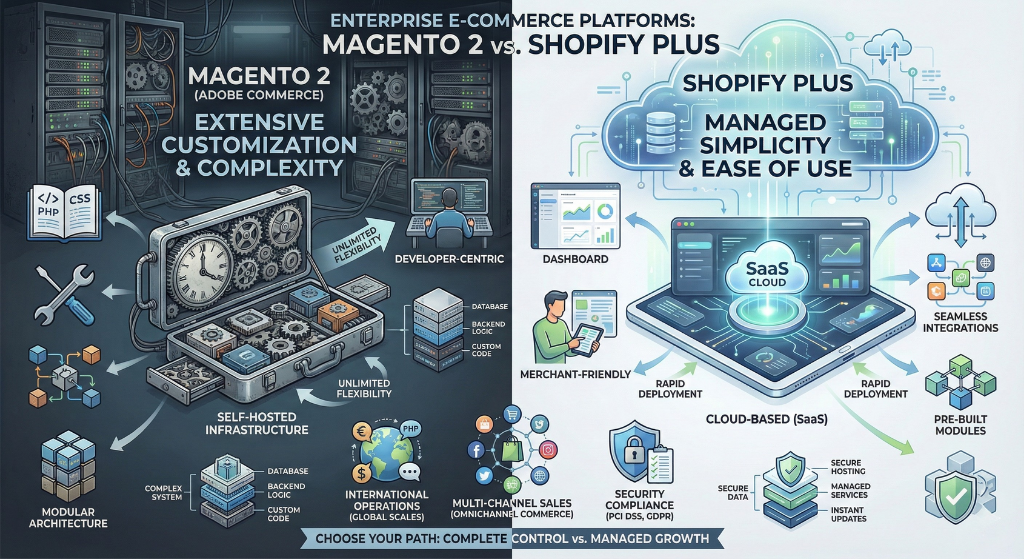
Two platforms consistently emerge as top contenders for enterprise e-commerce: Magento 2 (now Adobe Commerce) and Shopify Plus. Both power major brands generating millions in annual revenue, yet they approach enterprise e-commerce from fundamentally different philosophies. Magento offers unlimited customization and complete control at the cost of complexity and resource requirements. Shopify Plus provides managed simplicity and reliability within a structured ecosystem.
The choice between these platforms shapes your e-commerce operations for years. Migration between platforms at enterprise scale involves enormous cost, risk, and disruption. Getting the decision right the first time matters tremendously.
After building and supporting enterprise e-commerce operations on both platforms, we’ve developed clear understanding of where each excels, where each struggles, and which businesses are best served by each approach. This comparison cuts through marketing claims to provide practical insights based on real-world enterprise e-commerce implementation.
Understanding Enterprise E-commerce Requirements
Before comparing platforms, it’s worth defining what distinguishes enterprise e-commerce from smaller operations. Enterprise businesses face challenges that don’t exist for smaller stores.
Scale and performance requirements differ dramatically. Handling hundreds of simultaneous users, processing thousands of products, managing millions of SKU variations, and maintaining fast performance under high load requires robust architecture. Your platform must scale without degrading performance as traffic and catalog size grow.
Integration complexity increases at enterprise level. Your e-commerce platform must integrate with ERP systems, warehouse management systems, CRM platforms, marketing automation tools, payment processors, shipping carriers, and potentially dozens of other systems. These integrations must be reliable, real-time when necessary, and maintainable as systems evolve.
Multi-channel operations are standard for enterprises. You’re selling through your website, mobile apps, marketplaces like Amazon and eBay, social media platforms, physical retail locations, and potentially international sites. Your platform must manage inventory, pricing, and order data across all these channels coherently.
International operations introduce currency management, multi-language support, region-specific pricing and tax rules, localized payment methods, and compliance with various international regulations. Your platform needs native capabilities or robust solutions for managing geographic complexity.
Advanced business logic requirements include complex pricing rules (volume discounts, customer-specific pricing, promotional rules), sophisticated product configurations, quote-based sales processes, B2B functionality alongside B2C, and custom workflows matching your specific business processes.
Security and compliance obligations increase with scale. PCI DSS compliance for payment processing, GDPR for European customers, CCPA for California residents, and industry-specific regulations all require platform capabilities supporting compliance.
Team collaboration at scale means multiple team members managing different aspects: merchandising teams updating products, marketing teams creating campaigns, customer service accessing order data, and developers implementing customizations. Your platform must support role-based access and efficient collaboration.
Understanding these requirements helps evaluate whether platforms meet enterprise needs and where trade-offs exist between different approaches.
Magento 2 Overview: Power and Complexity
Magento 2 represents the most powerful and flexible e-commerce platform available. Built specifically for complex, large-scale operations, it provides enterprise-grade features and virtually unlimited customization potential.
Architecture and capabilities are designed for sophisticated operations. Magento handles massive product catalogs, complex product configurations, multiple stores and websites from one installation, advanced inventory management across locations, and sophisticated pricing rules. The platform was built assuming complex requirements and enterprise scale.
The open-source Magento Open Source version is free to download, while Adobe Commerce (the enterprise version) includes additional features, support, and services with licensing starting around $22,000 annually for mid-market businesses and scaling up for larger enterprises.
Customization potential is Magento’s defining characteristic. Because it’s built on modular architecture, virtually any aspect can be customized or extended. Need unique checkout workflows? Custom product types? Specialized B2B functionality? Integration with proprietary systems? Magento can accommodate all of this through custom development.
This flexibility comes with complexity. Magento requires substantial technical expertise to implement and maintain. The platform assumes you have development resources either in-house or through agency partnerships to configure, customize, and optimize your installation.
Performance at scale is strong when properly implemented. Magento can handle enormous catalogs and high transaction volumes. However, achieving this performance requires proper infrastructure, optimization, and ongoing performance management. A poorly configured Magento installation performs badly, while a well-optimized one handles enterprise load excellently.
Community and ecosystem surrounding Magento include thousands of extensions, themes, and development agencies specializing in the platform. This mature ecosystem means solutions exist for most common needs, and finding experienced developers is realistic, though they command premium rates.
Shopify Plus Overview: Managed Enterprise E-commerce
Shopify Plus is Shopify’s enterprise offering, providing additional features, support, and scalability beyond standard Shopify plans while maintaining the platform’s core philosophy of managed simplicity.
Hosted SaaS architecture means Shopify handles all infrastructure, security, updates, and performance optimization. You access your store through Shopify’s interface without managing servers, databases, or technical infrastructure. This managed approach reduces technical overhead substantially.
Pricing starts around $2,000 monthly for Shopify Plus, though costs vary based on sales volume and specific needs. Unlike Magento where infrastructure and development costs dominate, Shopify Plus pricing is straightforward and predictable.
Enterprise features in Shopify Plus include unlimited staff accounts, automation tools through Shopify Flow, wholesale channel for B2B sales, dedicated account management, access to Plus Partner agencies, and enhanced API rate limits. The platform provides substantially more flexibility than standard Shopify while maintaining ease of use.
Customization exists within boundaries. Shopify Plus allows extensive theme customization, access to checkout page customization (unavailable in standard Shopify), custom apps through private app development, and integration with external systems through robust APIs. However, you’re customizing within Shopify’s framework rather than modifying core platform functionality.
Reliability and uptime are exceptional. Shopify maintains industry-leading uptime, handles traffic spikes automatically, and scales infrastructure as needed without merchant involvement. During major sales events like Black Friday, Shopify’s infrastructure handles massive traffic increases seamlessly.
Ecosystem of apps and integrations extends functionality. The Shopify App Store includes thousands of apps, many with Plus-specific features. For requirements not met by existing apps, custom app development or API integrations provide solutions.
The platform works excellently for businesses wanting enterprise e-commerce capabilities without enterprise-level technical complexity. The trade-off is less flexibility than Magento but dramatically reduced technical overhead and faster implementation.
Feature Comparison: Core E-commerce Capabilities
Looking at specific features helps understand practical differences between platforms.
Product management in Magento handles unlimited products with complex configurations, custom attributes, downloadable products, bundled products, configurable products with extensive options, and sophisticated product relationships. The product management flexibility accommodates virtually any catalog complexity.
Shopify Plus manages products well but with more structure. Product variants are limited to three options and 100 variants per product (though workarounds exist). For most businesses this suffices, but extremely complex product catalogs might bump against these limitations.
Inventory management in Magento supports multiple warehouses with sophisticated rules for inventory allocation, backorder management, and multi-location inventory tracking. Enterprise businesses with complex supply chains appreciate this granular control.
Shopify Plus provides solid multi-location inventory management suitable for most enterprises. It’s less sophisticated than Magento’s capabilities but handles typical enterprise inventory scenarios well.
Pricing capabilities differ substantially. Magento excels at complex pricing rules: customer group pricing, volume discounts, promotional rules with extensive conditions, scheduled price changes, and currency-specific pricing. B2B pricing scenarios with negotiated rates, customer-specific catalogs, and quote-based sales work well in Magento.
Shopify Plus handles standard pricing scenarios effectively and supports customer-specific pricing through apps or custom development. However, extremely complex pricing rules requiring extensive business logic might be easier to implement in Magento.
Checkout customization represents a key differentiator. Magento provides complete checkout control, allowing radical customization of the entire checkout process. Shopify Plus allows checkout.liquid customization, providing meaningful flexibility, but you’re working within Shopify’s checkout framework.
For most businesses, Shopify’s checkout performs excellently and benefits from continuous optimization by Shopify’s team. However, businesses requiring unique checkout workflows might prefer Magento’s unlimited flexibility.
Multi-store capabilities are native to Magento. Running multiple stores, websites, or store views for different brands, regions, or languages from one Magento installation is straightforward. Sharing catalogs, customers, or pricing across stores while maintaining separate storefronts works well.
Shopify Plus handles multi-store through Shopify Plus Wholesale channel or by running separate stores. Each store requires separate subscription costs, though data can be synchronized through apps or custom integration. This approach is simpler but potentially more expensive for businesses requiring many stores.
Customization and Flexibility
Customization potential often determines platform choice for enterprises with unique requirements.
Magento’s modular architecture means virtually anything is customizable. Core functionality can be extended or replaced through modules. Custom payment methods, shipping calculators, product types, admin interfaces, or customer experiences all fall within Magento’s customization scope.
This unlimited flexibility serves businesses with unique processes, complex requirements, or competitive differentiation through custom functionality. If your business success depends on e-commerce capabilities that don’t exist in standard platforms, Magento accommodates custom development.
The cost is complexity and ongoing maintenance. Custom code requires testing with Magento updates, maintenance as your business evolves, and documentation so knowledge doesn’t reside solely with individual developers. Businesses must commit to ongoing development resources.
Shopify Plus customization works within the platform’s architecture. Theme customization using Liquid, custom apps using Shopify’s APIs, and integration with external systems all provide substantial flexibility. For many enterprise needs, this flexibility suffices.
However, fundamental changes to how Shopify operates aren’t possible. You can’t radically alter checkout beyond what checkout.liquid customization allows. You can’t change how product variants work fundamentally. You’re optimizing and extending within Shopify’s framework.
This structure has advantages. Updates don’t break your store because you haven’t modified core functionality. Best practices are baked into the platform. Onboarding new team members is easier because they’re learning standard Shopify rather than your unique custom implementation.
The choice depends on whether your business requires capabilities that exceed Shopify’s framework or whether optimization within a structured platform meets your needs. Our e-commerce development services help businesses evaluate which approach fits their requirements.
Integration Capabilities
Enterprise e-commerce never operates in isolation. Integration with existing systems determines whether a platform works within your technology ecosystem.
Magento’s integration capabilities are comprehensive. The platform provides REST and GraphQL APIs for programmatic interaction. The modular architecture allows building custom integrations directly into the platform. For complex, real-time integrations with ERP systems, warehouse management, or proprietary systems, Magento’s flexibility shines.
Integration with Salesforce, SAP, Oracle, Microsoft Dynamics, and other enterprise systems is well-established with numerous agency partners specializing in these connections. The maturity of Magento’s enterprise ecosystem means integration patterns and best practices exist for most scenarios.
Shopify Plus APIs are well-documented and robust. The platform provides REST, GraphQL, and Admin APIs enabling integration with external systems. Webhooks notify external systems of events in real-time. For most standard integrations CRM, email marketing, analytics, inventory systems solutions exist or are straightforward to build.
However, some complex, real-time integrations might be more challenging in Shopify’s architecture. If your business requires tight coupling between e-commerce and proprietary systems with complex, real-time data synchronization, Magento’s architecture might accommodate this more naturally.
Most enterprise businesses find Shopify Plus’s integration capabilities sufficient. The platform integrates successfully with major enterprise systems, and the focus can remain on business operations rather than technical integration maintenance.
Performance and Scalability
Platform performance affects user experience, conversion rates, and ability to handle traffic during peak periods.
Magento performance depends heavily on implementation quality and infrastructure. A well-configured Magento installation on robust infrastructure performs excellently, handling high traffic and large catalogs efficiently. However, achieving optimal performance requires expertise in Magento optimization, proper hosting configuration, caching strategies, and database optimization.
Poor Magento implementations perform badly. The platform’s flexibility means it’s possible to build slow, inefficient stores if not implemented carefully. Performance optimization is ongoing work requiring attention and expertise.
Scalability in Magento requires planning and investment in infrastructure. As your business grows, you’ll need to upgrade hosting, implement caching layers, optimize databases, and potentially distribute load across multiple servers. This scalability is achievable but requires technical management.
Shopify Plus performance is managed by Shopify. The platform handles traffic spikes automatically, optimizes infrastructure globally, and maintains fast load times without merchant involvement. During Black Friday and Cyber Monday, Shopify’s infrastructure proves its reliability annually, processing enormous transaction volumes without issues.
This managed approach means you’re not optimizing performance or worrying about whether your infrastructure can handle traffic spikes. Shopify’s team handles these concerns, letting you focus on business operations and marketing.
Page speed in Shopify Plus is generally excellent, though the specific theme and apps you use affect performance. Following Shopify’s best practices and limiting excessive app installations maintains strong performance.
Cost Analysis: Total Cost of Ownership
Understanding true costs requires looking beyond platform licensing to total cost of ownership over multiple years.
Magento costs include multiple components. Adobe Commerce licensing starts around $22,000 annually for mid-market and scales based on gross merchandise value. Open-source Magento is free but still requires all other cost components.
Hosting for Magento requires robust infrastructure, typically $500 to several thousand monthly depending on traffic and requirements. Managed Magento hosting from specialized providers costs more but reduces technical burden.
Development and implementation costs for Magento are substantial. Initial implementation typically costs $50,000 to $200,000+ depending on complexity and customization requirements. This reflects the development expertise required to properly configure and customize Magento.
Ongoing maintenance and support require development resources. Budget $30,000 to $100,000+ annually for ongoing development, updates, security patches, optimization, and feature additions. Some of this work can be done in-house if you have developers, but many enterprises maintain agency relationships for Magento expertise.
Extensions and integrations add costs. While many Magento extensions are free, enterprise-grade extensions often cost hundreds to thousands of dollars each.
Shopify Plus costs are more straightforward. Platform subscription starts around $2,000 monthly ($24,000 annually), though high-volume businesses negotiate custom pricing based on sales volume.
Transaction fees apply unless you use Shopify Payments. With Shopify Payments, credit card processing fees range from 2.15% to 2.4% plus 30 cents depending on plan details. If using third-party payment processors, additional 0.15% transaction fees apply.
Apps extend functionality, with most professional apps charging monthly fees. Enterprise stores might spend $500 to $2,000+ monthly on apps depending on requirements.
Implementation costs for Shopify Plus are typically lower than Magento, ranging from $20,000 to $100,000 depending on customization needs and design complexity. The platform’s structure and existing theme ecosystem reduce implementation time.
Ongoing maintenance is minimal because Shopify handles infrastructure and core updates. Ongoing development for new features, optimizations, or seasonal campaigns might cost $20,000 to $50,000 annually, significantly less than typical Magento maintenance.
Cost comparison shows Shopify Plus generally costs less over time for businesses without extreme customization requirements. The managed nature reduces the development and infrastructure costs that dominate Magento’s total ownership cost.
However, for extremely high-volume businesses processing tens of millions annually, Magento’s lack of transaction fees and predictable costs might provide better long-term economics despite higher development costs.
Implementation Timeline
Time to market matters for competitive businesses. Implementation timelines differ substantially between platforms.
Magento implementation typically takes 4-9 months or more for full enterprise launch. This timeline includes discovery and planning, architecture design, custom development, theme development, third-party integrations, data migration, testing, and launch preparation.
The timeline reflects Magento’s complexity and the development required for proper implementation. Attempting to rush Magento implementation typically results in technical debt, performance issues, or missing functionality that requires fixing post-launch.
Shopify Plus implementation typically completes in 2-4 months for most enterprises. The platform’s structure, existing themes, and ecosystem of apps reduce development time substantially. Businesses can launch faster, though highly customized implementations might take longer.
The faster timeline provides competitive advantage, letting you respond to market opportunities or competitive pressures more quickly. For businesses where time to market significantly impacts success, Shopify Plus’s implementation speed is valuable.
Security and Compliance
Enterprise e-commerce handles sensitive customer data and financial transactions, making security critical.
Magento security is your responsibility. The platform itself is secure when properly configured and maintained, but configuration, updates, security patches, and ongoing monitoring fall to your team. Magento releases security patches regularly, and applying them promptly is essential.
PCI DSS compliance requires proper configuration, secure hosting, and following best practices. Many Magento merchants work with specialized hosting providers offering PCI-compliant infrastructure as part of managed Magento hosting.
The advantage is complete control over security implementation. The disadvantage is that security becomes your responsibility and requires expertise and attention.
Shopify Plus security is managed by Shopify. The platform maintains PCI DSS Level 1 compliance, applies security updates automatically, monitors for threats, and handles infrastructure security. This managed security reduces your compliance burden substantially.
You still have responsibilities around access control, password policies, and apps you install, but core platform security is Shopify’s concern, not yours.
For businesses without substantial technical security expertise, Shopify’s managed security approach provides significant peace of mind and reduces compliance complexity.
Support and Resources
When problems arise, access to quality support and resources makes the difference between quick resolution and extended downtime.
Magento support for Adobe Commerce includes direct support from Adobe. Support quality varies but generally provides assistance with platform issues, bugs, and technical questions. Open-source Magento doesn’t include official support.
Most Magento enterprises work with development agencies or have in-house developers who understand the platform. This relationship provides practical day-to-day support for customizations, issues, and enhancements.
The Magento community is extensive, with forums, documentation, and resources addressing most issues. The challenge is finding accurate, current information among outdated content from older Magento versions.
Shopify Plus support includes dedicated account management and priority support access. Plus merchants have direct contact with Shopify’s team for technical issues, platform questions, and guidance.
Support quality is generally excellent, with responsive teams familiar with enterprise needs. However, support covers the platform itself, not custom development or theme customization, which falls to your development partners.
Shopify’s documentation is comprehensive and well-maintained. The platform’s consistency means solutions and best practices shared by the community remain relevant over time.
Making Your Decision: Which Platform Is Right for You?
After examining all factors, which platform best serves your enterprise needs?
Choose Magento 2 if:
- Your business requires extensive customization that exceeds what’s possible within structured platforms
- Complex B2B functionality with quote-based sales, negotiated pricing, and sophisticated approval workflows is central to your business
- You have substantial technical resources, either in-house or through dedicated agency partnerships
- Your product catalog requires capabilities beyond standard e-commerce product types
- Integration with complex, proprietary systems requires tight coupling and custom development
- You operate multiple brands or international stores sharing resources but requiring separate storefronts
- Complete control over every aspect of your e-commerce platform is worth the complexity and cost
Magento excels for businesses where competitive advantage comes from unique e-commerce capabilities and where the investment in technical resources provides return through differentiation and sophisticated operations.
Choose Shopify Plus if:
- You want enterprise e-commerce capabilities without enterprise-level technical complexity
- Fast implementation and time to market provide competitive advantage
- Reliability and uptime during high-traffic periods are paramount
- Predictable costs and managed infrastructure reduce operational burden
- Your team can focus on business operations and marketing rather than platform management
- Your requirements fit within Shopify’s framework, even with significant customization
- You value the ecosystem of apps and integrations available in Shopify’s marketplace
Shopify Plus works excellently for enterprises wanting to focus on growing their business rather than managing technical infrastructure. The platform provides the capabilities most enterprises need within a reliable, managed environment.
Real-World Considerations
Beyond feature comparisons, practical considerations often determine which platform better fits your organization.
Technical team capabilities significantly impact success. If you have strong development resources experienced with PHP and enterprise systems, Magento’s power is accessible. If technical resources are limited or focused on other priorities, Shopify Plus’s managed approach prevents technical constraints from limiting growth.
Organizational complexity affects platform choice. Businesses with many stakeholders, approval processes, and decision-makers might benefit from Shopify Plus’s clearer boundaries and structured approach. Endless customization possibilities in Magento can lead to scope creep and extended implementations.
Growth trajectory matters. Rapidly growing businesses might value Shopify Plus’s ability to scale automatically without technical intervention. Established enterprises with stable systems might prefer Magento’s control and ability to optimize exactly for their needs.
Risk tolerance for technical complexity varies. Conservative organizations might prefer Shopify’s managed approach and proven reliability. Organizations comfortable managing technical complexity and viewing technical control as competitive advantage might prefer Magento.
Neither platform is objectively better. The right choice depends on your specific situation, requirements, resources, and priorities. Many successful enterprises operate on both platforms, with choice determined by specific brand or business unit needs.
Hybrid Approaches and Alternatives
Some enterprises use both platforms for different purposes or explore hybrid approaches.
Multiple brands might run on different platforms. A primary brand on Magento for its complex requirements might launch secondary brands on Shopify Plus for faster time to market and lower maintenance.
Headless commerce architectures separate frontend from backend, using either platform as a backend while building custom frontiers with modern frameworks. This approach provides flexibility but introduces additional complexity.
Other enterprise platforms including BigCommerce Enterprise, Salesforce Commerce Cloud, and others deserve consideration for businesses with specific requirements. No single platform is perfect for every enterprise.
The key is matching platform capabilities and philosophy to your actual needs rather than choosing based on popularity or features you won’t use.
Moving Forward
Platform selection is just the beginning. Success requires proper implementation, ongoing optimization, and focus on business fundamentals regardless of platform.
Start with clear requirements documentation. Understanding exactly what you need helps evaluate whether platforms meet those needs and provides basis for implementation planning.
Engage experienced partners who understand enterprise e-commerce and your chosen platform deeply. Whether developing on Shopify or implementing Magento, expertise matters enormously in enterprise implementations.
Plan for long-term success, not just initial launch. Your platform choice affects operations for years. Consider how the platform will grow with your business and what ongoing resources are required.
Focus on customer experience above technical considerations. The best platform is the one that lets you deliver excellent customer experience while supporting business operations efficiently.
Enterprise e-commerce represents significant investment and strategic importance to your business. Taking time to understand options, evaluate platforms against your specific needs, and make informed decisions provides foundation for long-term success.
Both Magento 2 and Shopify Plus power successful enterprise e-commerce operations. Your choice should reflect your specific requirements, resources, and business priorities rather than attempting to determine which is objectively superior.
Ready to discuss your enterprise e-commerce platform? Our team has extensive experience with both Magento and Shopify Plus implementations. Contact us to discus