
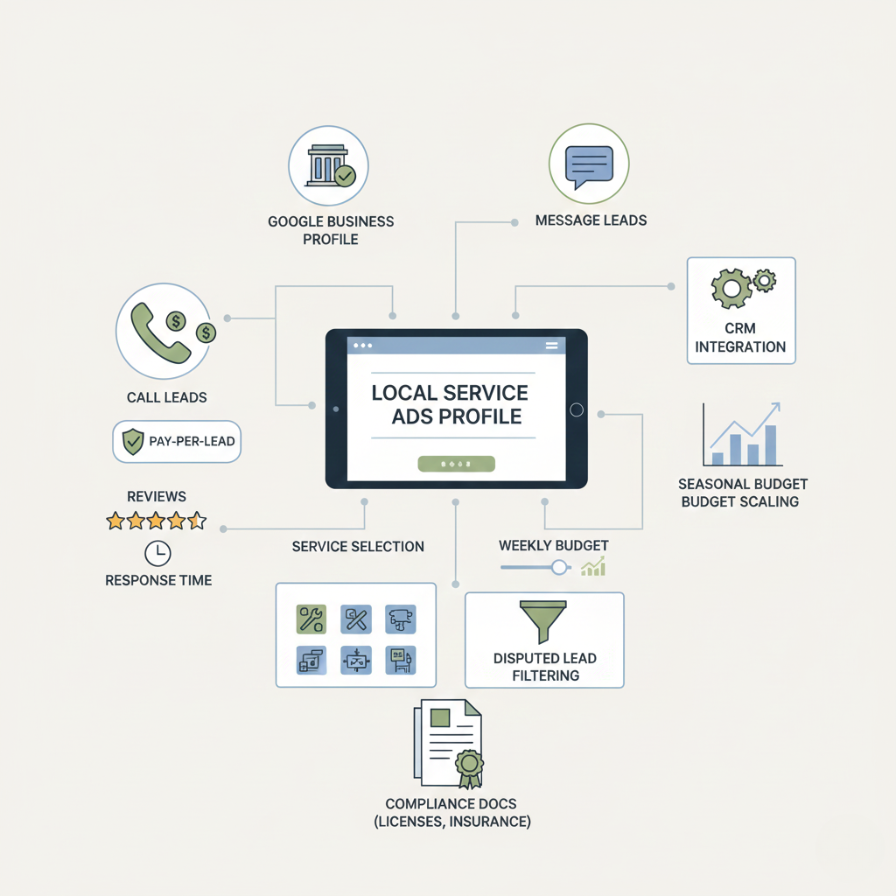
Google Local Service Ads (LSAs) function differently from traditional Google Ads. They operate on a pay-per-lead model, prioritize verified service providers, and require strict business, compliance, and operational readiness.
The following framework outlines every requirement small businesses must evaluate before launching LSAs and scaling lead generation profitably.
1. Business & Goals Alignment
Before enabling Local Service Ads, the business must define its operating model, service eligibility, economics, and lead-handling capabilities.
Business Model & Offer
- Identify the business category supported by Local Service Ads (e.g., HVAC, plumbing, electrical, locksmith, legal, real estate services, cleaning).
- Specify the exact service lines you want to appear for including core, high-margin, and emergency services.
- Define your ideal customer profile: location, urgency level, job type, and service value.
- Determine competitive differentiators such as reviews, response time, licensing, pricing transparency, warranty, or 24/7 availability.
- Document seasonal fluctuations (e.g., HVAC in summer/winter, plumbing in winter, tax services during Q1).
- Evaluate profitability constraints: which leads you can afford, what services generate positive unit economics.
Goals & KPIs
- Establish your primary LSA objective: inbound calls, message leads, bookings, or appointments.
- Set an acceptable cost per lead (CPL) based on job value and close rate.
- Define your maximum customer acquisition cost (CAC) using actual margin thresholds.
- For businesses with recurring revenue, define the lifetime value (LTV) to determine profitable scaling.
- Identify KPIs beyond CPC or CTR (LSAs do not use click metrics): cost per booked job, lead quality, close rate, revenue per lead, and pipeline value.
Resources & Readiness
- Validate that you have a strong offer (fast scheduling, emergency service, upfront pricing).
- Confirm that your landing pages, website, or business profile support the same claims used in LSAs.
- Ensure that your team can answer calls quickly slow response times degrade your LSA ranking.
- Align your CRM and lead management workflows with LSA reporting: missed calls, disputed leads, booked jobs, and revenue attribution.
2. Account Setup & Foundations
Local Service Ads rely on Google Business Profile (GBP), verification standards, and strong operational compliance.
Technical Setup
- Ensure Google Business Profile is fully verified, accurate, and updated.
- Connect GBP, Local Service Ads, and Google Ads (if running both).
- Configure call tracking numbers and ensure consistency across website and GBP.
- Enable message leads and review email/SMS forwarding for rapid response.
- Verify that billing, dispute settings, and notifications are configured correctly.
Account Structure
LSAs do not use keyword campaigns, but structural clarity still matters.
- Categorize services accurately (e.g., “Water Heater Repair,” “AC Installation”).
- Remove services you do not actually provide irrelevant leads reduce ranking.
- Add service areas precisely (city list or ZIP codes).
- Maintain accurate business hours, including emergency/after-hours availability.
- Ensure practitioner profiles (for legal, real estate, etc.) are added when applicable.
Safety & Controls
- Complete the Google LSA background check and license verification.
- Upload required documents (insurance, state licenses).
- Monitor compliance expiration dates to avoid ad suspension.
- Review lead disputes regularly refunds impact spend efficiency.
- Maintain owner and admin access under least-privilege principles.
3. Targeting & Audiences
Local Service Ads rely primarily on geographic relevance, business category, and review signals, not audience lists.
Location Targeting
- Ensure service areas reflect real operational boundaries LSAs rank poorly when targeting overly broad regions.
- Remove cities/ZIPs that historically produce unprofitable or low-quality jobs.
- Confirm that address, service area, and GBP coverage align to avoid ranking conflicts.
Language & Device Targeting
While LSAs do not offer granular targeting settings, performance varies by:
- Call device type (mobile usually dominates).
- Language alignment between GBP, website, and customer base.
Audience Strategy (Google-Driven)
- LSAs automatically use intent signals (e.g., “plumber near me”).
- Higher relevance comes from proximity, review volume, response rate, and job acceptance.
- Exclude non-qualified leads through dispute management.
4. Search Intent & Lead Quality Strategy
There are no keywords in Local Service Ads, but intent still matters.
Service Selection
- Prioritize high-margin, high-intent services.
- Remove services that attract low-quality or low-value leads.
- Add emergency service categories if response times and margins allow.
Negative Intent Management
Since LSAs don’t support negatives, control is achieved through:
- Disputing irrelevant or spam leads.
- Refining service lists.
- Adjusting service area boundaries.
- Monitoring recurring patterns in unqualified calls.
5. Ad Profile & Creative Quality
LSAs rely on your business profile, not traditional ad copy. Optimization focuses on completeness, accuracy, and trust signals.
Ad Relevance
- Ensure all services listed match what users search for.
- Align business description with key value propositions.
- Maintain consistent messaging across GBP, website, and LSA profile.
Creative Quality
- Upload high-quality team photos, service photos, and logo assets.
- Maintain at least 20–50 strong customer reviews with consistent recency.
- Highlight differentiators (warranty, 24/7 availability, financing options).
Extensions / Assets
While LSAs do not use extensions, equivalent assets include:
- Business highlights (e.g., “Locally Owned,” “Bonded & Insured”).
- Review snippets.
- Job types and sub-services.
6. Landing Page Quality & Conversion Optimization
LSAs can send users to either your profile or website. If using website clicks:
UX & Conversion Flow
- Ensure pages load under 2 seconds.
- Place a clickable phone number at the top of every page.
- Keep forms minimal.
- Emphasize trust elements (licenses, badges, testimonials).
- Align CTAs to the service type (book, call, schedule estimate).
Intent Match
- Each service should have its own landing page.
- Messaging must match the LSA profile and GBP listing.
- Avoid generic “home page” routing it reduces conversion rate.
7. Bidding Strategy & Budget Allocation
Local Service Ads use bid settings but operate on a pay-per-lead model.
Bidding Setup
- Set a weekly budget aligned with average lead volume and close rate.
- Use bidding adjustments to increase lead flow for high-value job types.
- Monitor lead volume consistency LSAs can throttle based on quality and responsiveness.
Budget Allocation
- Allocate more budget to profitable services based on close rate.
- Increase budgets during seasonal spikes.
- Reduce budgets for low-value service areas or poor-margin job types.
Scaling
- Scaling LSAs requires:
- High review volume
- Fast response rate
- High lead acceptance rate
- Low dispute rate
- Strong profile completeness
These operational metrics often matter more than budget.
8. Campaign Types & When to Use Them
Local Service Ads operate independently from other Google Ads formats.
Local Service Ads (primary acquisition for local businesses)
Use LSAs when you want:
- Phone leads
- High-intent local traffic
- Pay-per-lead pricing
- Priority placement above search results
When to combine LSAs with Google Ads Search
Add traditional Search campaigns if:
- You need more volume
- You offer niche services not in LSA categories
- Competition reduces LSA visibility
- You want retargeting or brand reinforcement
Performance Max & Display
Use PMax or Display only when:
- LSA + Search coverage is fully optimized
- You have strong tracking and intent controls
- You want full-funnel reach, not just lead volume
9. Lead Quality, Optimization & Ranking Control
Local Service Ads do not use Quality Score. Ranking depends on:
Lead Quality Controls
- Promptly rejecting irrelevant calls
- Filing disputes for bad leads
- Identifying patterns of low-quality leads via call recordings
Ranking Signals
Google uses:
- Review volume and rating
- Proximity to searcher
- Responsiveness
- Hours of operation
- Lead acceptance rate
- Complaint history
- Budget and competitiveness
Improving any of these metrics directly impacts ranking and lead flow.
10. Measurement, Reporting & Troubleshooting
LSA measurement focuses on calls, messages, bookings, and revenue attribution.
Measurement Quality
- Verify that call recordings and durations are tracked.
- Review call classifications (booked vs. not booked).
- Track job value by integrating CRM or manual reporting.
- Deduplicate leads across LSA, GBP, and Search Ads.
Reporting
- Weekly lead type and quality report.
- Pipeline tracking: total leads → qualified → booked → completed → revenue.
- Cost per booked job, not cost per lead, as the primary KPI.
- Revenue attribution aligned with job categories.
Troubleshooting
- Drop in impressions: check business hours, reviews, response rate.
- Drop in lead quality: review service list and service areas.
- Drop in ranking: check responsiveness, disputes, and review recency.
- Spike in low-quality calls: adjust service area boundaries.
11. Risk Mitigation & Spend Protection
LSAs require operational safeguards to avoid wasted spend.
- Monitor call recordings for spam and dispute invalid leads promptly.
- Keep service hours accurate to avoid after-hour wasted leads.
- Maintain compliance with licensing and background checks.
- Protect your ranking by improving review velocity and response times.
- Create internal response SOPs for lead handling during weekends and holidays.
- Maintain a kill-switch threshold for unexpected volume spikes.
12. Long-Term Strategy & Growth
Local Service Ads are not a one-time setup; they require ongoing optimization.
- Tie scaling decisions to LTV, close rate, and margin not raw lead volume.
- Invest in continuous review acquisition.
- Expand service areas gradually into profitable regions.
- Split out job types and prioritize high-margin categories.
- Integrate LSA learnings into SEO, GBP optimization, and offline sales processes.
- Maintain a quarterly roadmap for service expansion, review generation, and operational improvements.


