
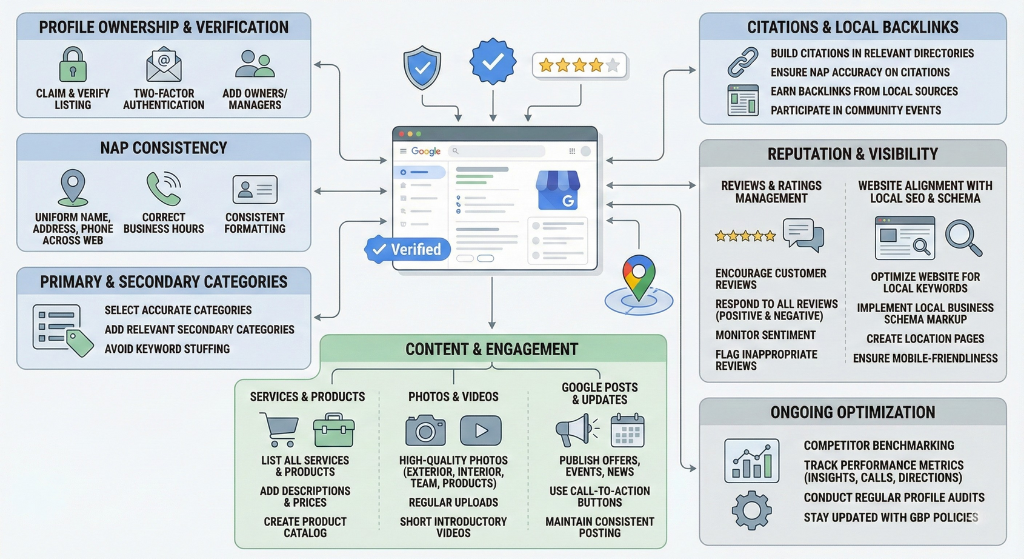
A Complete Operational Framework for Local Visibility, Trust, and Lead Generation
Google Business Profile (GBP) is one of the highest-impact assets for local businesses. Most ranking, visibility, and conversion issues originate from incomplete profile setup, inaccurate information, weak service/category relevance, poor media quality, inconsistent NAP, or lack of ongoing maintenance. The following framework outlines the full technical and strategic audit required for a fully optimized GBP.
1. Profile Ownership, Verification & Access Control
Correct ownership and compliance determine whether the listing ranks consistently and avoids suspensions.
Key Verification Checks
- The business must be fully claimed in Google Business Profile.
- Ownership verification must be complete via mail, phone, video, email, or Search Console.
- The correct Google account must hold Primary Owner rights; avoid outdated, personal, or unmonitored accounts.
- Resolve all verification issues, reinstatement cases, or guideline warnings immediately.
- Review for any suspensions, soft suspensions, or ranking suppression due to violations (virtual office usage, keyword stuffing, address conflicts).
- Identify and remove duplicate listings or conflicting map entries that dilute ranking signals.
- Access roles must be updated only essential staff or agency representatives should retain Manager or Owner roles.
- Audit unauthorized edits made by users or Google’s automated systems (business name, hours, categories).
Operational Requirements
- Verified ownership
- Correct primary owner
- No duplicates
- No suspension flags
- Clean access-control list
- Log of unauthorized edits reviewed
2. Business Information (NAPW) & Category Accuracy
Accurate and consistent business information is one of the strongest local ranking signals.
NAPW Consistency Checks
- Business name must match real-world signage exactly (no keyword stuffing).
- The address must be consistent across all online directories and citations.
- Service Area Businesses (SABs) must hide the address properly and configure service areas accurately.
- Phone number must be correct, active, and consistent; local numbers preferred.
- Call tracking numbers must be configured properly (primary: tracking number; secondary: main number).
Category & Attribute Checks
- Primary category must match the main service precisely.
- Relevant secondary categories should be added but not overused.
- Business hours must be accurate, including holiday, seasonal, or special hours.
- Attributes (women-owned, wheelchair accessible, delivery available, online appointments) must be configured correctly.
- “Service Options” must reflect the actual offering (on-site services, dine-in, takeaway, delivery, etc.).
- All services must be listed with complete details.
- “Products” must be configured with photos, descriptions, pricing where appropriate.
- Verify no reviews or edits are being suppressed due to inconsistent NAP.
- Check for competitor-driven malicious edits.
Operational Requirements
- Accurate NAP
- Correct primary + secondary categories
- Complete service list
- Complete attributes and service options
- Products added if relevant
- Hours correct
- No suppressed reviews due to NAP conflicts
3. Profile Description, Services & Relevance Signals
Profile content influences relevance and helps Google map your business to search intent.
Description & Service Completeness
- Business description must be natural, concise, keyword-relevant, not spam-inserted.
- Core services must be fully listed, with detailed descriptions aligned to ranking goals.
- Add location-specific variants where needed (e.g., “Roof Repair in Dallas”).
- Organize products into collections if retail or e-commerce.
- Ensure the service area radius matches the realistic business footprint; avoid overexpansion.
- Use semantic keyword variations in service descriptions to strengthen topical relevance.
- Avoid irrelevant categories or services that dilute ranking.
Operational Requirements
- Optimized description
- Detailed services (with semantic variations)
- Location-specific service variants
- Realistic service area
- No irrelevant categories
4. Photos, Videos & Media Health
High-quality, fresh media strongly influences trust, ranking velocity, and conversions.
Media Checks
- Sufficient number of photos uploaded across all categories.
- Recency: Upload photos at least every 30–60 days.
- Include interior, exterior, staff, products/services in professional quality.
- Logo and cover photo must be uploaded and properly selected.
- Review customer-uploaded photos for relevance and accuracy.
- Report inappropriate or misleading user-uploaded photos.
- Upload short videos for walkthroughs, product demos, and team introductions.
- Use metadata-rich images where possible (optional but beneficial).
- Attach photos to product/service listings for visual reinforcement.
Operational Requirements
- Recent photos
- Professional media
- Logo + cover photo
- Videos uploaded
- Inappropriate photos flagged
- Photo-to-service/product mapping complete
5. Posts, Updates & Engagement
Sustained engagement through posts signals activity and relevance to Google.
Engagement Checks
- Post frequency should be consistent (weekly or bi-weekly).
- Posts must include keywords, relevant visuals, and clear CTAs.
- Offers and promotions should be posted regularly.
- Events should be used when applicable.
- Service updates should be created for new offerings or changes.
- Remove outdated or expired posts.
- Monitor post views/impressions via GBP Insights.
- Respond promptly to customer Q&A submissions.
- Add proactive Q&A entries to reduce confusion and improve trust.
Operational Requirements
- Weekly/bi-weekly posts
- Offers + events active
- Q&A monitored and responded
- Insights reviewed
- Service updates maintained
6. Reviews, Ratings & Reputation Signals
Reviews are one of the strongest ranking and conversion drivers.
Review Health Checks
- Track total review count and recency.
- Compare rating level to local competitors.
- Reviews should mention services, products, and local areas naturally.
- Maintain a proactive review acquisition strategy.
- Respond to every review (positive or negative) within 24–72 hours.
- Identify recurring negative themes and address operational issues if needed.
- Report spam or malicious reviews.
- Monitor review filtering or suppression patterns.
- Evaluate photos within reviews for quality and accuracy.
Operational Requirements
- Steady review flow
- Full response coverage
- Competitive rating
- Spam removed
- Issue patterns identified
7. Website Alignment & Local SEO Integration
GBP signals strengthen when aligned with on-site SEO and structured data.
Website Alignment Checks
- Website URL must be correct (with UTM tracking).
- Landing page should be a city-specific or service-specific page, not a generic homepage (unless homepage is optimized).
- NAP must match GBP exactly.
- Website should include:
- LocalBusiness schema
- Breadcrumb schema
- Service area schema
- Review/Rating schema
- Website must include location pages for all areas served.
- Homepage and location pages should highlight city/service clearly.
- Internal linking must reinforce location relevance.
- Title Tags and H1s should align with GBP categories and services.
- Core Web Vitals must be strong for speed and UX.
- Mobile experience must be clean and conversion-optimized.
- Conversion tracking must be properly configured.
Operational Requirements
- Local schema in place
- Service/city pages live
- Matched NAP
- Fast mobile experience
- UTM tracking enabled
- Optimized titles/H1s
8. Local Authority, Citations & Backlinks
Authority and trust signals strengthen map rankings and validate business information.
Citation & Authority Checks
- Major citations (Yelp, Facebook, Bing, industry sites) must be consistent.
- Niche directories relevant to your industry must be included.
- Local directories (city sites, chambers, community blogs) should reference the business.
- Clean up outdated or conflicting citations.
- Evaluate the number and quality of local backlinks.
- Review presence in local press, sponsorships, or partnerships.
- Identify missing high-authority citations.
Operational Requirements
- Major + niche citations consistent
- Local backlinks present
- Old citations corrected
- High-authority citation targets identified
9. Competitor Benchmarking
Benchmarking indicates ranking gaps and actionable opportunities.
Competitive Insights
- Identify top 3–5 competitors in the map pack.
- Observe categories used.
- Compare review count, review velocity, and rating.
- Monitor competitor photos, post frequency, updates, and Q&A usage.
- Identify keywords competitors dominate.
- Analyze their landing pages for local relevance.
- Evaluate whether competitors have stronger backlinks or citation footprints.
- Check listing age and activity history.
- Review competitor use of tracking numbers, detailed service listings, products, or richer media.
Operational Requirements
- Competitor categories logged
- Review + rating benchmarks noted
- Backlink and media analysis complete
- Landing page comparisons done
10. Ranking Troubleshooting & Suppression Checks
Declines often relate to guideline compliance, category changes, location issues, or spam in high-risk industries.
Diagnostic Checks
- Identify any recent ranking drops and correlate with GBP or website changes.
- Confirm whether category edits affected positions.
- Check competitor listing updates or sudden activity surges.
- Evaluate address accuracy coworking spaces or virtual offices reduce trust.
- Identify if the industry is high-spam (HVAC, locksmiths, legal).
- Check map-radius limitations (especially near city borders).
- Determine whether ranking differs between Maps vs Search.
- Look for “service area too broad” warnings.
- Review “updated by Google” modifications.
- Confirm website relevance hasn’t changed due to redesign or content edits.
- Check branded vs non-branded ranking strength.
- Identify any reinstatement requirements.
- Track customer interaction metrics (calls, direction requests) declining signals indicate reduced visibility.
Operational Requirements
- Recent changes mapped
- Address + compliance validated
- Spam-industry mitigation steps reviewed
- Search vs Maps discrepancy monitored
- Non-branded ranking checked
- Interaction data tracked