
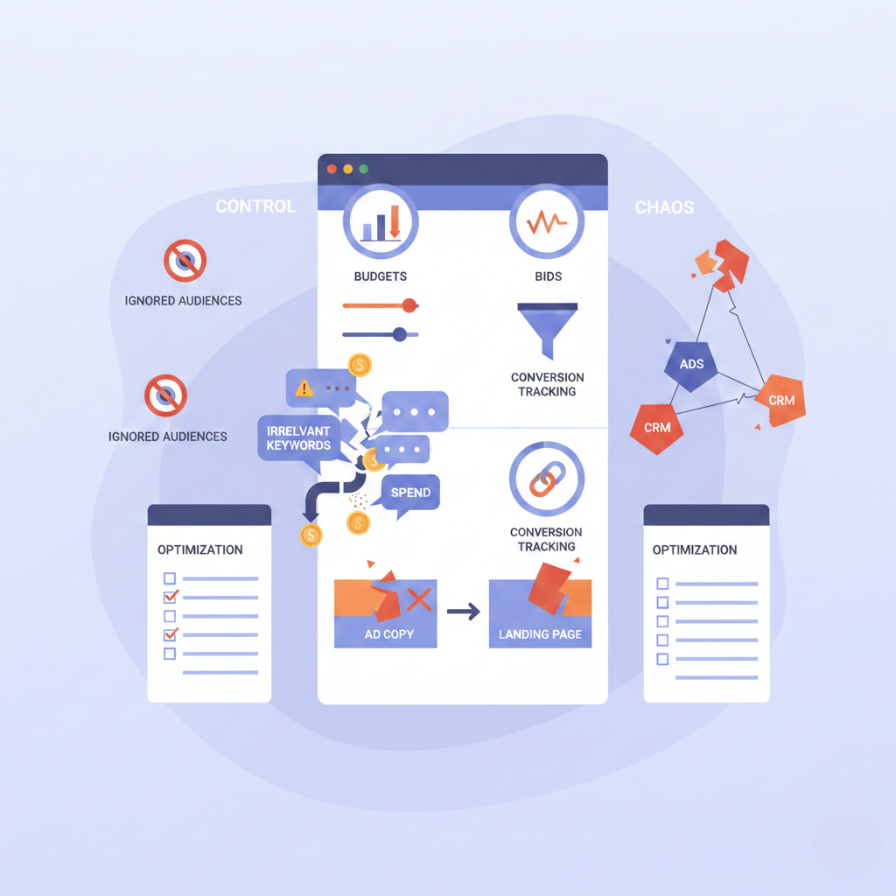
Google Ads can be an efficient acquisition channel for small businesses but only when campaigns are configured, monitored, and optimized correctly. In many accounts, wasted spend comes from preventable errors: incorrect setup, weak keyword strategy, poor creative alignment, incomplete tracking, and inconsistent optimization workflows.
The following sections outline the most common issues we see when auditing small-business accounts and the operational steps required to prevent them.
1. Campaign Setup & Configuration Errors
Many performance issues originate before the first impression is served. A misconfigured campaign can drain budget rapidly. Small businesses often encounter the following:
Budget and schedule errors
- Setting daily budgets incorrectly or confusing daily vs. monthly budgets.
- Applying budgets 10–100x higher than intended due to template duplication or oversight.
- Allowing campaigns to run 24/7 even when only specific business hours convert profitably.
Targeting misalignment
- Launching campaigns with the wrong geographic region selected.
- Targeting nationwide or globally instead of focusing on the actual service area.
- Missing location exclusions, allowing traffic from cities, states, or countries with no business relevance.
- Using incorrect language targeting that restricts or expands traffic unintentionally.
Improper launch processes
- Going live with placeholder ad groups, placeholder keywords, or unused template ad text still active.
- Launching campaigns with the wrong landing page attached often from previous builds or templates.
- Enabling Smart Bidding strategies (Max Conversions, tCPA, tROAS) before any real conversion data exists, preventing the algorithm from learning effectively.
- Making major structural changes right before weekends or holidays when monitoring is limited.
Automated system risks
- Accidentally enabling auto-apply recommendations that overwrite bidding, keyword, and ad settings.
- Allowing Display Expansion or Search Partners to run by default, leading to low-quality traffic and poor match relevance.
How to avoid these issues
- Implement a pre-launch checklist covering budgets, targeting, landing pages, bidding, exclusions, and schedules.
- Disable auto-apply recommendations unless intentionally needed.
- Launch or modify campaigns only when monitoring is possible.
- Maintain testing environments separate from active campaigns.
2. Keyword Strategy Problems
Keyword strategy is frequently the largest source of inefficiency for small-business advertisers. Poor alignment between intent, match type, and ad groups leads to wasted spend.
Intent mismatch
- Targeting overly broad, intent-poor keywords that invite unqualified traffic.
- Relying heavily on Broad Match without strong audience signals or conversion history.
- Bidding on competitor or branded terms unintentionally.
Structural issues
- Adding too many unrelated keywords into a single ad group, reducing ad relevance.
- Creating “catch-all” ad groups without thematic focus.
- Having duplicate keywords across campaigns, forcing them to compete against one another.
- Targeting low search-volume keywords instead of prioritizing demand capture.
Neglecting negative keywords
- Missing critical negatives that prevent irrelevant searches from consuming budget.
- Failing to review the Search Terms Report frequently enough to identify waste.
- Not excluding unprofitable themes after testing.
How to avoid these issues
- Build tightly grouped ad clusters around commercial intent.
- Use Broad Match only when supported by robust conversion signals and audience inputs.
- Maintain shared negative keyword lists.
- Conduct ongoing query mapping and remove low-value patterns.
- Expand long-tail commercial terms consistently.
3. Ad Copy, Creative, and Relevance
Ad performance depends on alignment between keywords, messaging, and landing pages. Small businesses often face issues stemming from rushed or inconsistent creative production.
Quality and accuracy problems
- Publishing ads with typos, placeholder text, or outdated offers.
- Using keyword insertion without control, resulting in irrelevant headline variations.
Relevance gaps
- Ads not aligned with the keyword themes inside each ad group.
- Disconnect between the ad promise and the landing page experience.
- Display or Discovery ads using weak visuals or generic stock imagery.
Ineffective testing
- Running too few ad variations to train Google’s RSA system effectively.
- Not providing enough high-quality assets (headlines, descriptions, sitelinks).
- Over-prioritizing “Ad Strength” ratings instead of actual performance data.
How to avoid these issues
- Maintain an asset library with validated headlines, CTAs, offers, proof points, and visuals.
- Ensure each ad group’s messaging directly reflects search intent.
- Use structured RSA pinning strategies when control is required.
- Update creative regularly and test new variations in controlled experiments.
4. Bidding & Budget Management
Many advertisers select bidding strategies or increase budgets without understanding performance impact, leading to unstable results.
Misaligned bidding strategies
- Choosing Smart Bidding models without sufficient conversion volume (typically 30–50 conversions minimum).
- Switching strategies based on assumptions instead of data.
Poor budget allocation
- Distributing budgets evenly instead of prioritizing high-value products or services.
- Failing to pace budgets across days and weeks, resulting in mid-month depletion or end-of-month surges.
- Allowing campaigns to remain budget-limited instead of restructuring.
Profitability blind spots
- Entering bidding wars for unprofitable keywords due to ego metrics.
- Increasing bids without analyzing incrementality.
- Ignoring portfolio bidding strategies where appropriate.
How to avoid these issues
- Use manual or Enhanced CPC in early stages until conversion signals are reliable.
- Reallocate budgets based on profitability, not traffic volume.
- Monitor impression share, budget pacing, and conversion efficiency weekly.
- Incorporate LTV, ROAS, and contribution margin analysis when scaling.
5. Conversion Tracking & Measurement
Incorrect measurement is one of the most damaging errors in small-business Google Ads accounts. Without accurate data, bidding algorithms cannot optimize, and reporting becomes misleading.
Tracking gaps and inaccuracies
- Not linking Google Ads and Google Analytics.
- Tracking only micro-engagements (scrolls, page views) instead of meaningful conversions.
- Overcounting conversions due to duplicated imports or overlapping call tracking.
- Conversions firing multiple times due to technical setup errors.
Missing value attribution
- Not assigning monetary values where appropriate.
- Ignoring conversion lag when analyzing performance.
- Underutilizing Enhanced Conversions for improved match accuracy.
Lead-gen tracking issues
- Missing offline conversion imports (CRM → Ads).
- Inconsistent call tracking numbers across ads and landing pages.
How to avoid these issues
- Implement a complete measurement framework with primary and secondary conversions.
- Validate conversion firing using tag testing tools.
- Establish monthly tracking audits.
- Feed high-quality, deduplicated conversion data into Smart Bidding systems.
6. Audience Targeting & Segmentation
Audience data is critical for modern Google Ads performance, especially when using Broad Match or Smart Bidding.
Common segmentation gaps
- Not using remarketing lists or abandoning users with high purchase intent.
- Missing first-party data integration (email lists, CRM records).
- Not excluding non-converting audiences or irrelevant interest groups.
- Underutilizing in-market, affinity, and custom intent segments.
- No segmentation between new and returning users.
RLSA and intent stacking issues
- Not applying remarketing lists to Search Ads (RLSA) for higher conversion probability.
- No differential bidding for audiences with stronger likelihood to convert.
How to avoid these issues
- Build structured remarketing lists and audience segments.
- Layer audiences on search campaigns to guide algorithmic learning.
- Exclude low-value or irrelevant audiences regularly.
- Push more budget to segments with higher conversion efficiency.
7. Monitoring, Maintenance, and Optimization Workflows
Small businesses often fail not because campaigns are poorly built, but because they are inconsistently maintained.
Monitoring failures
- Reviewing accounts monthly instead of weekly or daily.
- Ignoring changes in search terms, placements, or negative lists.
- Missing sudden shifts in spend, conversions, or CPC due to limited monitoring.
Operational inefficiencies
- No tracking of Quality Score components (CTR, relevance, landing page experience).
- No structured testing of PMax, Shopping, Video, or new campaign types.
- No landing page optimization or A/B testing.
- Inconsistent naming conventions that harm account clarity.
Weak reporting frameworks
- Relying on CPC or CTR instead of CAC, ROAS, LTV, or MER.
- No funnel alignment between ad clicks → leads → revenue.
- No defined scale plan or “kill switch” to stop runaway spend.
How to avoid these issues
- Implement a weekly and monthly optimization checklist.
- Maintain structured reporting dashboards with revenue-level attribution.
- Use change history to diagnose anomalies.
- Build decision frameworks for scaling, pausing, or reallocating spend.
Final Recommendation
Most small-business Google Ads failures stem from operational discipline not from lack of budget or competitive disadvantage. Businesses that implement structured setup processes, rigorous measurement, controlled testing, aligned creative, and consistent monitoring outperform competitors who rely on guesswork or automation alone.


