
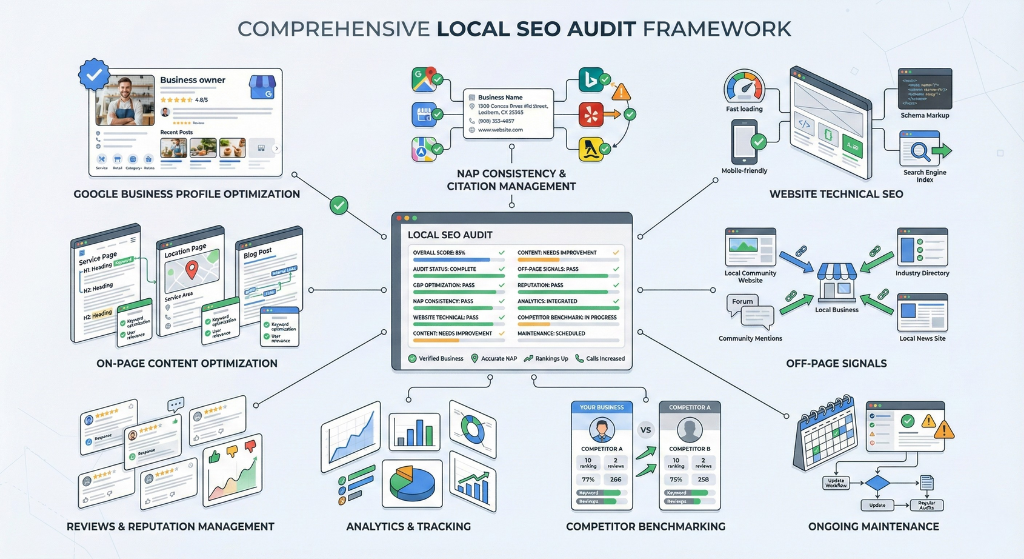
A Complete Operational Framework for Verifying Local Visibility, Accuracy, and Ranking Strength
This checklist addresses every core pillar of Local SEO: Google Business Profile quality, citation consistency, website technical health, on-page optimization, off-page signals, reviews, analytics, competitor comparison, and long-term maintenance. Each section outlines the exact items that must be validated to ensure a strong, stable, and scalable local presence.
1. Google Business Profile (GBP) / Local Listings
GBP is often the #1 ranking factor for local results. Every element must be accurate, verified, and complete.
Verification & Profile Integrity
- Profile claimed and fully verified (mail, phone, video, or Search Console).
- Business name exactly matches the real-world and website identity.
- Address is correct, complete, and formatted consistently with citations.
- Phone number matches canonical number used everywhere else.
- No duplicate or conflicting listings exist (unverified, legacy, auto-generated).
Categories, Services & Business Info
- Primary and secondary categories are accurate and reflect actual services.
- All services, products, and offerings are fully populated with descriptions.
- Business hours (standard + holiday/special hours) are correct
- GBP description includes relevant local keywords, service terms, and a natural business overview.
Media Quality
- Sufficient photo coverage: exterior, interior, staff, products, service examples, logo, and cover photo.
- Recent photos uploaded periodically (every 30–60 days).
- No stock or irrelevant photos dominating the gallery.
- Videos added where relevant (walkthroughs, staff intros, product demos).
Reviews & Engagement
- Total number of reviews and average rating benchmarked against competitors.
- Reviews received steadily, not in irregular surges.
- Responses posted consistently to all reviews within 24–72 hours.
- Reviews mentioning service keywords and locations appear naturally.
- GBP posts (updates, offers, events) published regularly.
- Q&A monitored and answered; proactive Q&A added where helpful.
Operational outcome: GBP fully optimized, active, consistent, and aligned with ranking signals.
2. NAP Consistency & Citations
Name, Address, Phone (NAP) consistency supports Google’s ability to trust your business and rank it reliably.
NAP Consistency Checks
- NAP consistent across all citations and directories (major, niche, local).
- Industry-specific directories included where relevant.
- All listings contain complete details: categories, descriptions, website, hours, services.
- Master NAP document exists and is used for every submission/update.
Audit & Correction
- Duplicates or outdated listings identified and flagged for merge/removal.
- Incorrect listings updated to match canonical NAP exactly (character-by-character match)
- Citations verified to ensure they are live, indexed, and linked correctly.
- SABs (Service Area Businesses) configured correctly regarding address visibility.
- Low-quality, spammy directories avoided to protect trust signals.
- System in place to push updates whenever business details change.
Operational outcome: consistent citation footprint reinforcing GBP and local authority.
3. Website Technical SEO
Technical stability ensures search engines can crawl, index, and understand the site without errors.
Technical Audit Checks
- HTTPS/SSL enabled and functioning.
- URLs clean and SEO-friendly (hyphens, lowercase, no unnecessary parameters).
- No major technical errors: 404s, redirect chains, canonical errors, duplicate pages.
- Mobile-friendly, responsive layout validated via Google tests.
- Page speed optimized: compressed images, caching, lightweight scripts, minimized blocking resources.
- All core pages indexable; robots.txt or meta tags not blocking essential content.
- LocalBusiness schema markup implemented with accurate NAP, service areas, and sameAs links.
- Internal linking logical, descriptive, and functioning properly.
Operational outcome: a technically sound website that reinforces local intent.
4. On-Page SEO & Content
Local results require targeted, unique, and location-aware content.
On-Page Optimization Checks
- Title tags unique, optimized, and contain service + location terms.
- Meta descriptions written for relevance and click-through appeal.
- H1/H2/H3 structure logical and keyword-relevant.
- High-quality content free from keyword stuffing or duplication.
- Optimized images (alt text, compressed file sizes, descriptive file names).
- Pages include local signals: city names, service area details, location references.
- Distinct location pages exist for multi-location businesses; each page unique and detailed.
- Service pages comprehensive and aligned to search intent.
- CTAs prominent and compelling.
- Internal links direct users to service and location pages for relevance and UX.
- Content updated periodically with accurate service details and fresh information.
Operational outcome: pages that target local searchers effectively and support ranking consistency.
5. Off-Page SEO / Local Signals
External signals confirm business legitimacy, relevance, and local authority.
Off-Page Checks
- Backlinks from relevant local sites (blogs, news, community organizations).
- Mentions in local publications or community listings.
- Listings in relevant niche/industry-specific directories.
- Consistent unstructured citations (mentions of business name + city).
- No spammy or low-quality backlinks harming trust.
Operational outcome: strong external relevance signals that reinforce GBP and organic rankings.
6. Reputation & Reviews
Reviews influence both rankings and conversions.
Review Audit Checks
- Review volume growing steadily (healthy review velocity).
- Reviews detailed and referencing specific services or locations.
- Structured review acquisition process in place (email follow-ups, SMS reminders, offline requests).
- Responses respectful, timely, and consistent.
- Ratings benchmarked against competitors.
- Repeated negative themes identified and addressed.
Operational outcome: a credible, competitive reputation footprint that converts users.
7. Analytics & Tracking
Measurement ensures local SEO efforts are tied to business outcomes.
Tracking Requirements
- GA4 fully installed and capturing traffic, events, and conversions.
- GBP Insights monitored for key actions: website clicks, calls, direction requests, queries.
- Local rankings tracked for relevant service terms and target locations.
- Citation performance measured: referral traffic, calls, impressions.
- Conversion goals configured for forms, calls, and bookings.
- Regular auditing schedule defined for technical SEO, content, citations, reviews, backlinks.
Operational outcome: reliable data framework supporting optimization and ROI tracking.
8. Competitor Analysis & Benchmarking
Local SEO is relative. Benchmarking reveals gaps and opportunities.
Competitor Checks
- Identify top local competitors for primary services.
- Compare GBP optimization: categories, reviews, photos, posting frequency.
- Analyze competitor review velocity and rating quality.
- Identify keywords competitors rank for in Maps and organic results.
- Compare backlink profiles and local coverage.
- Evaluate competitors’ landing pages for local relevance, UX, and content depth.
- Identify service gaps or underserved niches competitors are missing.
Operational outcome: a competitive roadmap for improving local visibility.
9. Long-Term Strategy & Maintenance
Local SEO is ongoing. Stability requires structured processes.
Maintenance & Strategy Checks
- Multi-location strategy defined (unique NAP, GBP profiles, location pages).
- Clear process for updating information across all platforms after business changes.
- Continuous monitoring of GBP, reviews, citations, technical health, and rankings.
- Regular content creation and updates (blogs, service pages, location pages).
- Alignment between online signals and offline customer experience.
- Periodic cleanup of low-quality citations or harmful backlinks
Operational outcome: a sustainable framework that preserves rankings and adapts to business changes.


