
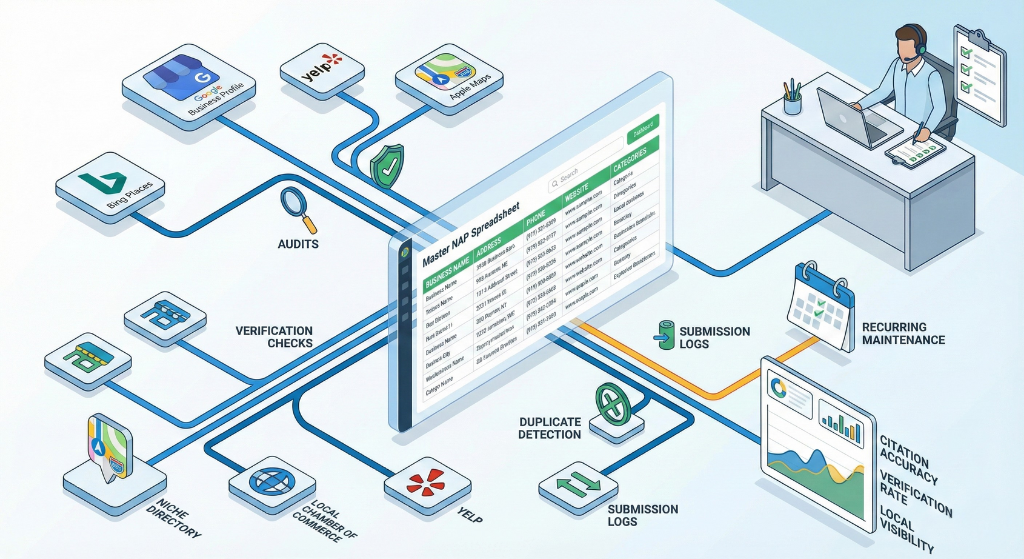
A practical, operational framework for canonical NAP management, citation audits, submission strategy, and ongoing citation hygiene.
This guide answers every question in your brief with clear checks, required actions, and measurable outputs. Use it as a standard operating procedure (SOP) for citation work or to brief an agency/vendor.
1. Canonical NAP & Citation Master Setup Pre-Submission Checklist
Objective: establish a single source of truth to ensure every citation matches exactly and to prevent fragmentation.
Required outputs (deliverables)
- Master NAP Spreadsheet (single source of truth) containing: Canonical Business Name, Address (line 1, line 2 if needed), City, State/Region, Postal/ZIP, Country, Primary Phone (E.164 or chosen format), Alternate Phone (if any), Website URL (HTTPS), Primary Category, Secondary Categories, Primary Email, Hours, Service Area (if SAB), Notes (tracking number, location ID, etc.).
- Canonical Business Identity Statement (one-line): exact spelling, punctuation, capitalization the version used on signage, invoices, legal docs.
- Per-location NAP Set for multi-location businesses (one row per location).
Operational checklist (must complete before any submission)
- Confirm the canonical business name matches legal signage and branding (no keyword stuffing).
- Confirm the canonical address is validated (postal service / utility bill) and includes suite/unit if applicable.
- Confirm primary phone number format and whether a tracking number will be used. If using tracking, document which citations will show tracking vs primary number and why.
- Confirm canonical website URL (HTTPS) and that it resolves to the intended landing page for that location.
- Confirm primary category and 2–3 legitimate secondary categories that reflect real services.
- Create and save the Master NAP Spreadsheet in a controlled folder with versioning (date-stamped copies).
- Record credentials (login/email) and access notes for any directories that require account creation.
Minimum acceptance criteria before submission: Master NAP exists, all fields populated, per-location rows created (if applicable), and internal sign-off from business owner.
2. Citation Audit Verifying Existing Listings & Listing Health
Objective: identify mismatches, duplicates, and incomplete listings; prioritize corrections by authority and business impact.
Audit steps and checks (for every existing listing):
- Name check: Does the listing’s business name match the canonical name exactly? (Yes/No)
- Address check: Does the address match exactly, down to abbreviations and punctuation? (Yes/No)
- Phone check: Does the phone match exactly? Is a toll-free or alternate number present? (Yes/No; note alternates)
- Website check: Is the website URL identical to canonical? (Yes/No)
- Verification status: Is the listing claimed/verified? (Yes/No)
- Duplicate detection: Are there duplicate listings for the same business on that directory or others? (list duplicates)
- Completeness: Are category, hours, description, services, photos, attributes populated properly? (score 0–3)
- Action flag: Mark as OK / Update / Merge / Remove / Claim.
- Logging: Record directory name, URL, date audited, person who audited, and action required in Master NAP Spreadsheet.
Priority triage rules
- High priority: Google Business Profile, Bing, Facebook, Yelp, Apple Maps, industry aggregators, and any directory that is a major referral source. Fix these first.
- Medium priority: Regional and high-authority local directories (city portals, chamber of commerce, Better Business Bureau).
- Low priority: Low-domain-authority or spammy directories either suppress (do not submit) or remove if auto-created.
Correction actions (concrete)
- Submit exact canonical edits to listings marked Update.
- Merge or request deletion for duplicates; follow directory-specific workflow and document ticket/confirmation IDs.
- Claim and verify unclaimed listings where possible.
- Flag unresolved or suspicious listings for escalation (support ticket or manual intervention).
Deliverable: Completed audit sheet with status per listing and remediation plan.
3. Citation Expansion Strategy Where & How to Publish New Citations
Objective: grow high-quality, relevant citations with consistency and measurable tracking.
Selection hierarchy (where to publish, in order)
- Canonical platforms: Google Business Profile, Bing Places, Apple Maps, Facebook.
- High-authority aggregators/data partners: Factual, Neustar/Localeze, Infogroup, etc. (use carefully; ensure human review).
- Major directories: Yelp, YellowPages, TripAdvisor (industry-dependent), industry-specific leaders.
- Regional / City directories: municipal portals, local media business directories, city Chamber of Commerce.
- Niche directories: vertical-specific sites (healthcare, legal, hospitality, trade-specific).
- Local authority sources: university business pages, local PR sites, sponsorship pages, high-quality blogs.
Submission method & rules
- Prefer manual submissions to ensure accuracy; when using aggregator services, require human verification/proofing for each record.
- For each submission, enter full business details not minimal fields: NAP, categories, business description, services, hours, photos, payment methods, URLs, social profiles. Thin citations provide limited SEO value.
- Avoid bulk, blind submissions to low-quality sites. Prioritize quality over quantity.
Submission logging (must be recorded)
- Directory name, submission URL, submission date, account credentials (securely stored), verification method used, listing URL, screenshots of final listing, next follow-up date.
Verification workflow
- After submission, verify listing appears correctly within 2–14 days (depending on directory). If unverified after 30 days, open a support ticket or re-submit.
Deliverables: Submission log exported as CSV, screenshots folder, and per-directory notes.
4. Maintenance, Monitoring & Regular Audit Workflow
Objective: prevent data drift and detect unauthorized or auto-generated listings.
Ongoing cadence (recommended)
- Weekly: monitor top-tier listings (GBP, Bing, Yelp) for edits, reviews, or issues.
- Quarterly (every 3 months): full citation audit for priority directories.
- Bi-annually: run a complete duplicate-detection pass across the entire citation inventory.
- Immediately: after any business changes (address, phone, name, hours), trigger full update workflow.
Maintenance tasks (procedural)
- Update Master NAP Spreadsheet and push changes to all existing listings within 48–72 hours of business change.
- Monitor automated/new auto-listings via a citation-tracking tool or manual search; flag and remove unauthorized entries.
- Keep a log of every edit, merge, deletion, or creation with date, directory, and confirmation ID.
- Periodically refresh photos, business description, and products where supported.
Tooling and tracking
- Use a citation monitoring tool (BrightLocal, Moz Local, Yext, or a spreadsheet+alerts workflow) to detect changes. Tools speed detection; maintain manual verification for high-impact sites.
- Store credentials securely (password manager) and limit access.
Deliverable: Maintenance calendar, audit logs, and summary reports showing citation accuracy over time.
5. Advanced & Edge-Case Considerations
Service-Area Businesses (SABs)
- Do not invent or use virtual addresses. Use canonical name and phone consistently; set the address hidden and define explicit service area cities/zip codes. Ensure citations reflect service area logic rather than a fake address.
Call tracking numbers
- Use a single approach: either show primary business number everywhere, or consistently show the tracking number across citations intended for tracking. Avoid mixing numbers across authoritative citations. Document mapping between tracking numbers and canonical numbers.
Multi-location chains
- Treat each location as a separate entity: unique NAP, unique landing page (location page), and unique GBP. Avoid cross-posting single-location content and use location-specific schema markup.
Keyword stuffing & name hygiene
- Never add keywords to the business name in citations (e.g., “Joe’s Plumbing – Best AC Repair City”). This risks manual actions or suppression.
Structured + unstructured citations
- Complement directory submissions with PR, local sponsorships, blog mentions, and guest posts to diversify signals.
Schema & site-level matching
- Implement LocalBusiness schema on the website matching canonical NAP; include sameAs links to primary directory profiles.
6. Measurement, Impact & Quality Metrics
Primary metrics to track
- Citation Accuracy Rate: percentage of listings that exactly match canonical NAP. Target: 98–100%.
- Duplicate Count: number of duplicate/conflicting listings found. Target: zero duplicates on priority directories.
- Verification Rate: percentage of claimed/verified listings among priority directories. Target: 100% where verification is allowed.
- Directory Authority Score: weighted score of citation quality (based on DA/traffic/relevance). Prioritize higher scores.
- Leads from Citations: track phone calls, direction requests, and referral traffic attributed to directory listings (via call-tracking and UTM parameters).
- Local Visibility: Map-Pack rankings for target keywords before and after citation work (weekly/quarterly snapshots).
- Citation Refresh Rate: percent of listings updated or reviewed within the last 6 months.
Reporting cadence and format
- Monthly: top-line changes (new listings added, critical fixes).
- Quarterly: accuracy rate, visibility changes, referral leads, and prioritized action items.
- Event-driven: immediate report after any business change or detected problem.
Attribution controls
- Add UTM parameters to the website URL used in high-value directory listings to measure referral performance in GA4. Use separate tracking numbers for call attribution where necessary.
7. Why This Level of Detail Matters Risks & Business Impact
Operational risks of poor citation hygiene
- Minor discrepancies (St vs Street, suite missing) can fragment signals and reduce local ranking power.
- Duplicates confuse search engines and customers, resulting in lost calls or wrong directions.
- Low-quality auto-submissions can harm trust and dilute authority; they should be removed or suppressed.
- Without ongoing audits, information drifts after moves or rebrands, negating previous citation investments.
Business impacts (what you can expect when done correctly)
- Cleaner citation footprint increases local relevance and can improve Map-Pack placements and organic local rankings.
- Consistent citations improve consumer trust and reduce misrouted leads.
- High-quality, industry-targeted citations support topical authority and improve discovery in vertical searches.
8. Recommended Deliverables & Implementation Timeline
Quick implementation plan (example for a single-location SMB)
Week 0 Preparation
- Create Master NAP Spreadsheet and canonical identity.
- Inventory existing citations (initial audit).
Week 1–2 Cleanup & Priority Fixes
- Fix Google Business Profile data and major directory mismatches.
- Merge/delete high-impact duplicates.
- Claim and verify unclaimed priority listings.
Week 3–6 Expansion & Enrichment
- Submit to prioritized authoritative directories and industry-specific sites.
- Enrich listings: descriptions, services, photos, hours, categories.
- Implement LocalBusiness schema on site.
Ongoing Maintenance
- Run monthly checks on priority listings and quarterly full audits.
- Update and log changes in Master NAP.
- Quarterly reporting and visibility measurement.
Deliverables you should request or produce
- Master NAP Spreadsheet (CSV).
- Citation Audit Report (pre-work).
- Submission Log with screenshots (post-work).
- Quarterly Citation Health Report (metrics + actions).
- SOP for business changes and citation updates.


