
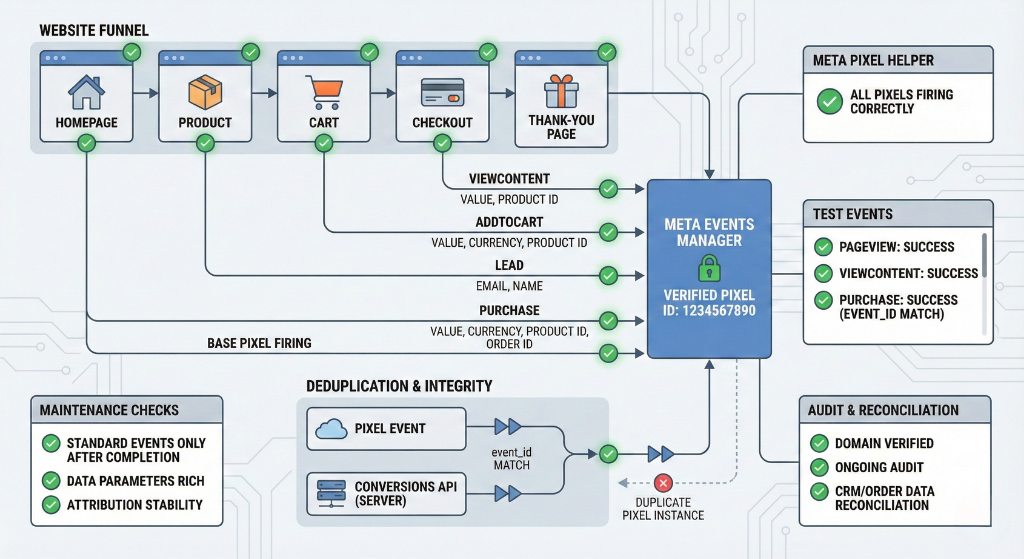
Accurate Facebook Pixel implementation is foundational for conversion tracking, retargeting, and Meta Ads optimization. Small businesses frequently face performance issues not because of weak campaigns, but because core tracking elements are misconfigured or incomplete. The following framework outlines the operational checks required to ensure a correct, stable, and scalable Pixel setup.
1. Pixel Setup & Installation: Foundational Integrity
A Pixel setup is only functional when the ID, placement, and deployment flow are configured precisely. Several failure points are common during installation.
Common Setup Issues
Incorrect Pixel creation or ID mismatch
- Pixel created in the wrong Business Manager.
- Pixel ID in site code does not match the ID inside Meta Events Manager.
Incomplete base-pixel installation
- Pixel added only to the homepage or a handful of pages.
- Missing installation on critical funnel assets: product pages, cart, checkout, confirmation pages.
Improper GTM deployment
- Pixel fired from Google Tag Manager while another hard-coded instance is still active.
- Incorrect trigger settings (e.g., no All Page Views trigger).
- Pixel firing only on some templates due to misconfigured rules.
Duplicate integrations
- Pixel added manually in theme code + added again through plugins/native integrations.
- E-commerce plugins automatically inserting another Pixel instance without detection.
Domain configuration issues
- Domain not verified or mismatched (www vs non-www, http vs https).
- Unverified domains prevent correct attribution and event prioritization.
How to Prevent Setup Errors
- Confirm Pixel ID consistency between Meta Business Manager and website implementation.
- Install base Pixel code on every public-facing and funnel-critical page.
- Deploy Pixel via a single method (GTM or native), not multiple.
- Validate that only one Pixel instance fires per page.
- Configure and verify domain inside Meta to ensure tracking recognition.
2. Event Configuration & Correctness: Tracking the Right User Actions
The Pixel is only useful if events reflect real business actions. Misconfigured events lead to incorrect reporting, poor optimization, and wasted budget.
Common Event Issues
Incorrect or placeholder events
- Using generic events (e.g., ViewContent) instead of real business actions (Lead, Purchase, AddToCart).
Incorrect event placement
- Firing Lead on page load instead of after form submission.
- Firing Purchase before checkout completion.
Missing event parameters
- No value or currency included for Purchase.
- Missing product identifiers (content_ids).
- Missing event_name consistency for optimization.
Malformed custom events
- Parameter names not matching Meta’s requirements.
- Data types incorrect or inconsistent across pages.
CAPI deduplication errors
- Browser and server events sent without matching event_id.
- Duplicate conversions counted or dropped due to mismatch.
How to Ensure Correct Event Tracking
- Map each business action to the correct Meta standard event.
- Trigger conversion events post-completion, not on intermediate actions.
- Provide Meta with required parameters (value, currency, product IDs).
- Validate naming conventions for custom events.
- Configure deduplication when using both Pixel and Conversions API.
3. Testing & Verification: Confirming Pixel Functionality
Installation does not guarantee functionality. Verification is mandatory.
Core Testing Requirements
Use Meta Pixel Helper
- Confirm PageView and event firing across homepage, product pages, cart, checkout, and thank-you pages.
- Identify warnings, missing parameters, or duplicate firings.
Use Meta Test Events
- Simulate full funnel flows:
- View product
- Add to Cart
- Checkout
- Purchase / Lead submission
- Confirm real-time event visibility.
Cross-browser testing
- Check across Chrome, Safari, Firefox, mobile browsers, and incognito.
- Validate behavior with/without ad blockers.
Redirect and third-party checkout flows
- Verify Pixel firing after external gateways (PayPal, Razorpay, Stripe-hosted pages).
- Ensure cookie and parameter values persist through redirects.
Post-update validation
- Re-test all events after theme updates, plugin updates, code deployments, or checkout changes.
How to Maintain Testing Accuracy
- Establish a standard QA checklist for Pixel validation.
- Perform a complete funnel test after any update or deployment.
- Document baseline expected events and parameters.
4. Data Integrity & Attribution: Ensuring Clean, Reliable Signals
Accurate optimization requires clean, deduplicated, parameter-rich event data.
Common Data Integrity Issues
Duplicate Pixel firing
- Multiple Pixel instances due to overlapping integrations.
- Double Purchase or double Lead conversions.
Incorrect event values
- Missing or zero purchase value.
- Wrong currency codes.
- Incorrect product IDs not matching catalog feed.
CAPI + Pixel mismatch
- Missing event_id alignment leading to double-counting or dropped conversions.
Low Event Matching Quality
- Missing parameters (email, phone, browser data).
- Poor match rate reduces optimization capabilities.
Low-quality or irrelevant conversion events
- Using non-meaningful interactions (scroll, view) as primary conversions.
- Inflated performance reports due to micro-events.
Internal traffic pollution
- Admin or developer traffic counted as conversions.
- Test transactions inflating conversion value.
Ensuring Data Accuracy
- Maintain a single, authoritative Pixel installation.
- Validate event parameters regularly.
- Segment primary vs. secondary events.
- Exclude staff/admin IPs or traffic patterns.
- Monitor Event Matching Quality in Events Manager.
5. Ongoing Monitoring, Maintenance & Stability Controls
Pixel tracking is not static. Stability requires recurring audits and consistency.
Key Maintenance Requirements
Periodic audits
- Monthly review of Pixel integrity, event flow, parameters, and duplicates.
Re-testing after updates
- Full funnel tests after theme or plugin changes.
Server-side tracking checks
- Monitor CAPI reliability and fallback mechanisms.
- Ensure deduplication remains stable across releases.
Business data reconciliation
- Compare Meta conversion totals with actual CRM or order data.
- Identify under-reporting (Pixel not firing) or over-reporting (duplicate events).
Rapid anomaly investigation
- Drops or spikes in conversions should trigger immediate diagnostic checks:
- Pixel firing behavior
- Event parameters
- Checkout conditions
- Redirect changes
- CAPI health
Maintaining Stability
- Use monitoring dashboards for event diagnostics.
- Document responsible parties and processes for tracking.
- Build a controlled change-management workflow.
6. Common Failure Modes & Edge Cases
Several issues frequently surface in community forums and audits.
Blocked JavaScript or cookies
- Ad-blockers, ITP (Safari), cookie consent popups blocking Pixel firing.
Platform or theme migration
- Pixel integrations break after CMS change, theme swap, checkout upgrades.
External payment gateways
- Pixel not firing on confirmation pages delivered by third-party systems.
Duplicate installations
- Plugin + manual + tag manager all active simultaneously.
Reload-triggered duplicates
- Purchases firing again on page refresh.
Catalog mismatch
- Product IDs not syncing with Meta catalog, breaking dynamic ads.
7. Strategic Tracking Considerations
Beyond installation, tracking architecture must support long-term optimization.
Strategic Requirements
Robust tracking ecosystem
- Pixel + CAPI with deduplication ensures data resilience.
Privacy limitation mitigation
- Prepare for cookie restrictions, browser limitations, and regulatory changes.
- Use server-side tracking as fallback.
Documented tracking policies
- Clear definitions of:
- Primary conversion
- Secondary events
- Deduplication logic
- Test event protocols
- Internal traffic exclusions
Why This Matters
A structured tracking framework improves:
- Retargeting accuracy
- Lookalike audience quality
- Value-based bidding performance
- Attribution reliability


