
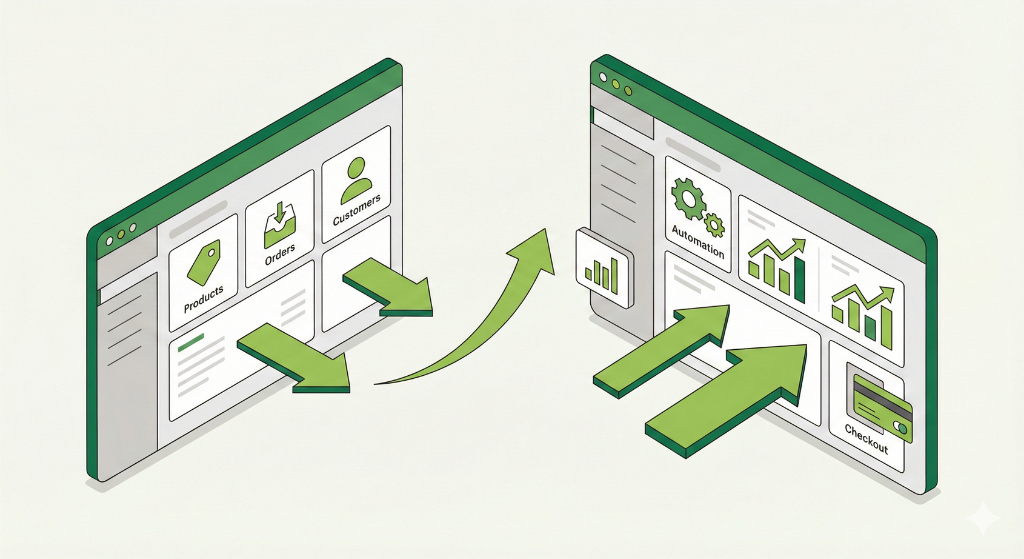
Your Shopify store is doing well. Sales are climbing, traffic is increasing, and your team is busier than ever. But lately, you have been hitting walls. Checkout limitations frustrate customers. Manual tasks eat up hours that could go toward growth. And during flash sales, you worry whether your store can handle the traffic.
This is the growth dilemma many eCommerce businesses face. Standard Shopify got you here, but is it enough to take you where you want to go?
Shopify Plus is Shopify’s enterprise solution, designed for high-volume merchants who need more power, flexibility, and support. But it comes with a significantly higher price tag. The question is whether that investment makes sense for your business.
This guide breaks down the real differences between Shopify and Shopify Plus, helping you decide which platform fits your growth stage.
Quick Overview: Shopify vs Shopify Plus
Standard Shopify offers three pricing tiers: Basic ($39/month), Shopify ($105/month), and Advanced ($399/month). These plans serve the majority of eCommerce businesses, from startups to established stores doing several million in annual revenue.
Shopify Plus starts at $2,300/month (or variable pricing based on revenue for larger merchants). It is designed for high-growth brands, enterprise retailers, and businesses with complex operational needs.
The core Shopify experience remains the same on both platforms. You get the same admin interface, app ecosystem, and fundamental eCommerce capabilities. The differences lie in customization depth, automation tools, API limits, and the level of support you receive.
Key Differences Explained
Pricing and Total Cost
The price gap between Advanced Shopify ($399/month) and Shopify Plus ($2,300/month minimum) is substantial. That is roughly $23,000 more per year at minimum.
However, pricing is not the complete picture. Shopify Plus offers lower transaction fees for high-volume merchants. If you process significant revenue, these savings can offset part of the platform cost.
Shopify Plus also includes features that would require paid apps on standard plans. Depending on which apps you currently use, consolidating functionality into Plus could reduce your overall tech stack costs.
Before deciding based on price alone, calculate your total cost of ownership on both platforms, including transaction fees, app subscriptions, and any custom development needs.
Customization Capabilities
Standard Shopify provides solid customization through themes, the theme editor, and Liquid (Shopify’s templating language). For most stores, this flexibility is sufficient.
Shopify Plus unlocks deeper customization options:
Access to additional Liquid objects and variables not available on standard plans. The ability to modify checkout.liquid directly (though this is being phased out in favor of Checkout Extensibility). Script Editor for custom pricing, shipping, and payment logic. Greater control over the checkout experience through Checkout Extensibility and Functions.
For brands that need unique customer experiences or complex business logic that standard themes cannot support, these capabilities matter significantly.
Our Shopify custom theme development services help businesses maximize their platform’s potential regardless of which Shopify tier they use.
Checkout Customization
Checkout is where Shopify Plus truly separates itself from standard plans.
On standard Shopify, checkout customization is extremely limited. You can adjust colors, add a logo, and make minor styling changes. The actual checkout flow and functionality remain locked.
Shopify Plus provides:
Checkout Extensibility for adding custom fields, upsells, and unique functionality directly in checkout. Shopify Functions for creating custom discount logic, shipping rules, and payment method filtering. The ability to create branded post-purchase experiences. Greater control over the thank you and order status pages.
For businesses losing sales due to checkout friction, these capabilities can directly impact conversion rates. Our guide on eCommerce checkout optimization covers strategies that become much more implementable with Plus-level access.
Automation Features
Shopify Plus includes Shopify Flow, a powerful automation tool that eliminates manual tasks.
With Flow, you can automatically tag customers based on behavior, trigger notifications when inventory runs low, flag high-risk orders for review, segment customers for marketing campaigns, and automate countless operational workflows.
Standard Shopify merchants can access Flow through the app store, but Plus merchants get it included and with higher usage limits.
Launchpad is another Plus-exclusive tool that automates flash sales, product launches, and campaigns. You can schedule price changes, theme switches, and inventory releases to happen automatically at specific times.
For growing businesses where the team is stretched thin, these automation capabilities free up significant time.
API and Integration Limits
Every Shopify plan has API call limits that restrict how frequently external applications can communicate with your store. Standard plans have lower limits that can become problematic as you scale.
Shopify Plus offers significantly higher API limits, which matters when you use multiple apps, integrate with ERP systems, sync with marketplaces, or run complex marketing automation.
If your integrations are hitting rate limits or experiencing slowdowns, Plus provides the headroom to operate smoothly.
Support and Account Management
Standard Shopify provides 24/7 support through chat, email, and phone. Response times and support quality are generally good but vary based on issue complexity.
Shopify Plus includes:
A dedicated Merchant Success Manager who understands your business and provides strategic guidance. Priority support with faster response times. Access to the Plus partner ecosystem for specialized development and consulting. Launch support for migrations and major initiatives.
For businesses without in-house eCommerce expertise, this dedicated support can be extremely valuable during growth phases.
Comparison Table: Shopify vs Shopify Plus
Feature | Advanced Shopify | Shopify Plus |
Monthly Cost | $399 | $2,300+ |
Transaction Fees | 0.5% (third-party gateway) | 0.15-0.3% (negotiable) |
Staff Accounts | 15 | Unlimited |
Checkout Customization | Limited | Extensive |
Shopify Flow | Available (app) | Included |
Launchpad | Not available | Included |
Script Editor | Not available | Included |
API Call Limits | Standard | Significantly higher |
Dedicated Account Manager | No | Yes |
Expansion Stores | Not available | Up to 9 included |
B2B Features | Limited | Full wholesale channel |
When to Stay on Standard Shopify
Shopify Plus is not necessary for every growing business. Standard Shopify remains the right choice in several situations.
Your revenue does not justify the cost. If you are doing under $1-2 million annually, the Plus price tag likely does not make financial sense yet. Focus your resources on growth initiatives rather than platform fees.
Your customization needs are modest. If standard themes and apps meet your requirements, you do not need Plus-level flexibility. Many successful stores operate on Advanced Shopify without hitting limitations.
Your checkout converts well already. If your current checkout process works and conversion rates are healthy, the additional checkout customization of Plus may not move the needle significantly.
You have a small product catalog and simple operations. Plus automation tools shine for complex operations. Simpler businesses may not benefit enough to justify the investment.
Your team can handle current workflows. If manual processes are manageable and not limiting growth, automation tools are nice-to-have rather than essential.
Our Shopify theme customization services help standard Shopify merchants maximize their platform before considering an upgrade.
When to Upgrade to Shopify Plus
Certain situations make Shopify Plus a smart investment.
You are hitting technical limits. If API rate limits cause integration problems, if you need checkout customization that standard plans do not allow, or if you have outgrown what standard Shopify can do, Plus removes those ceilings.
High volume demands reliability. If your store processes hundreds or thousands of orders daily, or if flash sales drive massive traffic spikes, Plus provides infrastructure and support designed for that scale.
Checkout friction is costing you sales. If cart abandonment is high and you have identified checkout issues you cannot fix on standard Shopify, Plus customization capabilities may directly improve revenue.
Manual operations are limiting growth. If your team spends hours on tasks that could be automated, Flow and Launchpad free up time for higher-value work. Calculate the labor cost of manual processes versus the Plus price difference.
You sell B2B and B2C. Shopify Plus includes robust wholesale functionality that lets you run separate B2B operations from the same backend. Standard Shopify requires workarounds for true B2B commerce.
You are expanding internationally. Plus includes expansion stores that let you create localized storefronts for different markets without paying for separate Shopify subscriptions.
You need dedicated support during critical growth. Having a Merchant Success Manager who understands your business provides value during complex initiatives, migrations, or rapid scaling periods.
Fashion and apparel brands often benefit significantly from Plus capabilities. Our article on how fashion brands benefit from Shopify Plus explores this in more detail.
The Migration Process: What to Expect
If you decide Shopify Plus is right for your business, migration from standard Shopify is relatively straightforward since you are staying within the Shopify ecosystem.
Timeline: Most migrations complete within 2-4 weeks for straightforward transitions. Complex customizations or integrations may extend this to 6-8 weeks.
What transfers automatically: Your products, customers, orders, and core store data move seamlessly. You are not changing platforms, just upgrading your plan.
What needs attention: Custom theme code may need updates to leverage Plus features. Apps should be reviewed for Plus compatibility. Checkout customizations require new development using Checkout Extensibility.
Recommended approach: Work with a Shopify Plus partner or experienced agency to plan your migration. Identify which Plus features you want to implement immediately versus what can wait for phase two.
Our Shopify website development team has guided multiple merchants through Plus migrations and implementations.
Also consider mobile optimization as part of your upgrade. Our guide on optimizing your Shopify store for mobile commerce covers essential practices that complement Plus capabilities.
Making the Decision
The choice between Shopify and Shopify Plus comes down to three questions:
Are you hitting real limitations? If standard Shopify genuinely restricts what your business needs to do, Plus solves those problems. If limitations are theoretical rather than actual, stay where you are.
Does the ROI make sense? Calculate the potential return from Plus features against the cost increase. Consider transaction fee savings, labor savings from automation, and potential revenue from checkout improvements.
Is now the right time? Upgrading during a major initiative (replatforming, redesign, international expansion) maximizes the value of migration effort. Upgrading just because you can afford it wastes resources.
Many businesses find that the right time for Plus is when they have clearly outgrown standard Shopify, not when they are simply growing steadily on it.
Conclusion
Shopify Plus offers powerful capabilities for high-volume merchants: deeper customization, extensive automation, superior checkout control, and dedicated support. For businesses genuinely constrained by standard Shopify limitations, Plus removes those barriers and enables continued growth.
However, Plus is not necessary for every growing business. Standard Shopify, especially the Advanced plan, serves most merchants well into the multi-million dollar revenue range. Upgrading too early means paying enterprise prices without enterprise needs.
Evaluate your specific situation honestly. Identify concrete limitations you are experiencing today. Calculate whether Plus features would deliver returns exceeding the cost difference. And if the numbers work, plan your migration strategically to maximize the investment.
Considering Shopify Plus for your business? CGColors has been developing Shopify stores since 2014, from startups to Plus merchants. We help you evaluate whether Plus is right for your growth stage and implement it effectively if you make the move. Contact us today for a free consultation.