Introduction
Here’s What’s Happening to Your Website Traffic Right Now
Your customers are still searching for what you sell. They are just not always landing on your website anymore.
A growing share of searches now end with an answer, not a click. Roughly 60% of Google searches finish without anyone visiting a website, according to Bain & Company. When Google shows an AI answer at the top, that number climbs higher. Pew Research tracked tens of thousands of real searches and found people clicked a result only 8% of the time when an AI summary appeared, compared to 15% when it did not.
The pattern is simple. The search box answers the question, and your site never gets the visit.
The Hidden Problem Most Small Business Owners Don’t See Yet
Here is the trap. Your rankings can look perfectly healthy while your traffic quietly slips.
You still rank on page one. Your SEO expert is still showing that you are ranking on many strong keywords. But the clicks behind those positions are thinning out. A top spot that once earned 20% to 30% of clicks on a competitive keyword now pulls closer to 8% to 12% when an AI answer sits above it.
Most owners notice the symptom before they understand the cause. Leads soften. The phone rings a little less. The rankings report says everything is fine. The gap between “ranking well” and “getting found” is the story of search in 2026, and it has a name worth learning.
Understanding the Basics
SEO vs. GEO: What’s the Difference
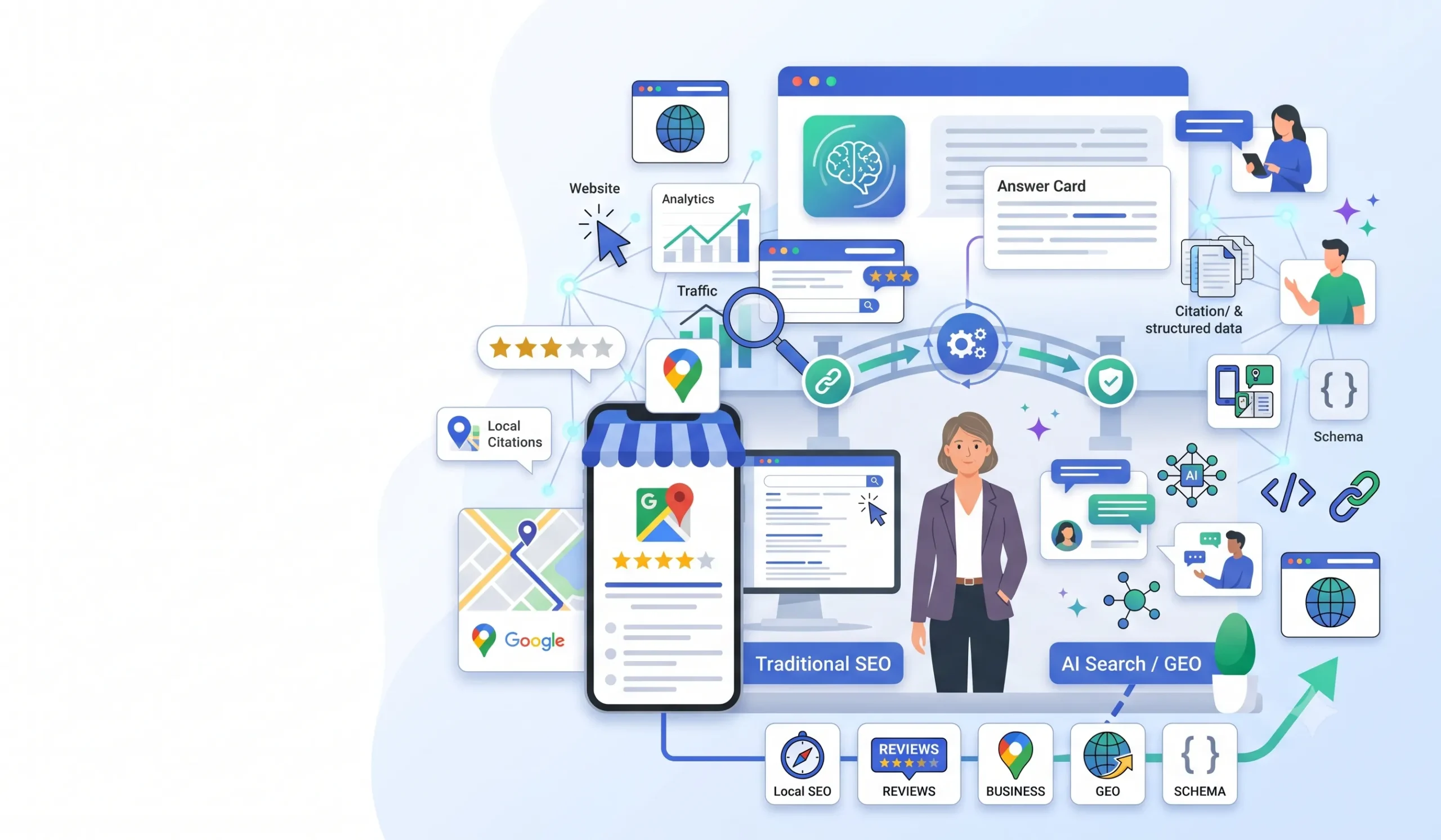
SEO, search engine optimization, helps your website rank in a list of blue links on Google. You win by earning relevant keywords, useful pages, and trusted links pointing back to you.
GEO, generative engine optimization, helps AI tools like ChatGPT, Google AI Overviews, Perplexity, Gemini, and Claude pick your business as the answer they give. You win by being clear, credible, and easy for a machine to quote.
SEO gets you on the list. GEO gets you in the answer
Traditional Google Search vs. AI Search: How Your Customers Find You
Traditional search hands the customer a menu. They type a query, scan a page of options, and choose where to click. You compete for attention on a crowded results page.
AI search skips the menu. The customer asks a question in plain language and gets one composed answer, often with a few cited sources. You are either named in that answer or you are invisible. There is no second page to scroll.
Both still matter in 2026. Google still handles the largest share of searches. But the way people ask, and what they expect back, is shifting under your feet.
GEO Stands for Generative Engine Optimization, and Here’s Why It Matters
When an AI tool builds an answer, it pulls from sources it considers trustworthy and easy to understand. GEO is the practice of becoming one of those sources.
This matters because being cited is the new version of ranking. Around 93% of AI search sessions end without a single click to a website, per Semrush data from late 2025. So the mention itself, the moment the AI says your business name, often is the entire interaction. If the answer recommends a competitor and not you, the customer may never know you exist.
The Reality Check
AI Search Currently Drives Less Than 1% of Traffic, But That’s Changing Fast
Let’s be honest about the size of this today. AI referral traffic sits near 1% of total web traffic across most industries as of early 2026, with technology and IT leading at roughly 2.8%. Organic Google search still drives a far larger slice.
So why care about a sliver?
Because the slice is growing fast and the people inside it are ready to buy. One analysis of 2.3 billion sessions found AI-referred traffic grew 796% over two years. Forrester research summarized across B2B markets shows AI already driving 2% to 6% of organic traffic, climbing roughly 40% month over month from a low base. Small today does not mean small for long.
The SEO-GEO Gap: Why Your Rankings Don’t Tell the Whole Story
The gap is the space between how well you rank and how often you actually get found and chosen.
You can hold position one and still lose the click to an AI answer sitting above you. You can rank nowhere near the top and still get cited by ChatGPT, which often pulls from sources outside the top 20 results. Studies show about 60% of AI Overview citations come from pages that do not rank in the top 20 of classic search.
Your rankings report measures one game. AI search plays a different one. Tracking only the first game leaves you blind to the second.
Fewer Clicks, Less Engagement: How AI Search Is Changing Visitor Behavior
People behave differently when an AI answers first. They click less, and they stop searching sooner. Pew found searchers end their session 26% of the time after an AI answer appears, compared to 16% when it does not.
When they do click through from an AI tool, the visit looks different. AI-referred visitors tend to spend less time on site and view fewer pages per session. The flip side is striking. That smaller group converts far better, because they arrive already informed and close to a decision. Some studies put AI-referred conversion at several times the rate of standard organic traffic.
Fewer visitors. Higher intent. That trade defines the new traffic you are about to fight for.
What This Means for Your Small Business
Why Traditional SEO Alone Won’t Cut It in 2026
SEO is not dead. U.S. organic search traffic dipped only about 2.5% year over year by early 2026, not the collapse some headlines claim. Google still sends the most visitors of any channel.
But SEO alone leaves money on the table. Strong rankings no longer guarantee clicks, and they say nothing about whether AI tools recommend you. If you optimize only for the blue links, you compete hard for a prize that keeps shrinking while ignoring a prize that keeps growing.
The Traffic You’re Losing: AI Answers Instead of Website Clicks
Picture a customer asking, “who’s the best plumber near me for a burst pipe.” A few years ago they scanned a list and clicked. Today an AI answer may name two or three local businesses and summarize their reviews. The customer calls one of them. No website visit, no analytics record, just a booked job for whoever the AI named.
That booked job either went to you or it did not. The loss never shows up as a missing click in your report. It shows up as a competitor’s busy schedule.
Local Small Businesses Are Hit in New Ways by AI Search Changes
Local search is changing in ways that cut both directions for small businesses.
The risk: AI answers increasingly summarize “best near me” questions, hours, reviews, and service details without sending the searcher to your site. If your listings and pages are thin or inconsistent, the AI has little reason to name you.
The opening: AI tools favor clear, specific, well-structured local information. A small business with accurate listings, sharp service pages, and direct answers to common local questions can earn a citation that a sloppier competitor cannot. Local clarity is a genuine advantage if you claim it.
Key Differences Between SEO and GEO Traffic
| Aspect | Traditional SEO (Google) | GEO (AI Search) |
|---|---|---|
| How it works | Keywords, backlinks, metadata | Clarity, context, authority |
| What users see | A list of websites | An AI-generated answer with sources |
| Click-through rate | Higher | Lower, fewer clicks through |
| Visitor quality | Steady engagement | Less time on site, higher intent |
| Content format | Keyword-optimized pages | Question-based, natural language |
The takeaway is not that one replaces the other. They reward different things. SEO rewards structure and links. GEO rewards clarity and credibility. A page built well serves both.
Action Steps for Small Business Owners
Start Here: Review Your Service Pages and FAQs
Before you build anything new, read what you already have through fresh eyes. Open your top service pages and ask one question. If an AI read this page, could it explain clearly who you help, what you do, and where you do it?
Most pages fail that test. They bury the answer under marketing language. Your FAQs are often the easiest fix, because they already match the way customers ask questions. Tighten them first.
5 Simple GEO Changes You Can Make This Week
- Use plain language and clear messaging. Say what you do in words a customer would use. AI tools quote pages they can understand fast.
- Add question-based headings that match customer questions. Turn “Our Services” into “How much does emergency plumbing cost in Dallas.” Match the real question.
- Answer common questions directly in your content. Put the answer in the first sentence under the heading. Lead with it. Explain after.
- Include internal links between blog and service pages. Connect your helpful articles to the pages that book the work. Links guide both readers and AI through your expertise.
- Keep consistent language about who you help. Describe your audience and service area the same way across every page. Mixed signals confuse the AI and weaken your authority.
Where to Get Featured: Press Releases, Guest Blogs, Directories
AI tools weigh outside mentions when they decide who to trust. The more credible places that reference your business, the stronger your case to be cited.
Pursue a few high-value spots rather than dozens of low-value ones. Local press releases tied to real news. Guest articles on respected industry blogs. Accurate, complete listings in directories that matter to your field. Each genuine mention builds the entity authority that AI tools reward.
Don’t Overhaul Everything: Smart GEO Updates for Busy Owners
You run a business. You do not have weeks to rebuild a website. Good news: the highest-impact GEO work is editing, not rebuilding.
Start with the three or four pages that drive your revenue. Sharpen the headings. Lead with answers. Fix inconsistent details. That focused effort beats a full redesign you never finish.
Budget-Friendly GEO Strategy
GEO for Small Business: Publishing Across 3 to 5 Core Topics
You do not need to cover everything. You need to own a few things completely.
Pick three to five topics central to your business and become the clearest voice on each. A roofer might own storm damage, roof replacement cost, and choosing materials for the local climate. Depth on a focused set of topics signals real authority. Scattered content across fifty thin topics signals nothing.
Structured Content Formats AI Tools Love
AI tools reach for content they can parse and quote. Certain formats make their job easy.
Clear question-and-answer sections. Step-by-step instructions. Comparison tables. Short definitions placed right after a heading. Specific numbers and concrete details rather than vague claims. Blog content built this way is the single most-cited page type in AI Overviews, and pages with structured data and transparent specifics earn citations most often.
Building Your Digital Footprint Without a Big Marketing Budget
Budget is not the barrier many owners assume it is. Roughly 47% of AI-optimized content gets produced with internal tools rather than expensive agencies, and a large share of small businesses have already started.
Spend your limited time where it compounds. Keep your listings accurate everywhere they appear. Publish a steady drip of genuinely useful content on your core topics. Earn a few credible mentions a quarter. Consistency, not budget, builds the footprint AI tools notice.
What to Track
Set Up AI Search Tracking in Google Analytics 4 Today
You cannot improve what you cannot see. Most owners have no idea how much AI traffic they already get, partly because much of it arrives without a clear referral tag and slips past default reports.
In GA4, build a custom segment or channel grouping that captures referrals from sources like ChatGPT, Perplexity, Gemini, and Copilot. Start the tracking now, even at low volume. You want a baseline in place before this channel grows, not after.
How to Compare AI Search Traffic vs. Google Search Traffic
Once you tag AI sources, watch them side by side against organic Google traffic. Compare more than visit counts.
Look at how each channel behaves. AI traffic will likely show fewer pages per session and shorter visits, but check the conversion rate before you judge it. A channel can send fewer people and still produce more booked jobs. Judge each source by outcomes, not raw clicks.
The One Metric That Matters Most for Small Business
Forget vanity numbers. For a small business, one metric beats all the rest: leads that turn into paying customers.
Rankings, impressions, and even sessions are means to that end. Tie every channel back to booked jobs, calls, and sales. If AI search sends ten visitors and three become customers, that channel earns your attention regardless of how small it looks on a traffic chart.
The Bottom Line
SEO and GEO Together: Why You Need Both for 2026
This is not a choice between old and new. It is a both-and.
SEO keeps you visible in the searches that still send the most traffic. GEO puts you inside the AI answers shaping more decisions every month. Drop either one and you hand ground to a competitor who runs both. The businesses that win in 2026 treat search as one connected effort, not two rival camps.
Good SEO = Good GEO: The Small Business Advantage
Here is the reassuring part. The work overlaps more than it competes.
AI Overviews correlate strongly with traditional search rankings, and sites with healthy organic traffic earn more AI mentions. Clear, well-structured, credible content helps you rank and helps you get cited. You are not running two separate playbooks. You are building one strong foundation that pays off in both places. For a small, focused business, that overlap is an advantage over slower competitors.
Original Insights Are Your New Moat Against AI
AI tools blend and summarize what already exists. They struggle to invent. That is exactly where a real business pulls ahead.
Your firsthand knowledge is your moat. The pricing realities only a local pro knows. The mistakes you watch customers make. The specific cases you have solved. AI cannot manufacture that, but it loves to cite it. Original insight from real experience is the one thing competitors cannot copy and AI cannot fake.
Call to Action
Your Next Step: 3 GEO Actions to Take This Week
Keep it simple. Pick three moves and finish them this week:
- Rewrite the headings on your top service page as real customer questions, with the answer in the first line.
- Tighten your FAQ section so each answer is clear, specific, and grounded in your real experience.
- Set up AI traffic tracking in GA4 so you have a baseline to measure from.
Three actions. One week. That is enough to start closing the gap.
Don’t Wait: AI Search Is on Track to Reshape Discovery by 2028
The window to get ahead is open now, while most local competitors still ignore it.
Analysts expect AI search to keep eating into traditional search as a discovery channel, with several forecasts pointing to a major shift around 2028 and double-digit organic declines in some verticals before then. The businesses that build their AI visibility early will own the answers when the shift accelerates. The ones that wait will spend years trying to catch up.
You do not have to tear your site apart. You have to start. Sharpen a few pages, track the right numbers, and stay the clearest voice in your corner of the market.
If you want a partner to do it with you, that is what we do at CGColors. We help small businesses get found first, get called first, and get booked first, in Google and in the AI answers your customers now trust.
Reader Engagement Hooks
A few sharper framings you can drop into the post as pull quotes or section openers:
“Wait, ChatGPT is now my competitor?” Not your competitor. Your new front door. Whoever it names gets the customer.
“Why ranking #1 on Google isn’t enough anymore.” A top ranking under an AI answer can still lose the click. Visibility now means being in the answer, not just on the page.
“The truth: you don’t need to tear your site apart.” Roughly 47% of AI-ready content comes from in-house effort, not big agencies. Editing your best pages beats rebuilding everything.
“Small channel, serious intent.” AI search drives around 1% of traffic today, but those visitors convert at several times the rate of regular organic. Tiny stream, high value.